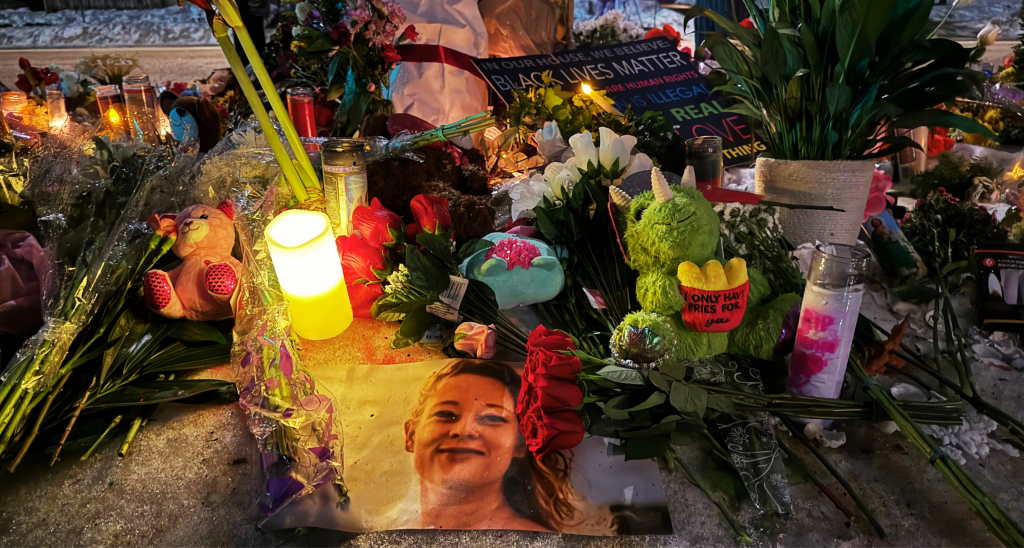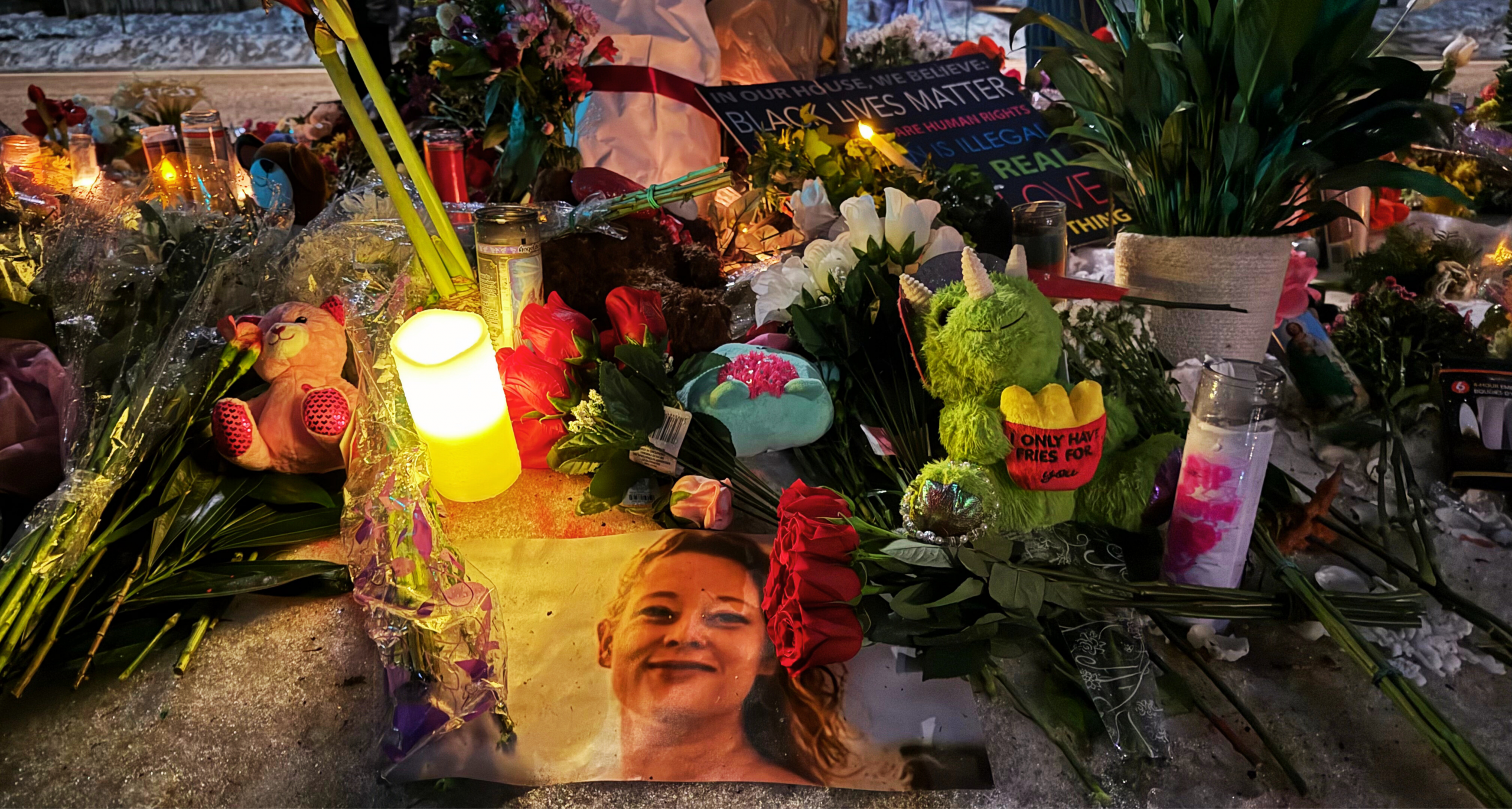
A photograph of Renee Good at the memorial site for her in Minneapolis. Photo: Meghnad Bose
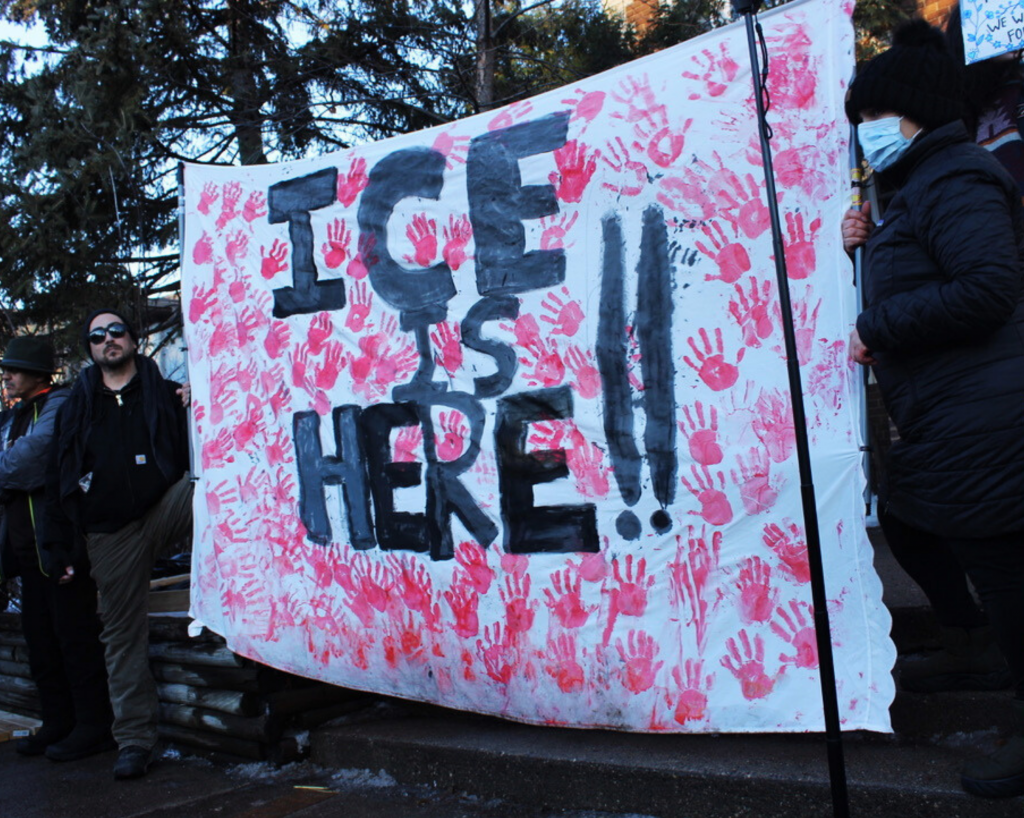
Two weeks ago, ICE agent Jonathan Ross shot and killed Renee Nicole Good. Despite video of the incident circulating widely online and protests in multiple cities, no charges have been brought against Ross. In Minneapolis, a city currently under federal occupation, calls for justice are not going away.
“If anybody else had murdered someone on the streets of Minneapolis, you would have arrested him. How come ICE walked away?” asked Helen DeFlorin, a healthcare consultant who came to pay her respects at the memorial for Good.
Shortly after Good’s killing, the FBI took charge of the investigation. The Minnesota Bureau of Criminal Apprehension (BCA) detailed in a statement on January 9 how they had been pushed out of conducting a joint investigation with the FBI.
Per the BCA statement, on January 7, the day of the incident, “after consultation with the Hennepin County Attorney’s Office, the U.S. Attorney’s Office and the FBI, it was decided that the BCA Force Investigations Unit would conduct a joint investigation with the FBI.” The BCA said that they had responded promptly to the scene and begun coordinating investigative work.
However, later that afternoon, the FBI informed the BCA that the U.S. Attorney’s Office had reversed course. “The investigation would now be led solely by the FBI, and the BCA would no longer have access to the case materials, scene evidence or investigative interviews necessary to complete a thorough and independent investigation.”
Without complete access to the evidence, witnesses and information collected, the BCA felt they could not meet the investigative standards that Minnesota law demands, and withdrew from the investigation.
Meanwhile, federal officials tasked with investigating Good’s killing are focusing more on her partner Becca Good, including what officials said were her possible ties to activist groups, two people familiar with the investigation told NBC News.
With little to no faith in the federal investigation, protesters and organizers are demanding that the state find ways to prosecute Ross.
‘Justice for Renee would be a successful prosecution. Justice for our community would be that they stop being terrorized.‘
“He should be prosecuted to the full extent of the law by our district attorney, by our attorney general, by the legal branch of our government in Minnesota,” said Dieu Do, an immigrant rights activist with the Minnesota Immigrant Rights Action Committee (MIRAC).
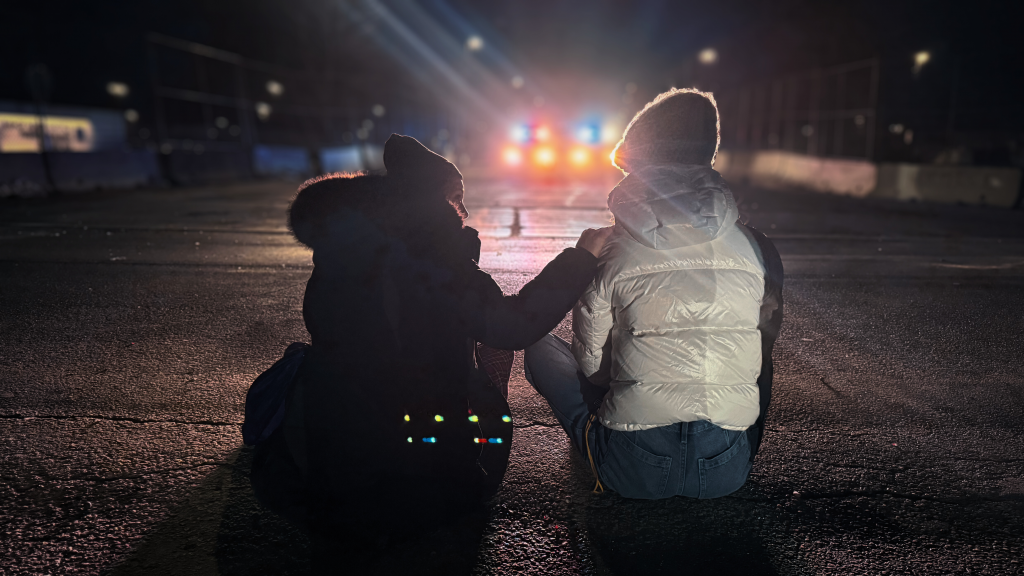
“Justice for Renee would be a successful prosecution. Justice for our community would be that they stop being terrorized,” said Natalie Ehret, an attorney who had come to protest outside the ICE facility at the Bishop Henry Whipple Federal Building near Minneapolis.
Minnesota can indeed still prosecute Ross, according to Carolyn Shapiro, former solicitor general of Illinois and professor of law at the Chicago-Kent College of Law. “The notion that Minnesota cannot investigate or prosecute a violation of its criminal laws within its borders is flatly inconsistent with our federalist system,” wrote Shapiro in a recent analysis of the state’s legal options.
The state has a legitimate interest in enforcing its laws even against federal actors, said Shapiro. “Such cases are unusual, but they are not unprecedented.”
The Minnesota Attorney General and Hennepin County Attorney’s offices had announced a joint effort on January 9 to gather their own evidence related to the shooting.
Beyond the killing of Good, organizers are also demanding that local law enforcement step in and arrest ICE officers who are seen violating the law while conducting immigration raids or acting against protesters.
‘The Mayor’s sharp rhetoric [against ICE] has no teeth if there’s no action behind it. He’s been very vocal in his support for what’s happening to immigrant communities, but he’s not taking any action to actually protect people from this harm.‘
ICE agents, for instance, were caught on camera kneeling on a detainee’s neck. In 2020, in the aftermath of the killing of George Floyd, Minnesota created a police accountability law that included a ban on neck restraints, like the one that killed Floyd.
Minneapolis Mayor Jacob Frey, in a press conference alongside Minneapolis police chief Brian O’Hara, said on January 14, “We’re in a position right now where we have residents that are asking the very limited number of police officers that we have, to fight ICE agents on the street, to stand by their neighbors.”
Frey continued, “We cannot be at a place right now in America where we have two governmental entities that are literally fighting one another.”
Responding to Frey’s statements, Do said, “The Mayor’s sharp rhetoric [against ICE] has no teeth if there’s no action behind it. He’s been very vocal in his support for what’s happening to immigrant communities, but he’s not taking any action to actually protect people from this harm.”
“What we’re seeing across the board from federal agents is the ability to act with tremendous impunity,” said Amanda Otero, co-executive director of Take Action Minnesota, “And so, we are absolutely calling for accountability and full investigations into Jonathan Ross for the killing of Renee Good, as well as every officer that has violated the rights of our neighbors and community members.”
Even as protesters and organizers are calling for more to be done by local and state authorities, the city administrations of Minneapolis and St. Paul, and the state of Minnesota, have announced that they are taking the Trump administration to court.
On January 12, the three administrations said that they were jointly filing a lawsuit “to stop the federal government’s unlawful, unconstitutional, and dangerous federal immigration actions.”
Three days later, the Minnesota attorney general’s office launched a Federal Action Reporting Form “to help assess and address the impacts of federal actions on Minnesotans”. The form asks residents to share information about the actions of federal agents, including violations of constitutional rights, civil liberties and more.
“You see these ICE agents in your neighborhood, take out that phone and hit record. Help us create a database of the atrocities against Minnesotans, not just to establish a record for posterity, but to bank evidence for future prosecution,” said Walz.
On Friday, a federal judge in Minneapolis limited the actions of federal agents in the city, barring them from arresting peaceful protesters, or using pepper spray, nonlethal munitions, and crowd dispersal tools.
The same day, two Democratic House representatives — Washington’s Pramila Jayapal and Minnesota’s Ilhan Omar — hosted a hearing in St. Paul titled ‘Kidnapped and Disappeared: Trump’s Deadly Assault on Minnesota’. More than two dozen members of Congress attended from across the country to conduct oversight.
‘If anybody else had murdered someone on the streets of Minneapolis, you would have arrested him. How come ICE walked away?‘
Jayapal, the ranking member on the House Subcommittee on Immigration Integrity, Security, and Enforcement, said, “We heard from incredibly powerful witnesses — members of the community who are standing up for their neighbors, and even [those] who have been detained and had their rights violated for no reason.”
Even as the hearings and lawsuits continue, the ground reality in the Twin Cities — of increasingly aggressive immigration raids — continues unabated.
“There’s an incredible dissonance between a regular citizen that shows up to watch unconstitutional violence happen and the urgency of the elected bodies that represent them,” said HwaJeong Kim, the vice president of the city council in neighboring St. Paul, which has also been targeted by ICE. “Elected bodies are not moving as quickly as they should, to be as responsive as they can be, to the concerns of their constituents.”
A range of community leaders in Minnesota have called for an economic blackout and total shutdown of the state on January 23..
“We’re coming together for a day of truth and freedom,” said Otero. “We are calling on all of us to not work, not go to school, not shop, and bring the economy to a halt to get ICE out of our state.”
BreakThrough News is building the media arm of the movement. We tell the untold stories of resistance from poor and working-class communities — because out of these stories we will construct a different narrative of the world, as it is and in real time.
Think to yourself, is this article something that would be published anywhere other than BreakThrough?
Five mega-corporations dominate the media landscape — controlling 90% of what we read, watch and listen to. People’s movements in every corner of the globe are changing history and shifting consciousness. But these movements barely receive any coverage from the corporate media. They need visibility. They need amplification. They need a media arm to break through.
Working-class people deserve better, we deserve media for and by us. We are not funded by billionaires or corporations – we are funded by you. Without you, BreakThrough would not be possible, so become a member and build the media arm of the movement with us.
To send a check to BreakThrough News, please make it out to BreakThrough / BT Media Inc. and send to 320 W. 37th Street, NY, NY 10018. Donations are tax-deductible in accordance with the law.

Meghnad Bose is an award-winning investigative journalist based in the United States. He is a professor of journalism at The University of Memphis, where he heads the graduate program in Open Source Investigative Reporting.