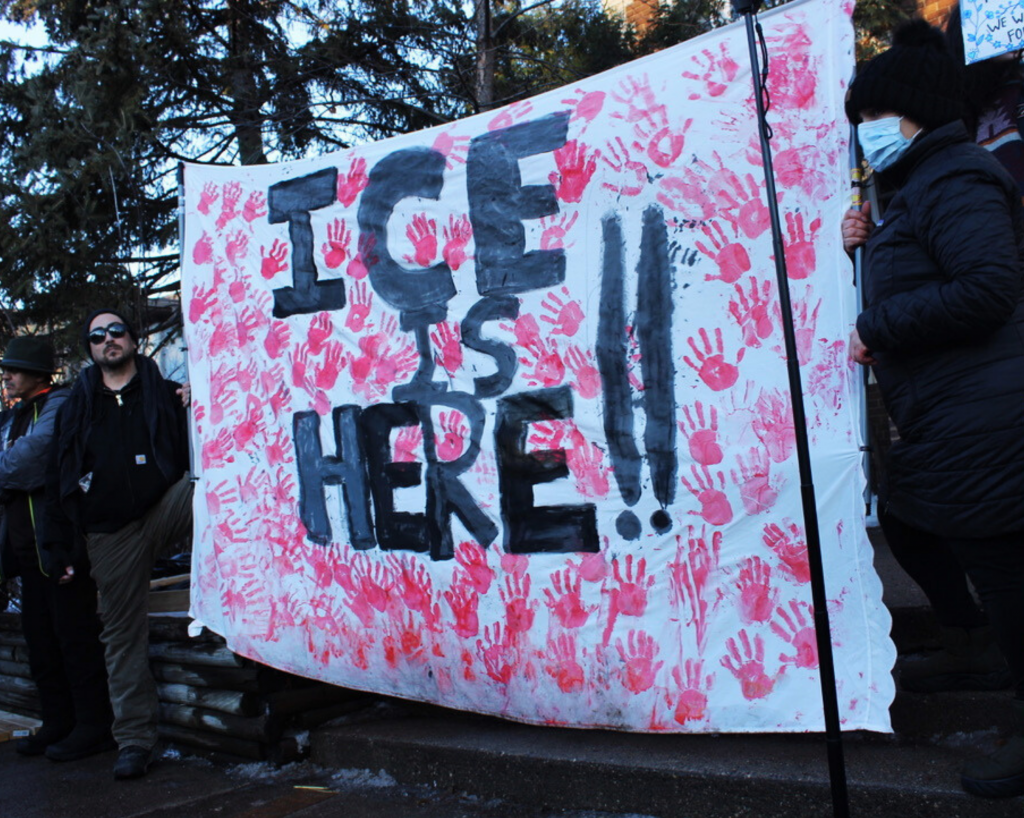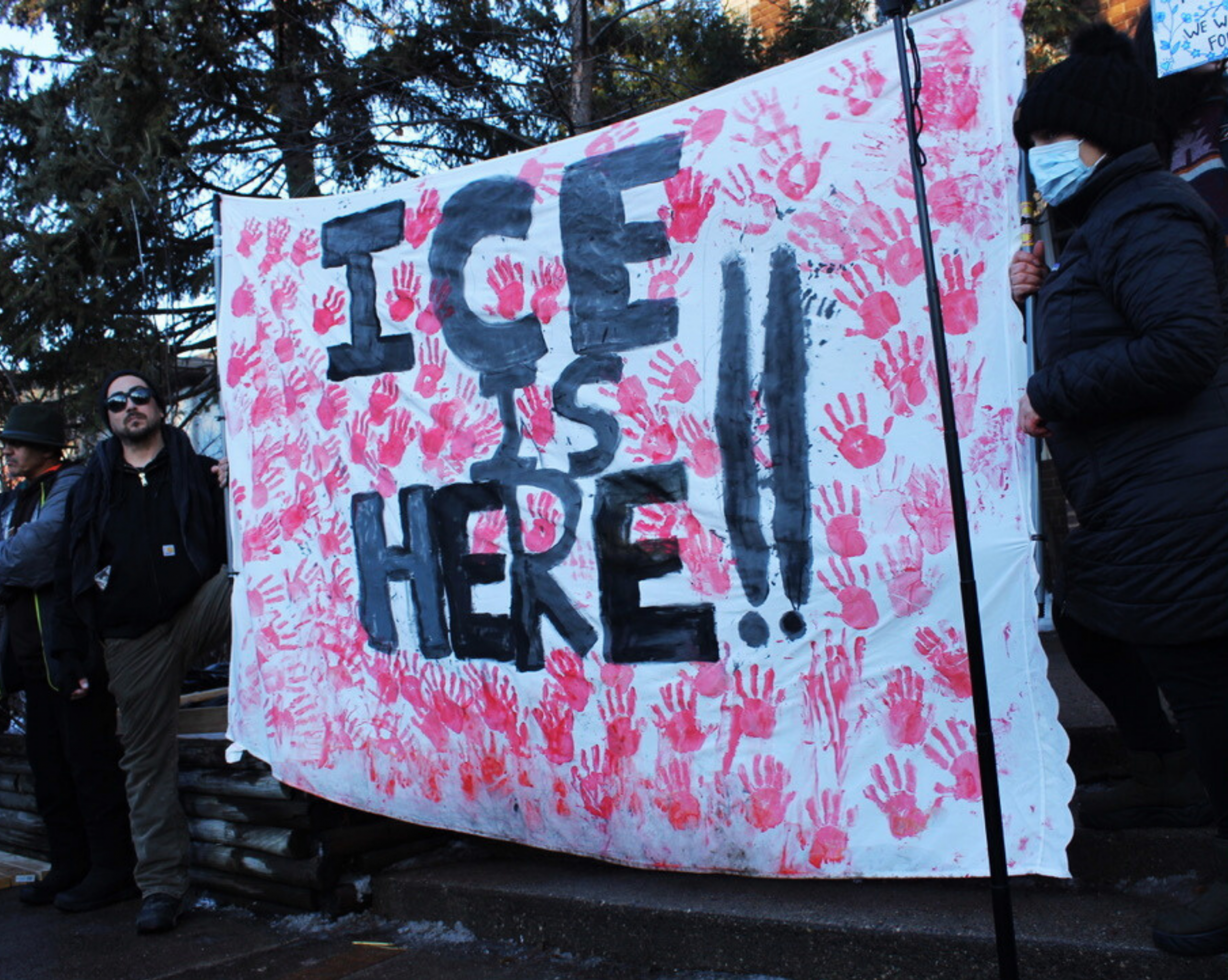
A sign held up during a protest at the memorial for Renee Nicole Good in Minneapolis. Photo: Rana Roudi
The killing of Renee Nicole Good by ICE officer Jonathan Ross on January 7th during Operation Metro Surge, ICE’s extended crackdown on Minnesota’s Twin Cities, has unleashed a wave of protests across the country.
Despite the vocal public opposition, the raids themselves are intensifying. More than 3,000 federal agents have been deployed to Minneapolis and St. Paul, and are using increasingly aggressive and indiscriminate tactics against immigrants, protesters, and local residents. In one incident, ICE fired tear gas into a van with six children inside, resulting in the hospitalization of a six-month-old infant who had to be revived with CPR.
As the ICE and DHS siege of the Twin Cities continues, many Minnesotans are becoming increasingly critical of city and state officials who they feel are not doing enough to protect those targeted by the federal crackdown.
“There’s not strong enough leadership to meet the moment that we’re in,” said Dieu Do, an immigrant rights activist with the Minnesota Immigrant Rights Action Committee (MIRAC). “There’s no action being taken by the governor through executive order, by the state legislature, even by local leaders to actually enact any policies that would attempt to either safeguard, protect, or just mitigate the harm that’s being perpetuated against particularly immigrant communities but really anyone that’s a person of color right now who lives in Minnesota.”
Since federal immigration enforcement ramped up in the state in December, Gov. Tim Walz has issued one executive order on the issue. On January 8, the day after Good was killed, Walz mobilized the Minnesota National Guard “in the case of changes to the public safety environment.”
Walz’s executive order said that federal agents have “indiscriminately arrested people off the street, intimidated our friends and neighbors, and have now caused the loss of life.” Yet some suspected Walz’s intent was to prepare to suppress protests as needed, rather than to protect immigrant communities or prevent federal agents from breaking the law.
HwaJeong Kim, the vice president of the city council of Saint Paul, told BreakThrough, “The last time he did this was during the civil uprising after George Floyd,” recalling how the Minnesota National Guard was deployed to repress protesters after the infamous police killing in 2020, which also occurred in Minneapolis. “For a lot of our residents, we remember exactly how [the National Guard] behaved and were violent against us. Who are they protecting?”
‘Funding should be cut. Congress should step up and stop authorizing funding for ICE in the way that they are.’
“I don’t think we can ask the same hands who abused us to protect us,” said Do, whose parents are Mexican and Vietnamese immigrants to the United States. “It’s absurd the way that they’re policing protestors and observers and not actually having their police maintain law and order and arrest the federal agents who are violating our laws.”
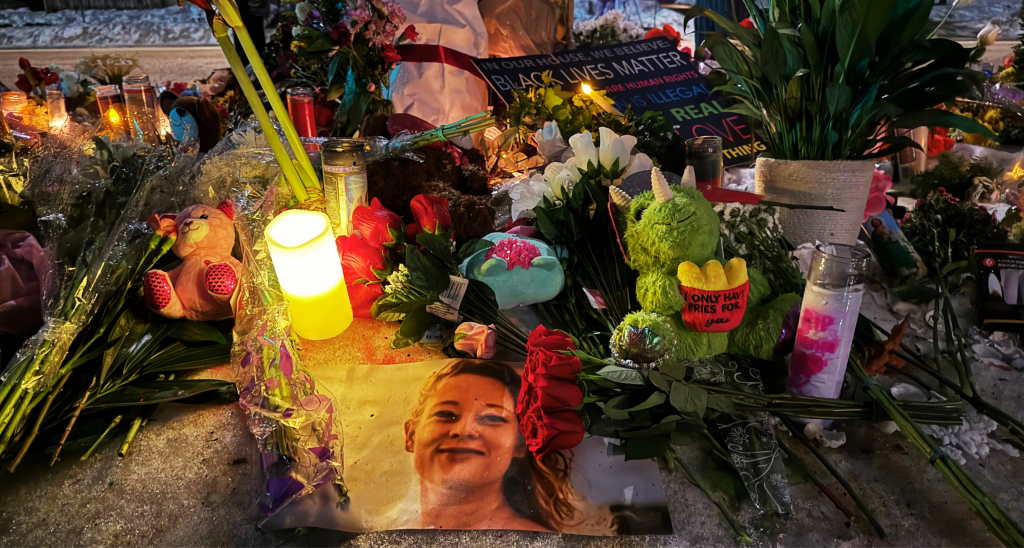
There have also been calls for members of Congress to advocate for and adopt more stringent measures. Reiki Michael, an artist in Minneapolis who had come by late one night to visit the memorial for Good at the site where her car crashed after she was fatally shot by Ross, told BreakThrough that the tragedy of her killing should lead to reform and accountability. “Funding should be cut. Congress should step up and stop authorizing funding for ICE in the way that they are,” said Michael.
The threats from the Trump administration, meanwhile, continue to escalate. A thousand additional federal agents were sent to the Twin Cities in the aftermath of Good’s killing. On Sunday, two U.S. officials told Reuters that the Pentagon has ordered about 1,500 active-duty soldiers in Alaska to prepare for a possible deployment to Minnesota.
Trump’s Justice Department is also investigating Walz and Minneapolis Mayor Jacob Frey over an alleged conspiracy to impede federal immigration agents. Trump has also threatened to implement the Insurrection Act, which would allow military forces to carry out law enforcement functions, such as making arrests and conducting searches.
Through it all, Republican politicians in the state and gubernatorial hopefuls from the party have remained steadfast in their allegiance to Trump, choosing to blame Democrats for the escalation. One Republican candidate for governor, Chris Madel, is providing legal assistance to Ross, the ICE officer who killed Good.
Not hopeful of any Republican pushback against Trump, multiple Minnesotans told BreakThrough that they felt Democrats in office needed to step up more.
“It’s more than overdue time for those that are in the positions of power to take action,” said Hannah Svanoe, an artist who had come to pay her respects at the memorial for Good. “[They] have said a lot of words that feel encouraging… but that doesn’t mean anything until there’s really action that can make effective change.”
Beyond demanding action to rein in ICE and stand up to federal overreach, activists are also pushing for state intervention to support the wider community.
The impact of the federal siege on immigrant-owned or primarily immigrant-serving businesses in the Twin Cities has been especially gutting.
Alfredo, a Mexican American owner of a meat shop in Minneapolis with a primarily immigrant clientele, said his business has faced a significant downturn in recent weeks due to his customers being afraid of venturing out. “If there is financial aid that we can get through the state government, that would help us a lot because we don’t know exactly how long this is going to last,” he said.
“These businesses need support,” said Amanda Otero, co-executive director of Take Action Minnesota. “Whatever elected officials can do to make sure that they stay afloat through this time is really critical for our communities being able to continue to move forward through this.”
St. Paul City Councilor Kim said that Governor Walz should declare a state of emergency like he had during the COVID-19 pandemic, which would enable measures like an eviction moratorium. “People should not be evicted out of their homes right now.”
“With so many families not able to work and staying home out of fear, making rent is really tough right now,” said Otero. “A lot of us are doing a lot of work to raise money and support folks with that, [but] we can’t get to everyone. We need an eviction moratorium to make sure that people can remain in their homes during this time.”
The Minneapolis City Council, too, passed a resolution on January 15 urging the governor to issue an eviction moratorium. Walz had done so during the pandemic, at a time when many had lost their employment or were out of work.
‘We need an eviction moratorium to make sure that people can remain in their homes during this time.’
Do also said that community organizations and support groups were stretched thin when it came to providing legal aid to impacted individuals and families. “There are so many pro bono attorneys, movement lawyers, and law firms that are taking on just an extremely high caseload that’s just never been seen before,” said Do. “The need has exploded and we’re not meeting that need.”
She added, “The local and state government should absolutely be helping more on those efforts.”
Kim, who has been serving the community as a constitutional observer, is a Korean American immigrant herself. Despite being a naturalized U.S. citizen and an elected official, she has been carrying around two forms of identification on her wherever she goes.
She said that St. Paul needed to update their separation ordinance, legislation that mandates that the city administration not collude with federal immigration enforcement. “I really commend Minneapolis — they took a really critical eye to their separation ordinance and offered up language that strengthens it,” said Kim. “In St. Paul, we are working on ours right now, and the goal is to introduce it before the end of this month.”
On December 11, after the Trump administration began ramping up immigration enforcement operations in Minnesota, the city council of Minneapolis passed changes to its separation ordinance outlining additional prohibitions for the city’s resources from being used for immigration enforcement.
The updated ordinance codified the mayor’s executive order that forbade federal immigration agents from using city-owned parking lots, ramps, vacant lots and garages as part of their operations. It also prohibited the city from entering into agreements with federal authorities on immigration enforcement.
As a day of economic blackout across Minnesota — led by labor unions, community leaders, and organizers — approaches on January 23, demands for further accountability from local and state elected officials along with the federal government are likely to continue.
BreakThrough News is building the media arm of the movement. We tell the untold stories of resistance from poor and working-class communities — because out of these stories we will construct a different narrative of the world, as it is and in real time.
Think to yourself, is this article something that would be published anywhere other than BreakThrough?
Five mega-corporations dominate the media landscape — controlling 90% of what we read, watch and listen to. People’s movements in every corner of the globe are changing history and shifting consciousness. But these movements barely receive any coverage from the corporate media. They need visibility. They need amplification. They need a media arm to break through.
Working-class people deserve better, we deserve media for and by us. We are not funded by billionaires or corporations – we are funded by you. Without you, BreakThrough would not be possible, so become a member and build the media arm of the movement with us.
To send a check to BreakThrough News, please make it out to BreakThrough / BT Media Inc. and send to 320 W. 37th Street, NY, NY 10018. Donations are tax-deductible in accordance with the law.

Meghnad Bose is an award-winning investigative journalist based in the United States. He is a professor of journalism at The University of Memphis, where he heads the graduate program in Open Source Investigative Reporting.