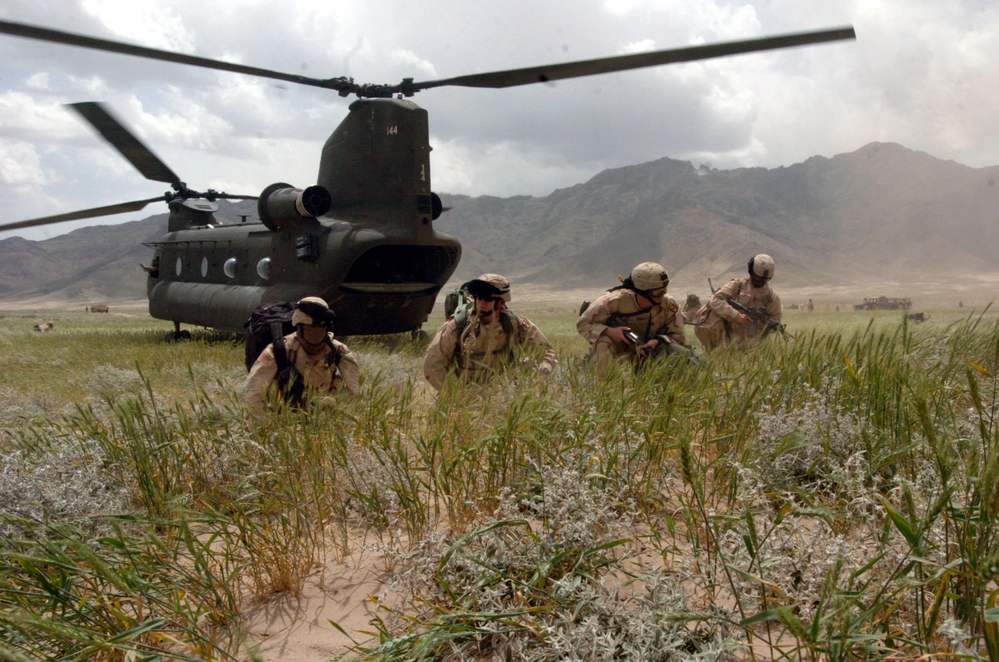
Soldiers establish a security perimeter after exiting a U.S. Army CH-47 Chinook helicopter during a Quick Reaction Force exercise at the East River Range near Bagram, Afghanistan, on June 10, 2005. The soldiers are from Alpha Company, 3rd Battalion, 141st Infantry Regiment of the Texas Army National Guard. DoD photo by Spc. Harold Fields, U.S. Army. (Released)
On September 18, U.S. President Donald Trump made waves by declaring his intent to “get back” Bagram Airfield in Afghanistan’s Parwan Province, citing its geographic proximity to China as a rationale for retaking the base.
Trump’s remarks elicited a swift response from Beijing. Chinese Foreign Ministry spokesperson Lin Jian reaffirmed China’s stance, stating that Beijing “respects Afghanistan’s independence, sovereignty, and territorial integrity,” and emphasized that “Afghanistan’s future should be decided by its own people.”
Trump’s comments might have seemed inexplicable to some, but his administration’s renewed interest in Afghanistan reflects the country’s shifting role in the region under Taliban rule, possibly making it a contested area within the grander context of the U.S.-China rivalry. More than four years since the Taliban reclaimed power, Afghanistan’s immediate neighbors and some countries further afield are no longer pretending the Islamic Emirate regime is a pariah to be isolated. Instead, they are recalibrating their policies, recognizing that Afghanistan’s post-occupation reality is probably here to stay.
The “Taliban 2.0” conducting foreign policy on the basis of pragmatism, reaching out to states whose values, interests, and systems diverge sharply from its own. Escaping isolation, joining regional economic networks, consolidating control at home, and thwarting external threats are its key objectives.
For now, the Taliban shows no interest in exporting its ideology beyond Afghanistan’s borders. As Nikita Smagin, an expert on Iranian foreign and domestic policies, Islamism, and Russia’s policy in the Middle East, put it, this orientation resembles a local “Afghanistan First” doctrine. This means no global jihad, no territorial ambition abroad—but instead a fierce insistence that the Afghan state be rebuilt according to their own vision.
“An ideal international partner [from the Taliban’s perspective] should be willing to cooperate with them while avoiding any intervention in their internal affairs. This is a pragmatic approach, and the Taliban are ready to deal with non-Muslim powers and entities if they meet these criteria,” said Smagin in an interview with BreakThrough News.
So far, Russia has been the only country to formally recognize the “Taliban 2.0”. Yet, a host of other states — such as China, Iran, Kazakhstan, Kyrgyzstan, Pakistan, Qatar, Turkmenistan, the United Arab Emirates, and Uzbekistan — have diplomatically engaged the current Afghan government in various ways, forging significant relationships with the Kabul regime albeit while stopping short of full recognition.
Ibraheem Bahiss, an analyst with the International Crisis Group focusing on Afghanistan, senses that the appeal of obtaining formal recognition is beginning to fade for the Taliban.
“They appear to have come to realize there will be no grand welcoming of their regime into the international fold, and they instead need to focus on improving interlinkages and channels of communications with as many states as possible,” he explained to BreakThrough News.
“Acquiescence and eventual normalisation appear to be the goals rather than recognition,” added Bahiss.
When others will follow Moscow’s example is uncertain — but the Taliban appear confident that even if recognition comes slowly, they have time on their side.
“The Taliban think that since they’re a political reality and no other group in Afghanistan can oust them, therefore eventually the international community regardless of its concerns about their domestic policies and partially also due to geopolitical compulsions will be forced to recognize their government,” Dr. Umer Karim, Associate Fellow with the King Faisal Center for Research and Islamic Studies, told BreakThrough News.
Diplomatic openings are not just about legitimacy. They’re also a response to immediate threats. Perhaps the main motivation that countries in the region have for working with the Taliban relates to the threat of Islamic State Khorasan Province (ISKP).
Formally established in 2015, ISKP emerged from defections within militant groups operating in Afghanistan and Pakistan. Throughout the past decade, ISKP has been engaged in a cycle of violent growth and retreat—fighting Afghan government forces, the Taliban, and international actors. Leveraging cross-border networks and recruitment pipelines, the group has spilled blood in Afghanistan, Iran, Pakistan, Tajikistan, Turkey, and Russia.
Today, ISKP remains the top threat to Taliban rule in Afghanistan and probably to regional security. Governments in Afghanistan’s vicinity see the Taliban is committed to fighting the organization—making their relations with the Taliban a matter of regional security.
“I think regional countries generally tend to view the Taliban’s response to ISKP quite positively. Some, like Russia, are even calling for military support for the Taliban in their fight against ISKP,” noted Bahiss.
Dr. Karim shares this opinion. “The regional stakeholders may not be happy with the Taliban government and its certain policies, but as of now they don’t have another option … [especially] when it comes to countering ISKP,” he told BreakThrough News.
China has become a focal point in the Taliban’s foreign policy calculus. Although Beijing has not formally recognized the Taliban’s government, in September 2023 it became the first country to appoint an ambassador to Kabul after the Taliban’s return to power.
Over the past few years, Chinese and Afghan officials have deepened collaboration across multiple spheres, raising important questions about Afghanistan’s potential inclusion in the Belt and Road Initiative, and particularly its integration into the China-Pakistan Economic Corridor (CPEC). Trump’s Bagram Airfield announcement clearly shows Washington intends to contest Beijing for influence.
Although the Taliban appears intent on keeping the door open to normalized relations with the West—and U.S. and European policymakers are gradually acknowledging the need to accept the reality of Taliban rule—it is likely that Kabul will tread cautiously, avoiding any arrangement with Washington that could provoke unease in Beijing or Moscow.
From China’s vantage point, Afghanistan is more than a diplomatic project—it is a repository of immense resource potential. Rich in fossil fuels, critical minerals, and other resources, the country offers Beijing opportunities to enhance its supply‐chain resilience and to secure raw inputs crucial for its industries.
At the same time, security concerns remain a serious impediment. ISKP’s activities, uncertainty over law and order, weak infrastructure, and the challenges of political legitimacy continue to dampen investor enthusiasm.
Even before the fall of the previous Afghan government in 2021, Beijing had expressed interest in extending CPEC’s reach into Afghanistan. Since the retaking power, the Taliban has endorsed this plan. However, realizing these ambitions has been stalled.
Among these are recurring tensions between Kabul and Islamabad stemming from Tehreek-e Taliban Pakistan (TTP), also known as the Pakistani Taliban. Formed in 2007, the TTP is a coalition of hardline Sunni Islamist factions responsible for numerous attacks within Pakistan. The group has long been a target of the Pakistani military, which accuses the Afghan Taliban of providing it safe haven across the border—an allegation the Taliban government in Kabul continues to deny.
In terms of whether Afghanistan will be able to become such a Eurasian connectivity hub, stability and security will determine the outcome. Yet, at this point, the prevailing instability in Afghanistan calls into question whether the country can meet the demands required for large-scale infrastructure, long-term investment, and high‐stakes economic integration.
“By now, the Taliban have significantly advanced toward greater stability compared to the last years of the pro-American government. If they can maintain power and stability over the long term — for a decade or more — then the idea of a connectivity hub has good chances of becoming operational,” Smagin explained to BreakThrough News.
“Russia, and especially China, are seeking new transit routes and will not consider the Islamist nature of the Taliban regime a negative factor, provided they succeed in building a truly stable state,” he added.
The question is no longer if these relationship shifts will spark change, but how far these changes will go, and how deeply the lives of ordinary Afghans will be transformed. After decades of war and strife, the country remains one of the poorest in the world, and is often viewed with fear and suspicion. As Afghanistan seeks to end its isolation, the long-held assumptions of outsiders may be profoundly challenged in time.
BreakThrough News is building the media arm of the movement. We tell the untold stories of resistance from poor and working-class communities — because out of these stories we will construct a different narrative of the world, as it is and in real time.
Think to yourself, is this article something that would be published anywhere other than BreakThrough?
Five mega-corporations dominate the media landscape — controlling 90% of what we read, watch and listen to. People’s movements in every corner of the globe are changing history and shifting consciousness. But these movements barely receive any coverage from the corporate media. They need visibility. They need amplification. They need a media arm to break through.
Working-class people deserve better, we deserve media for and by us. We are not funded by billionaires or corporations – we are funded by you. Without you, BreakThrough would not be possible, so become a member and build the media arm of the movement with us.
To send a check to BreakThrough News, please make it out to BreakThrough / BT Media Inc. and send to 320 W. 37th Street, NY, NY 10018. Donations are tax-deductible in accordance with the law.
Giorgio Cafiero is the CEO of Gulf State Analytics and an adjunct assistant professor at Georgetown University. He contributes regularly to outlets such as The New Arab and Amwaj.Media, and has advised governments, law firms, and international organizations on Gulf affairs. Cafiero holds an M.A. in International Relations from the University of San Diego.