US Secretary Rubio to host international ‘anti-Antifa’ ministerial meeting
US Secretary of State Marco Rubio is expected to hold a ministerial meeting in Washington this week to expand Trump administration attacks on “Antifa” and left.
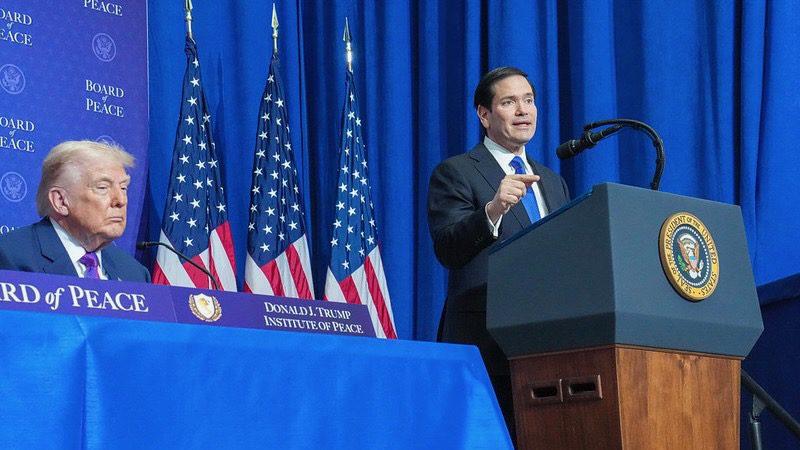
Secretary of State Marco Rubio attends the Board of Peace Inaugural Board in Washington, D.C., February 19, 2026. Photo: flickr
US Secretary of State Marco Rubio invited dozens of countries to a ministerial meeting in Washington this week to discuss the “resurgence of transnational far-left terrorism.” While the Department of State claimed overwhelming interest, unofficial signals reported in mainstream media indicated little enthusiasm among invitees.
The initiative aligns with the Trump administration’s campaign against left-wing networks, notably “Antifa” – a term used by the administration to describe a myriad of anti-capitalist and anti-fascist groups – which was declared a “domestic terrorist organization” in September 2025. This was followed by the designation of four anarchist and left groups based in Germany, Italy, and Greece, as “Specially Designated Global Terrorists.” The narrative set by the State Department fits within this framework that amplifies repression of dissenting US citizens and enables attacks on left and progressive governments around the world.
Watch: What is Antifa? The truth about anti-fascism
The effort also relates to the Trump administration’s 2026 Counterterrorism Strategy. While the document states counterterrorism operations will be “executed apolitically and founded upon reality-based threat assessments” and “will not be used to target our fellow Americans who simply disagree with us,” many analysts warn the very opposite is true. In practice, critics emphasize, the strategy is being used as a basis to expand repressive measures against individuals speaking out against this administration’s policies. Getting international partners to adopt terrorism labels could grant the government even broader room for surveillance and intelligence exchange.
Limited interest in “far-left terrorism” among Europe’s liberals and conservatives?
This week’s ministerial continues a string of discussions involving European governments. In previous talks, European politicians, generally eager to please Donald Trump, were reported disagreeing with his administration’s estimates of risks posed by “far-left terrorism” and “Antifa.” However, despite professed lack of interest, European leaders remain prone to giving in to US pressure. Some administrations invited to Washington have also been implicated in spying on left-wing organizations and political parties domestically. Thus, while interest may be limited, it would be wrong to assume it is absent.
Read more: Italian left party uncovers more cases of police infiltration in their ranks
Quoting the short timeframe provided by the State Department and “busy summer schedules,” most European countries indicated only embassy representatives would join the meeting. Confirmed exceptions include Bosnia and Herzegovina and Montenegro, whose Foreign Ministers are expected to participate, and Italy, where Prime Minister Giorgia Meloni apparently pushed for sending an undersecretary instead of lower-level diplomatic staff.
European far-right seeks to emulate attacks on anti-fascism
While center and right-wing parties in Europe do not currently speak of left-wing activism as a primary threat, the Trump administration’s narrative finds stronger proponents among far-right factions from the Netherlands to Germany and France. There, political groups have launched their own attempts to criminalize or disband anti-fascist networks. Spokespeople for Alternative for Germany’s (AfD) and National Rally’s Marine Le Pen (already in 2017) have called for repressive measures against anti-fascist groups, with the AfD explicitly citing the US terror designation. When in power, the European far right has already acted on this: notably, Hungary under Viktor Orbán attacked anti-fascist organizations using claims akin to those made in the US.
Read more: Far-right leaders gather in Madrid to “make Europe great again”
Ripples of this campaign can also be seen in the European Parliament, where far-right representatives proposed to “declare Antifa a terrorist organization” and floated ideas to crack down on “political violence” by left groups. They alleged that EU institutions treat them with impunity and show a “lack of scrutiny over movements that, under ideological cover, resort to violence as a political tool.” Many MEPs who signed these interventions have spoken in favor of Israel during the genocide in Gaza and shown no interest in addressing the occupation entity’s impunity, reaffirmed over and over again by the EU.
Although the European center and traditional right are not anti-fascist organizations today, growing trends of historical revisionism signal this could change. As mainstream parties lose ground to the far right and adopt more violent mechanisms to confront resistance, the landscape is changing. Murmurs of banning communist symbols in Eastern Europe and the gradual erasure of Soviet Union contributions from official World War II commemorations – a crucial point in Europe’s anti-fascist legacy – could easily become part of a broader anti-left crusade in the West.