G7 summit: leaders praise Trump, reaffirm Western imperialism amid protests
G7 leaders concluded their Évian summit with statements reaffirming a West-centric world vision as tens of thousands marched to oppose the agenda.
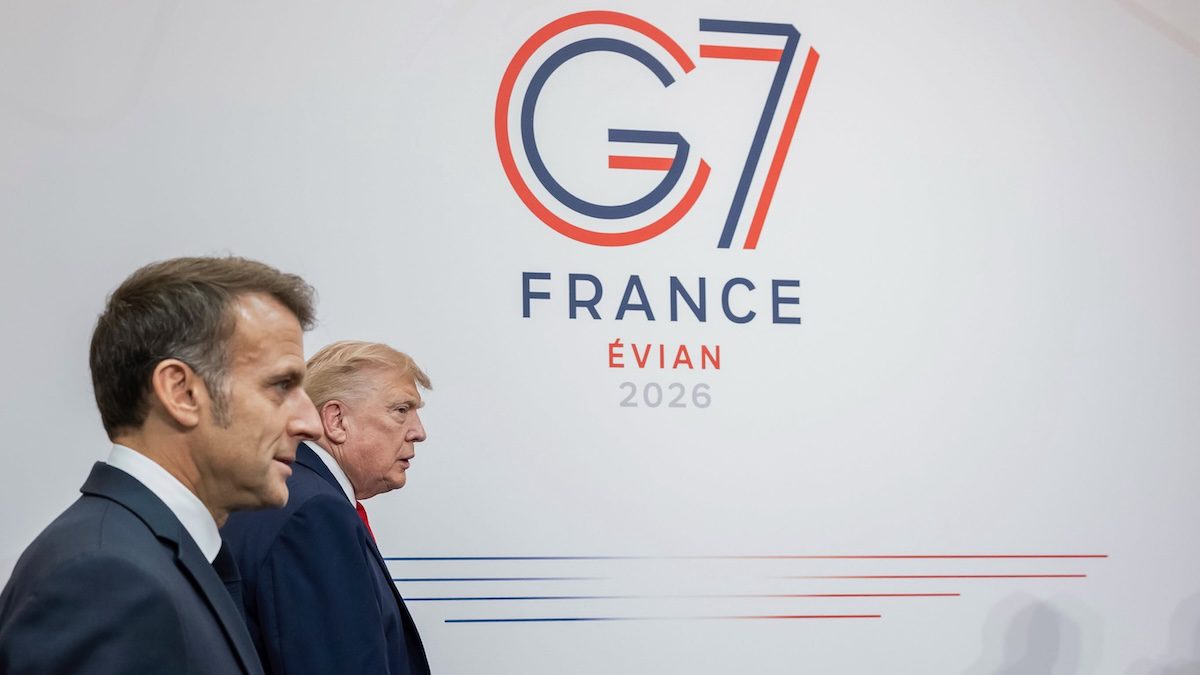
US President Donald Trump and French President Emmanuel Macron. Photo: G7/FB
G7 leaders met in Évian, France, from June 15-17 to discuss – in their own words – “geopolitical issues” and “mutually beneficial international partnerships.” In the days leading up to the summit, a counter-meeting was organized in nearby Geneva, followed by a mass demonstration against the Global North’s warmongering and exploitation of the Global South.
Read more: Pentagon pushes Lockheed Martin, GM to ramp up US weapons production
The heads of state from the United States, United Kingdom, Japan, Italy, Germany, France, Canada and representatives of the European Union addressed pressing global issues but maintained their standard biased vision. Notably, their official statements praised recent initiatives by US President Donald Trump while once again failing to name partner countries involved in gross human rights abuses.
They welcomed the understanding between Iran and the US – “secured under the strong leadership of President Trump” – framing it as an opportunity to “prevent Iran from acquiring any nuclear weapon and tackling the threats related to its regional and ballistic activities.” It seems their discussion made no mention of the Trump administration’s initiation of the latest war on Iran.
A similarly flawed approach appeared in their observations on the war in Ukraine, attacks on Lebanon, and the genocide in Gaza, where they again avoided mentioning Israel. “In Gaza, we will accelerate humanitarian and reconstruction efforts and the swift implementation of relevant political and security measures,” G7 leaders stated, looking away from Israel’s ongoing harassment of the Strip’s population.
Read more: Palestinian factions: We categorically reject unilateral disarmament
Discussions also produced statements on international development and cooperation and critical minerals, reflecting the same economic vision promoted by the G7 in the past. This includes an emphasis on international financial institutions like the International Monetary Fund (IMF) and warnings against countries straying from West-approved mechanisms to protect their sovereignty.
“We express our grave concerns regarding the use of non-market policies and practices and economic coercion, including arbitrary export restrictions and retaliatory measures on critical minerals and their dual-use items, all of which undermine economic security and resilience,” the group wrote in another statement.
As these statements were being discussed, the European Parliament approved an EU-US trade arrangement that imposes tariffs on EU exports to the US. European G7 members apparently did not view this agreement, nor the Trump administration’s aggressive negotiating tactics since 2025, as coercive, problematic or a “non-market practice.”
Read more: Burkina Faso asserts financial independence from the West with mineral-backed sovereign fund
Critical minerals featured prominently in the meeting outcomes, pointing to their importance in current trade and development agreements negotiations, as well as West endeavors against governments in the Global South who are not aligned with their agenda.
Alongside this focus, presidents and prime ministers promoted the private sector’s role in all areas of life, including in the development of protective equipment and treatment for the current Ebola outbreak in the DRC and Uganda. They also insisted on austerity. “Countries with large and persistent external deficits should undertake policies that include supporting domestic savings and fiscal consolidation,” the G7 statement for “a more balanced durable resilient growth” reads.
Read more: Kenya’s protests against Ebola quarantine facility are about the economy and sovereignty
Anti-imperialist and other progressive groups mobilized against the G7 agenda long before the meeting, culminating in a 30,000-strong demonstration in Geneva on Sunday, June 14. The NOG7 network, a coalition of approximately 50 organizations involved in the counter-program, described it as a message of social justice sent to the world. “NOG7 has defended the honor of this city and, at least in part, the idea of an internationalist Geneva,” they said.
The mobilization faced extreme repression from local authorities and police, with activists reporting tear gas and other forms of violence. “The worst part was that they kept hundreds of people in a park for the whole night,” an activist from the People’s Health Movement (PHM) told BreakThrough News. “There were protesters and unrelated people in that park – tourists, hospitality workers – and they were all stuck there from 8 pm to 6 am. There were no bathrooms, the police only gave water and blankets at 1 am.”
At the protest and counter-conference on June 12-13, activists debunked the G7’s agenda as ongoing Western imperialism, offering an alternative vision rooted in international solidarity, antifascism, and economic alternatives. Speakers included local BDS groups, feminist and student collectives, and workers’ organizations, all calling out the Global North’s war and militarization agenda.
“International cooperation is crumbling amid an arms race and trade wars,” NOG7 wrote in its call to action. “This imperialism is based on the proliferation of wars, most recently in Iran, Venezuela, Gaza, the Democratic Republic of the Congo, and Ukraine. Predation by the G7 countries – but also by Switzerland – occurs through their multinational corporations as they race for dwindling raw materials. This frenzied extractivism exploits the bodies of peoples of the Global South.”
“To secure their profits, G7 leaders team up with the capitalist class to intensify their usual strategies: lengthening working hours, raising the retirement age, slashing wages, raising rents, and dismantling public services and social protections,” the coalition wrote, adding that the group is still weaponizing debt in the Global South, “exporting policies of public spending cuts and privatization.”