Kenya’s protests against Ebola quarantine facility are about the economy and sovereignty
The facility has become the latest focal point through which citizens are expressing accumulated frustrations about how decisions are taken and whose voices matter in the process.
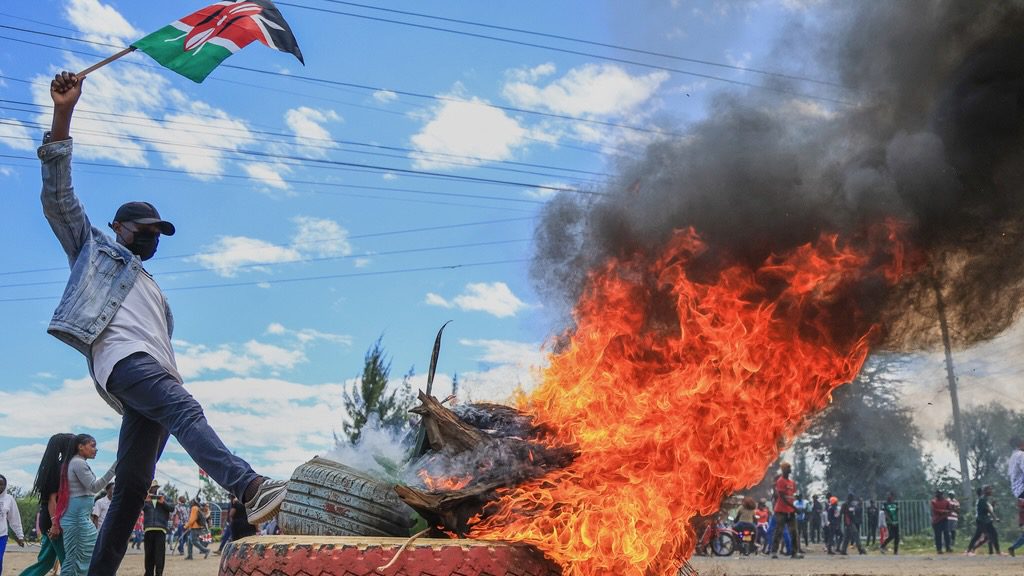
Protests in Kenya against Ebola quarantine facility. Photo: AP
Lee en español aquí
The main news item in African media this past week has been the controversy surrounding a proposed US-funded Ebola quarantine facility in Kenya. What began as a public health initiative has rapidly evolved into a politically charged national dispute. The project has triggered protests and legal action. Two people have reportedly died during demonstrations. The High Court, according to media reports, has ordered the government to disclose details of the agreement underpinning the facility, while public debate has expanded beyond epidemiology to questions of sovereignty, transparency, and public trust.
These public protests suggest that many Kenyans are not merely contesting the health facility and the US imperialist conspiracy surrounding it. They are contesting the way consequential public decisions are made, communicated, and justified. In this respect, the proposed facility has become a vehicle for expressing deeper anxieties about governance, accountability, and state responsiveness.
While sovereignty concerns have featured prominently in public debate, the controversy also reveals an important economic dimension. Kenya has already signed the Health Cooperation Framework, parts of which provide for health-data sharing arrangements that have become the subject of legal and political controversy. Narrative economics offers a useful lens for understanding Kenya’s political economy of public discontent. It argues that economic and political outcomes are shaped not only by institutions and material conditions, but also by the stories citizens construct about power, opportunity and the responsiveness of the state.
This angle helps explain why episodes of public protest have become a recurring feature of Kenya’s political economy. Successive administrations have confronted major demonstrations linked to contentious political or economic decisions, and in each instance, the state’s management of dissent has itself become a source of grievance. The pattern has remained remarkably consistent: public grievances intensify, citizens mobilize, confrontations occur with security forces and people die. Allegations of excessive force, disappearances and institutional indifference dominate Kenya’s politics. These disputes eventually subside, but the broader narrative of non-responsiveness survives.
The May 2026 fuel price protests illustrate this pattern with starkness. Following consecutive fuel price increases of 24 and 23% in successive months, transport unions called a nationwide strike that brought Nairobi and Mombasa to a near standstill. According to media reports, at least 4 people were killed, and 30 were injured, with 348 arrested. The Interior Ministry’s response was dismissive, attributing the unrest to criminal elements and political manipulation rather than to the material conditions driving ordinary Kenyans into the streets. Rights groups were swift to condemn the use of lethal force against citizens protesting fuel costs that were cascading into food prices and deepening household hardship. This was not an isolated incident. In June 2024, security forces are said to have killed at least 60 people during tax protests, and further deaths occurred in 2025 over corruption, brutality, and the rising cost of living. What connects these episodes is the consistency of the state’s response, and the lesson we draw from it.
The significance of this pattern lies in its cumulative effect. Citizens interpret new events through the lens of previous experiences. Over time, repeated interactions between citizens and the state create enduring narratives about how power is exercised, whether institutions listen and whether public concerns receive meaningful consideration.
In Kenya, one such narrative increasingly centers on the perception of political distance between the state and society and nowhere is that distance more legible than in the trajectory of the “Hustler Nation” narrative. President Ruto’s ascent to the presidency was built on an explicit compact with ordinary Kenyans including the small traders, boda operators, and the urban informal workers. It was premised on the promise that the state would finally be responsive to those at the margins. Yet the consecutive fuel price increases of recent months, the deaths of protesters at the hands of security forces, and the government’s dismissal of dissent as the work of criminal elements and political actors represent not merely policy failure but the visible collapse of that compact. For many citizens, particularly younger people, the question is no longer confined to a particular tax proposal, public health project or infrastructure initiative. The deeper concern is whether economic opportunity, social inclusion and upward mobility remain genuinely attainable under an administration that came to power speaking their language but has since deployed the same instruments of exclusion and force that defined its predecessors.
This is why the economic implications of recurring protests extend beyond the immediate political moment. Economic sentiment is shaped not only by macroeconomic indicators but also by perceptions of institutional quality and political stability. Investors, businesses and households respond to signals about predictability, responsiveness and risk. Repeated cycles of protest and confrontation reinforce perceptions of uncertainty and weaken confidence in the state’s ability to manage disagreement through consultation and consensus.
Kenya is not alone in confronting this challenge. Across Africa, governments increasingly find themselves governing within narratives that they do not fully control.
In Ghana, the “Beyond Aid” narrative emerged as a powerful story of economic sovereignty, self-reliance, and national dignity. It resonated because it promised a future less dependent on external assistance and more grounded in domestic capability. Yet the narrative’s durability depended on visible progress and tangible results. Aspirational stories can inspire confidence, but they can also generate disappointment when delivery falls short of expectations.
South Africa offers a similar lesson. The “New Dawn” narrative emerged after a period of institutional decline and state capture. It promised renewal, reform and the restoration of public trust. Initially, it generated optimism among citizens and investors alike. Yet over time, the pace of visible reform struggled to keep pace with the expectations created by the narrative. The result was not merely disappointment but growing skepticism about institutions’ capacity to deliver meaningful change.
The comparative lesson is straightforward. Narratives are not peripheral to governance. Citizens experience the state through both policy outcomes and the stories they construct about those outcomes. A strong narrative without delivery eventually loses credibility. Equally, technically sound policies can struggle to gain acceptance when they are introduced into an environment where trust has been weakened by previous cycles of contestation and confrontation.
This brings us back to the controversy surrounding the proposed Ebola quarantine facility. The issue is larger than the facility itself. The protests are best understood as part of a broader conversation about governance, participation and trust. The facility has become the latest focal point through which citizens are expressing accumulated frustrations about how decisions are taken and whose voices matter in the process.
Understanding Kenya’s current moment, therefore, requires more than an assessment of a single public health project. It requires an appreciation of the stories that citizens have come to tell about the state and their place within it.
The challenge for governments across Africa is not simply to communicate better. It is to ensure that policy, institutional behavior and public communication reinforce one another. Trust is not built through slogans, stunts, newsletters, commissions of enquiry, or public relations. It is built through repeated demonstrations that institutions are responsive, accountable, and attentive to citizens’ concerns. Where such trust exists, difficult policy decisions become easier to sustain. Where it is absent, even technically sound decisions can become catalysts for resistance.
The events unfolding in Kenya are therefore not only a public health story. They are also a story about governance, trust and economic confidence. They remind us that economic outcomes are shaped not only by policies and institutions but also by the narratives through which citizens interpret them.
Busani Ngcaweni is Director of the Centre for Public Policy and African Studies at the University of Johannesburg and Professor at China Foreign Affairs University.
This article was produced by Globetrotter.