“Not a deal, a rip-off”: EU agrees to subservient trade terms with US
The EU has announced a trade deal with the US involving high tariffs and major investments into the US economy, without securing anything in return.
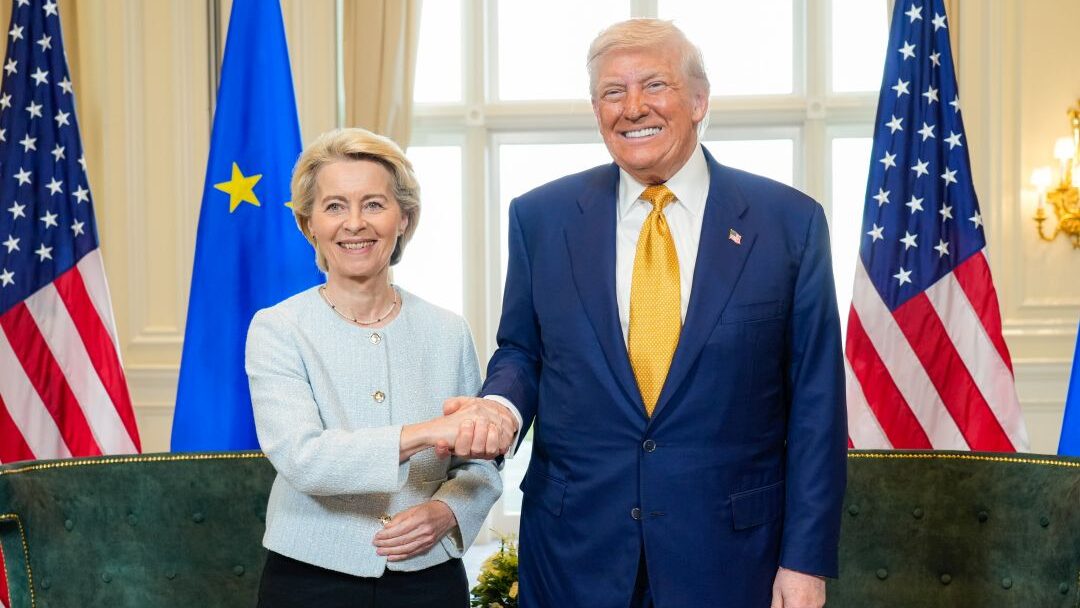
European Commission President Ursula von der Leyen and US President Donald Trump. Source: European Commission
The European Union has reached a non-binding trade and tariff agreement with the US administration, European Commission President Ursula von der Leyen announced this week. While von der Leyen literally beamed at the prospect of (presumably) having dodged a full-blown trade war, the known provisions of the deal offer far less comfort for Europe’s working class, facing new threats of deindustrialization, austerity, and militarization to appease the bloc’s alleged ally.
The deal was struck under the looming threat of steep tariffs set to take effect at the beginning of August, barring a new arrangement. To avoid 30% US import tariffs on EU goods, von der Leyen and EU negotiators accepted a 15% rate – substantially higher compared to pre-2025 levels and, notably, not reciprocal. “The US will not face higher tariffs for exporting to the EU in return,” the White House noted in its fact sheet.
Read more: Trump’s August 1 tariff deadline threatens global trade shock
Despite EU officials’ efforts to frame the deal as a stabilizing moment in a turbulent world, skepticism is warranted. Von der Leyen said that President Trump had once again proven to be “a tough negotiator,” but above all “a dealmaker.” Left and progressive parties across Europe have warned against these dealmaking skills, which instill a false sense of progress in political elites, only for governments to be pulled into more “negotiations” over, for example, steel or pharmaceutical imports. The Workers’ Party of Belgium (PTB-PVDA) pointed to Japan and Britain as cautionary tales: both signed similar agreements that fell far short of delivering long-term certainty. “These agreements are not only commercial, they’re also instruments of geopolitical pressure,” PTB-PVDA warned.
This pressure will be felt across key sectors of the EU economy. One of them is energy. The EU has pledged to purchase USD 750 billion worth of US energy products – primarily oil and liquefied natural gas (LNG) – over the next three years. This raises not only environmental concerns, but also questions of self-sufficiency. “Instead of investing in a sustainable energy transition to make European industry more independent and future-ready, Europe is now tying its fate to hundreds of billions of dollars in US fossil fuel interests,” the Belgian left party wrote.
A deal that serves US fossil and military industries
And the US energy sector isn’t the only one cashing in. Von der Leyen announced roughly USD 600 billion in projected European private investment into the US. How the EC President can predict private sector behavior remains unclear, but some analysts suggest she may be referring to companies where public entities hold significant stakes. “One of the most plausible explanations is that these investments will come from large industries, defense firms like Leonardo in Italy, which, though technically private, are majority-owned by the Treasury or other state entities and can thus be ‘guided’ in that direction,” wrote Maurizio Coppola, co-editor of Progetto Me-Ti, in his commentary.
There is also the matter of weapons. The US administration has stated that the agreement includes EU commitments to purchase a “significant” amount of US-manufactured arms and military supplies. While EU statements initially kept quiet on this point, estimates suggest the figure could start around USD 100 billion. This aligns neatly with the EU’s recent decision to raise NATO contributions to 5% of GDP and indulge in a military spending spree under the ReArm Europe program. But it clashes deeply with any hope of preserving social protections or workers’ rights, pools which will be drained to fund armament.
“This agreement mainly serves the interests of the US fossil and military industries, while the costs will be borne by workers and consumers in Europe and the US,” PTB-PVDA stated. “The US continues to show it has neither ‘allies’ nor ‘friends,’ only imperial interests.”
Not a deal, but a rip-off
Faced with these realities, most European governments have remained remarkably meek, despite reports of uneasiness. Few, like French President Emmanuel Macron, apparently channeling ghosts of colonial grandeur, floated the idea that Europe should return to negotiations and be feared. “To be free, one must be feared. We haven’t been feared enough,” Macron said, according to French media. If and how this statement will be put into practice remains to be seen.
Read more: Brazil seeks dialogue, but Trump administration “does not want to talk” to negotiate tariffs, says Lula
Meanwhile in Italy, Coppola observed, the Meloni government seems more preoccupied with preserving US market access for Italian-made cheese, wine, and Gucci handbags than with protecting wages or workers’ rights. “The government is more concerned with luxury exports that enrich a few companies than with the lives of the people who actually produce those goods,” he told Peoples Dispatch.
“The EU may have (perhaps) avoided a trade war with the US,” Coppola concluded, “but at the cost of a social war that will be even more brutal.” Or, as PTB-PVDA Secretary General Peter Mertens put it: “This is no deal, this is a rip-off.”