SPC Kingkeo Simlamany from 172nd Infantry Brigade Combat Team, places important landmarks on maps his unit will use during scenarios at Saber Guardian 2013, a U.S. European Command Black Sea regional exercise planned and executed by Romanian Land Forces and U.S. Army Europe. This is the first time these Black Sea regional countries (Romania, Bulgaria, Armenia, Azerbaijan, Republic of Georgia, Moldova, and Ukraine) have come together to train and exercise their battlestaff and command post procedures at one location. Photo by Richard Bumgardner, U.S. Army Europe Public Affairs.
The South Caucasus, a strategic crossroads where global and regional powers vie for influence, has undergone a dramatic realignment. Turkey and Israel have expanded their regional roles with Azerbaijan’s foreign policy growing more assertive. These shifts, aligned with U.S. efforts to isolate Iran, are eroding Tehran’s traditional foothold in the region.
On August 8, U.S. President Donald Trump hosted Azerbaijani President Ilham Aliyev and Armenian Prime Minister Nikol Pashinyan for the signing of a preliminary peace agreement. This trilateral deal aims to resolve the decades-long conflict between Armenia and Azerbaijan over Nagorno-Karabakh—a mountainous enclave, located within Azerbaijan’s internationally recognized borders. Ethnic Armenians governed this territory under the self-proclaimed Republic of Artsakh from 1991 until its dissolution in 2023.
A central element of the agreement is the establishment of a U.S.-backed corridor connecting mainland Azerbaijan to Nakhchivan—an Azerbaijani exclave landlocked between Turkey, Armenia, and Iran. Branded the Trump Route for International Peace and Prosperity (TRIPP), the United States holds development rights in this 27-mile corridor, which replaces the original “Zangezur Corridor” concept.
It should be noted that this development might not move forward due to a host of unresolved issues that could prevent Armenia and Azerbaijan from entering into a formal peace agreement. Nonetheless, if realized, TRIPP would reinforce the influence of the United States, Azerbaijan, and Turkey in the South Caucasus while diminishing Iranian leverage.
TRIPP aligns with the logic of the Middle Corridor, also known as the Trans-Caspian International Transport Route (TITR)—a strategic multimodal corridor comprising rail, road, and maritime networks that connect Western China to Europe via Central Asia, the Caspian Sea, the South Caucasus, and Turkey, while deliberately bypassing Russia and Iran. Emphasizing enhanced regional connectivity across Eurasia, TITR aligns closely with Beijing’s Belt and Road Initiative. It also underscores how Turkey, Georgia, Azerbaijan, and the Central Asian republics increasingly view transit through Russia as geopolitically and economically risky, particularly in light of Western sanctions on Moscow, while simultaneously positioning themselves as vital links in the evolving architecture of Sino-European trade. TRIPP is set to boost Turkey’s influence across the broader “Turkic world”—largely at Iran’s expense. By creating a direct land route to Central Asia via Azerbaijan and the Caspian Sea, Turkey would strengthen its strategic foothold from the South Caucasus to China’s Xinjiang.
For decades, the only land connection between Azerbaijan proper and Nakhchivan ran through Iranian territory—quietly giving Tehran both economic gains and political sway. With TRIPP, that long-standing dependency may soon disappear.
“For Iran it is an uncomfortable development given the fact that Azerbaijan for decades has relied on transit via Iran’s northern territories to reach its exclave of Nakhchivan,” Dr. Emil Avdaliani, a professor of international relations at European University in Tbilisi, Georgia, told BreakThrough News. “The potential opening of the TRIPP would deprive Iran not only of lucrative transit fees but also an important geopolitical lever over Azerbaijan,” he added.
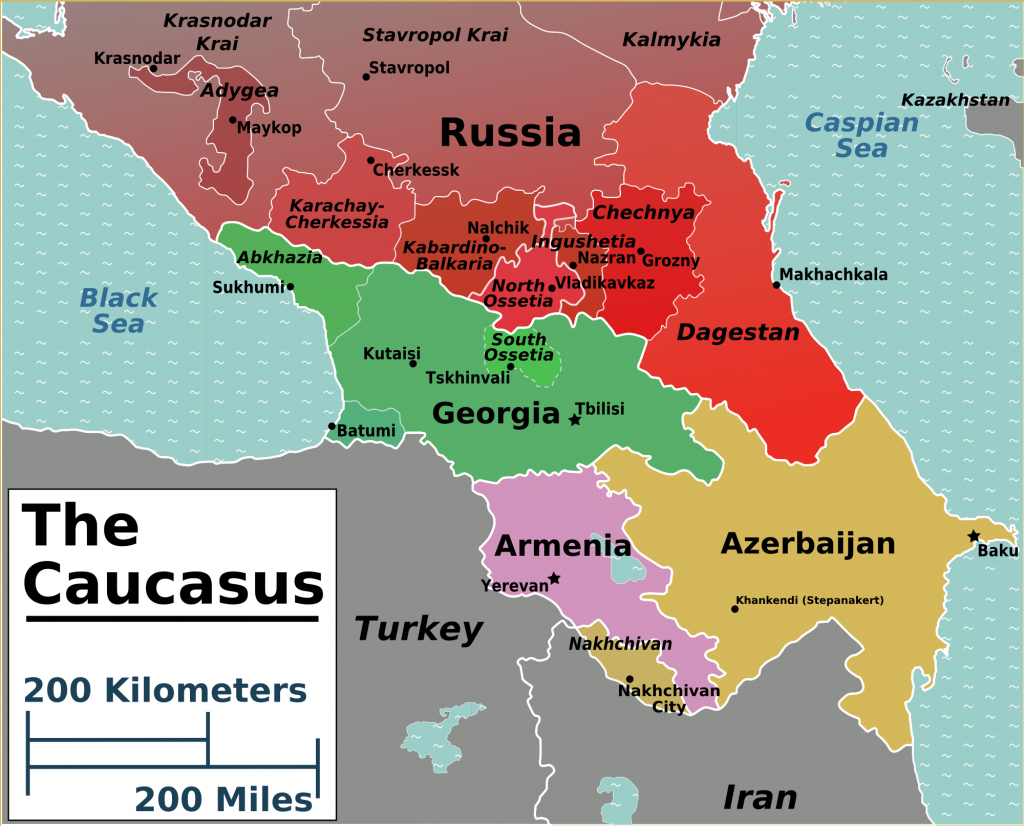
A map of the Caucuses region, per Wikimedia
This shift follows key regional developments that have bolstered Turkey’s position while weakening Iran’s, including the 2020 Karabakh War and the fall of Syria’s government in 2024.
Turkey’s anticipated gains from the corridor threaten not only to sideline Iran but to erode two centuries of Russia’s powerful influence in the South Caucasus. Despite TRIPP’s implications, Moscow officially welcomed the Washington-brokered deal, raising concerns in Tehran about Russia’s reliability as a partner. This follows what Tehran understood to be Moscow’s failure to defend the Islamic Republic during the June Iran-Israel war in concrete manners that went beyond rhetoric and diplomatic gestures, further deepening Iranian disillusionment.
Turan Gafarli, a non-resident fellow at the Baku-based Topchubashov Center, explained to BreakThrough News that Russia and Iran have different pressing concerns with the former focused on Ukraine and the latter trying to recover from its recent conflict with Israel.
“We should also remember that Russia did not fully support Iran during those clashes but rather acted as an actor seeking calm, nor should we forget Russia’s deep ties with Israel,” he noted, adding that “Russia is unlikely to prioritize Iranian concerns in the region.”
Nonetheless, Iran and Russia share concerns over the presence of non-regional actors—chiefly the United States—and the growing influence of Turkey in the South Caucasus.
Yeghia Tashjian, a regional affairs expert at the Issam Fares Institute, noted in a BreakThrough News interview that Turkey’s role in TRIPP positions it as a “bridge for NATO’s interests in the region,” thereby extending Western influence deeper into Central Asia and weakening the strategic positions of Iran and Russia.
Tehran has long viewed Azerbaijan’s close defense ties and intelligence cooperation with Israel as a national security threat. Iranian officials accuse Baku of enabling Israeli surveillance and sabotage operations along their shared border—accusations that intensified after the June Iran-Israel war, during which Azerbaijan allegedly provided intelligence support to Israel. While Baku denies involvement, the perception in Tehran is clear: Azerbaijan’s alignment with Israel is deepening, further straining an already tense relationship and heightening fears of Israeli encroachment on Iran’s northern frontier.
Iran’s deep-rooted concerns over separatism in its northwest further strain Tehran-Baku relations. With more than 18 million ethnic Azeri citizens (nearly twice Azerbaijan’s population), Iran fears secessionist movements in its provinces of East Azerbaijan, West Azerbaijan, and Ardabil. The idea of a “South Azerbaijan”—amplified by nationalist rhetoric, Israeli media, and neo-conservative think tanks in Washington promoting a “Greater Azerbaijan”—stokes longstanding anxieties in Tehran.
On August 9, Iran’s Foreign Ministry formally welcomed the peace agreement, but warned about “negative consequences” stemming from “foreign intervention, especially near shared borders.” That same day, Ali Baqeri-Kani, who was Iran’s deputy foreign minister until last year and who sits on the Strategic Council on Foreign Relations, vowed that Tehran will “not easily ignore” TRIPP and warned about its “direct and indirect effects” on Russia and other countries. “Foreigners—particularly Americans—entering the region to advance their own interests at the expense of others would be unacceptable to Iran and other regional states,” he declared.
Separately, Ali Akbar Velayati, a senior advisor to Supreme Leader Khamenei, warned that TRIPP would “move borders” and he mocked Trump for thinking the route named after him is feasible. Velayati called it a “conspiracy” backed by Washington which will require Tehran to make a decision “with or without Russia.”
Alaeddin Boroujerdi, a member of the Iranian parliament’s national security and foreign policy commission, reacted by saying that history demonstrates that “wherever the Americans have been present, they have created tension and insecurity” and that naturally Iran will “not allow the security of our border areas to be harmed.”
A key question is how Iran will respond if TRIPP materializes.
In response to the deepening strategic partnership between Azerbaijan and Israel—particularly in the realms of defense and intelligence—Iran has increasingly turned to Armenia as a counterweight in the South Caucasus. Strengthening ties with Yerevan has emerged as a key component of Tehran’s regional strategy, especially as the Islamic Republic grapples with growing fears of geopolitical encirclement. On August 18, Iranian President Masoud Pezeshkian made his first visit to Armenia since taking office, meeting with Prime Minister Pashinyan in Yerevan to discuss TRIPP. During the visit, the two countries signed ten bilateral agreements across various sectors.
“Iran needs Armenia as an outlet in case of full NATO and American-Israeli encirclement,” said Gafarli. However, while Iran may view Armenia as a natural partner against the expanding influence of Baku, Ankara, and Tel Aviv, Armenia’s foreign policy trajectory introduces notable complications.
Amid growing disillusionment with Russia, particularly over Moscow’s perceived failure to support Armenia during recent confrontations with Azerbaijan, Yerevan is actively seeking to diversify its foreign relations. This has translated into a marked pivot toward the West, which in turn limits the extent to which Armenia can embrace Iran. As Gafarli commented, Yerevan is likely to “maintain friendly ties with Iran to preserve balance,” but Armenia will do so with greater caution to keep alive the option of future U.S. support.
“So far, Iran has done nothing but issue empty warnings or downplay the risks involved,” remarked Dr. Shireen Hunter, an honorary fellow at the Center for Muslim-Christian Understanding at Georgetown University who served as an Iranian diplomat before 1979, in a recent conversation with BreakThrough News when discussing Tehran’s next move vis-à-vis TRIPP.
“Some officials have also said that Armenia has promised that it would not allow the road to endanger Iran’s interests. However, Armenia is in no position to do anything to help Iran even if it wanted to. The reason Armenia agreed to the deal was because it was defeated in the war with Azerbaijan while all key players, including its historical ally Russia, remained silent,” she added.
TRIPP is more than a transportation project—it’s a strategic gambit with sweeping implications for regional power dynamics. For Iran, it risks encirclement by hostile or Western-aligned states, exclusion from key trade routes, and a rise in separatist sentiment. Meanwhile, traditional partners like Russia and Armenia appear to have their own priorities, or to be constrained in countering U.S.-backed designs.
The dynamic reflects a wider pattern seen across the Global South—where infrastructure, diplomacy, and “peace deals” are shaped by powerful external actors, often sidelining the needs, voices, and security concerns of other countries. While TRIPP may bring certain logistical and commercial benefits, its geopolitical undercurrents reveal a more complex reality: one where power, not peace, often determines whose interests are prioritized.
In this environment, Tehran’s response—rhetorically strong but materially limited—highlights the broader dilemma facing many Global South states seeking to assert sovereignty in an international environment that still presents significant challenges for countries not aligned with the West.
BreakThrough News is building the media arm of the movement. We tell the untold stories of resistance from poor and working-class communities — because out of these stories we will construct a different narrative of the world, as it is and in real time.
Think to yourself, is this article something that would be published anywhere other than BreakThrough?
Five mega-corporations dominate the media landscape — controlling 90% of what we read, watch and listen to. People’s movements in every corner of the globe are changing history and shifting consciousness. But these movements barely receive any coverage from the corporate media. They need visibility. They need amplification. They need a media arm to break through.
Working-class people deserve better, we deserve media for and by us. We are not funded by billionaires or corporations – we are funded by you. Without you, BreakThrough would not be possible, so become a member and build the media arm of the movement with us.
To send a check to BreakThrough News, please make it out to BreakThrough / BT Media Inc. and send to 320 W. 37th Street, NY, NY 10018. Donations are tax-deductible in accordance with the law.
Giorgio Cafiero is the CEO of Gulf State Analytics and an adjunct assistant professor at Georgetown University. He contributes regularly to outlets such as The New Arab and Amwaj.Media, and has advised governments, law firms, and international organizations on Gulf affairs. Cafiero holds an M.A. in International Relations from the University of San Diego.