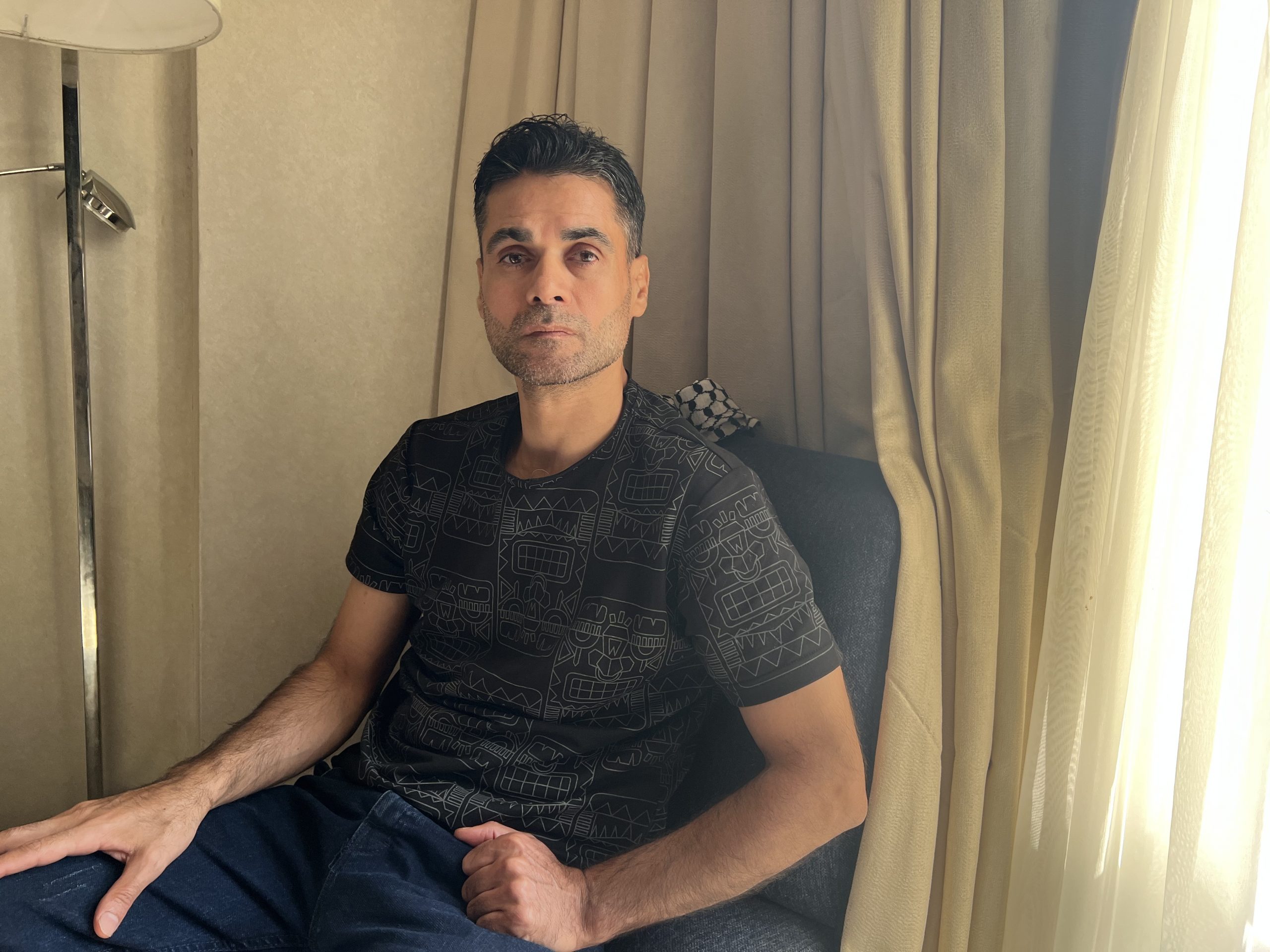
Mahmoud Al-Ardah, from the town of Arraba in Jenin refugee camp in the West Bank, was born on November 8, 1975. First arrested in 1992, and then again in 1996, Al-Ardah has spent most of his life in Israeli prisons. On September 6, 2021, he and five other prisoners escaped from Gilboa Prison by digging their way out with spoons and other kitchen utensils.
The Gilboa Prison escapees remained free for a week, before they were captured and placed in solitary confinement. Nevertheless, the story of the “Freedom Tunnel” operation became legendary among Palestinians.
Beyond his role in the Gilboa escape, Al-Ardah is known as a prolific writer. He pursued his education from Israeli prison, and has a 1200-page novel that he wrote while incarcerated.
As a result of Israel’s prisoner exchange with Hamas, Al-Ardah is now free. He was deported to Egypt as a condition of his release, and spoke to BreakThrough News on October 30, 2025.
Describe your childhood before your arrest?
I was a student in school and helped my father with farming. I worked on a tractor and loved the land. I was in the tenth grade when I was arrested while in school. I loved the mountains, valleys, trees, birds, and animals. That was my life. I was arrested at home because of my activities during the First Intifada (the uprising of the stones). I was 16 years old and sentenced to life imprisonment.
What were the conditions of the prisoners before the October War?
In 1992, there were approximately ten thousand prisoners in several prisons, including the Negev and Junaid Prison, which was the most notorious. In Nablus, there were also prisons like Megiddo, Ashkelon, and the Russian Compound (al-Maskubiya).
The prisoners’ movement improved the conditions of prisoners in Israeli jails. We used to sleep on very thin sheets and cover ourselves with black blankets from the Red Cross. The movement played a crucial role in wresting prisoners’ rights from the Israeli jailers through hunger strikes. Education was fundamental to their cultural and intellectual development. In 2010, we were able to enroll in universities thanks to Dr. Marwan Barghouti. We were forced to attend the Hebrew University, and many prisoners graduated from it. Later, Arab universities also opened, thanks to Dr. Barghouti, who gave lectures inside the prisons. In prison, all we have is time, so prisoners spend their time reading and learning.
We used to use cardboard from tissue and cigarette boxes to write on. Later, stationery was introduced into the prisons. We were forced to study for university and take the high school exams.
I consider everything I studied to be merely a formality, not real. That’s why I consider myself to have only a tenth-grade certificate.
What were the conditions of the prisoners after the October 7th War?
During the war on Gaza, everything was forcibly taken from us, and all of this stopped. What I mentioned came to a halt, but there are Palestinian experts in the prisons. The occupation only arrests the elite of the Palestinian people—teachers, doctors, engineers, and scientists who were helping students. During my time in solitary confinement, Dr. Marwan Barghouti taught us, and I attended his last fifty lectures.
Itamar Ben-Gvir, the extremist Israeli Minister of Security, gave orders to the prison guards to beat the prisoners violently—deadly blows that could cause severe injuries affecting their lives in the long term. But the Gazans were strong and resilient; we have never seen fighters like them in history. What impressed me most about the Gazan prisoners was their strength and determination to live. I remember one prisoner from Gaza entering a waiting room in the prison and drawing a rifle, then signing his name next to it. No one else would dare do that because we knew the soldiers would beat or kill anyone who wrote anything on the walls. Also, on their last day in prison, when the Gazans learned of their impending release, they were dancing the Dabke (a traditional Palestinian dance). I consider them very strong and unique.
But the Gazans were subjected to severe beatings, oppression, humiliation, and degradation. We could hear their screams and the sound of stun grenades. I’m almost certain that dozens of Gazan prisoners were executed inside the prisons, and time will reveal the truth. They deliberately targeted sensitive areas to inflict injuries that would affect our lives in the long run.
How did you spend your time in prison?
I spent my time reading, about 17 hours a day. I read all kinds of books in various fields, such as history, philosophy, and religion. There were libraries in the prison, and I read a lot. I also spent my time writing. I wrote a piece about women, but it was confiscated and torn up. Then I wrote about my escape from Gilboa Prison, which I called “The Tunnel of Freedom.” It talked about my experience and other topics related to various Palestinian issues.
How would you describe conditions in prison?
The prison experience is harsh. All religions reject this. If prison is worse than anything, then a person can be killed every day. Death is easier than prison because one dies and finds peace, but in prison, one dies every day. One’s freedom and humanity are taken away.
What price does the Palestinian pay under occupation?
Occupation is enslavement. It controls and humiliates the Palestinian body, controlling everything from water and air to electricity. It’s like a prison; it kills us and imposes starvation. We lose our freedom because of the occupation, and what we experience in the Palestinian territories confirms this. We can’t even harvest olives, as is happening now in the West Bank.
What is your opinion of the Western world’s reaction to the Palestinian cause?
The Gaza war awakened the conscience of humanity and highlighted the injustice suffered by the Palestinian people. This exposed the lies and true nature of the Israeli army and its oppression of our people. It occupies a people who have the right to freedom and the liberation of their homeland.
What is a Palestinian prisoner?
A Palestinian prisoner is a freedom fighter. We fight for our freedom. Palestinian prisoners are the elite of the Palestinian people. Since 1967, a million Palestinians have been imprisoned. A prisoner is not a terrorist; they are freedom fighters. They are doctors, academics, and engineers. We are not terrorists at all. Trump said he might help secure the release of Marwan Barghouti. What is your opinion of him?
He is a historical and national figure in Palestine. Comprehensive resistance encompasses voice, words, popular mobilization, image, and armed resistance—part of, but not the entirety of, resistance. Unfortunately, the occupier only understands the language of force, as we are witnessing now in the Gaza war. Dr. Marwan Barghouti gives numerous lectures and has made significant cultural contributions. He even compelled the prison administration to allow prisoners to study at universities. Barghouti would play a powerful role in Palestinian politics if released. He believes in peace and the establishment of a Palestinian state within the 1967 borders, and he possesses a strong vision for the future of Palestine. His release would be one of the most important achievements of this war.
What did you think of the injustice in prison?
I was very surprised by the Israelis’ policies in prisons. People who suffered great injustice and torture in Germany should not repeat that experience with others. They did something terrifying to us; they forced us to walk on all fours like animals. I sympathize greatly with the Jews because of the great injustice they suffered in the 1940s, and if I had been there, I would have gone to defend the oppressed Jews. We expected the Israeli soldiers to be humane with us, but unfortunately, they repeated what happened to them, and in even more horrific ways. They admitted that what they did to us was the most horrific thing humanity has ever seen.
Could you tell us about the Freedom Tunnel initiative?
I was not afraid and I did not hesitate to dig the Freedom Tunnel in Gilboa Prison in 2021. I had a previous attempt in 2013, but my plan was discovered and I did not succeed. So I thought about it again without hesitation. What prompted me to do that was that when I went out to the courtyard outside the prison cell, we had limits that we did not cross, but I saw my shadow outside those limits. Therefore, my freedom has no limits and there are no restrictions on it. My mind was not restricted, and I tried again and succeeded in that, and I was able to break my chains for a week. This encounter with the sky and the sun is very wonderful. I was surprised by what I saw of children and women because I live in a patriarchal society and we do not see children of such small sizes or women, and until now I do not know how to deal with them. I left prison and was amazed by the emptiness after being confined to a cell that was only two meters square. I walked the streets and met people. I ate guava. I didn’t think about escaping to the Jordanian border, even though I had the chance. I expected to be arrested and returned to prison, but the Israeli army didn’t attack or harm us because the international media was focused on that story. I wrote about this experience in a novel of over 1200 pages. I wrote it in prison, hiding the pages from the Israeli soldiers so they wouldn’t confiscate them. They confiscated about six pages, but I managed to rewrite it. After finishing it, I managed to smuggle it out of prison, and it’s now in its final stages of development.
How would you describe the moment of freedom?
My family didn’t have regular visits with me in prison, and the punishments were harsher after my escape. I was certain I would be released after hearing the resistance’s speeches promising the liberation of prisoners. This gave me even more hope, and indeed, I was released in the last prisoner exchange. All of Palestine is my land. I don’t believe in borders at all, and I’m certain I’ll return to my homeland soon. Freedom is a beautiful thing every human being deserves, and I hope all prisoners will be freed. I urge anyone who is oppressed not to lose hope of freedom and to fill their time with reading, because it transcends the limits of imagination. They should think about the beautiful moments with their family and nurture hope in their lives, knowing that this prison will ultimately lead to freedom. I see my future in academic studies because I care about them. Now I’m outside Palestine, and I will focus on my studies. This is also my plan. If I’m released in Jenin, I will concentrate on my academic pursuits because knowledge and culture are also forms of resistance.
BreakThrough News is building the media arm of the movement. We tell the untold stories of resistance from poor and working-class communities — because out of these stories we will construct a different narrative of the world, as it is and in real time.
Think to yourself, is this article something that would be published anywhere other than BreakThrough?
Five mega-corporations dominate the media landscape — controlling 90% of what we read, watch and listen to. People’s movements in every corner of the globe are changing history and shifting consciousness. But these movements barely receive any coverage from the corporate media. They need visibility. They need amplification. They need a media arm to break through.
Working-class people deserve better, we deserve media for and by us. We are not funded by billionaires or corporations – we are funded by you. Without you, BreakThrough would not be possible, so become a member and build the media arm of the movement with us.
To send a check to BreakThrough News, please make it out to BreakThrough / BT Media Inc. and send to 320 W. 37th Street, NY, NY 10018. Donations are tax-deductible in accordance with the law.
Ruwaida Amer is a freelance journalist from Khan Younis.