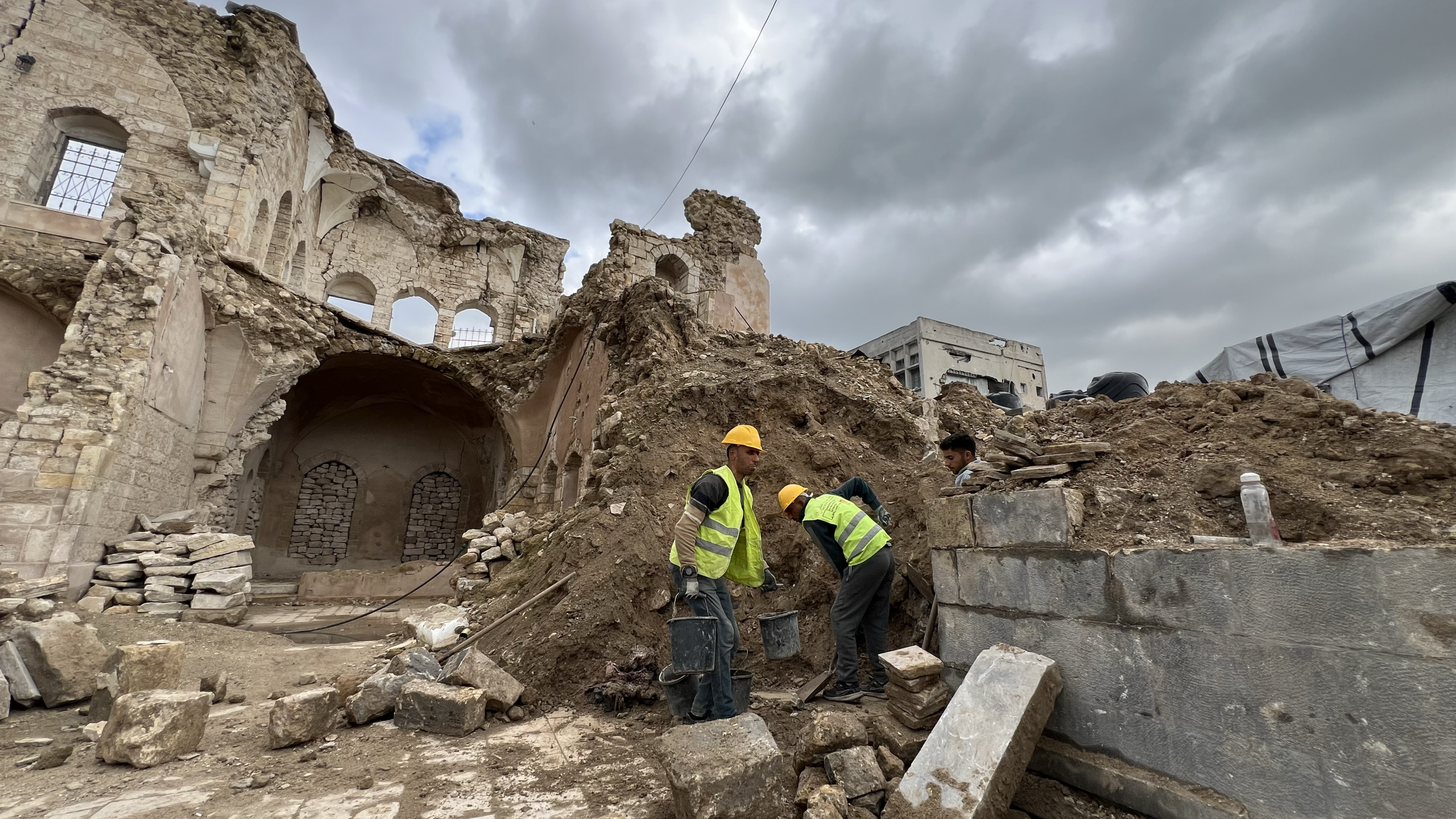
Workers clear rubble as part of the restoration work on Pasha’s Palace in Gaza City. Photo by Ruwaida Amer
The old city of Gaza, once rich in ancient heritage, has been reduced to rubble. Over two years of aggression, the occupation forces targeted more than 300 archaeological sites in an attempt to erase historical memory and obliterate the cultural identity of the Palestinian people.
Among the most prominent examples is the Mamluk Pasha Palace. After destroying the palace through bombing, Israeli occupation forces looted more than 17,000 rare artifacts from the site, according to the palace museum’s director, Nariman Khalla.
Zakaria Al-Hour, Director General of the Ministry of Tourism and Antiquities in Gaza, told BreakThrough News that 316 archaeological sites and buildings were completely or partially destroyed, obliterating religious and cultural values that affirm the authenticity of the Palestinian people. Among the archaeological sites destroyed by Israeli bombing includes the Ottoman-era Al-Shamra Bathhouse, the last of the historical baths in the Gaza Strip. The Church of Saint Porphyrius, the third oldest church in the world, was immensely damaged by Israeli bombing as well.
The remaining minaret of the Great Omari Mosque, the third largest mosque in Palestine, stands as a testament to the scale of the disaster, after the occupation reduced it to rubble and destroyed its historic library.
Targeting heritage is not merely material damage; it is a war crime. The 1954 Hague Convention for the Protection of Cultural Property in the Event of Armed Conflict compels Israel to protect the very heritage sites it has instead destroyed and looted.
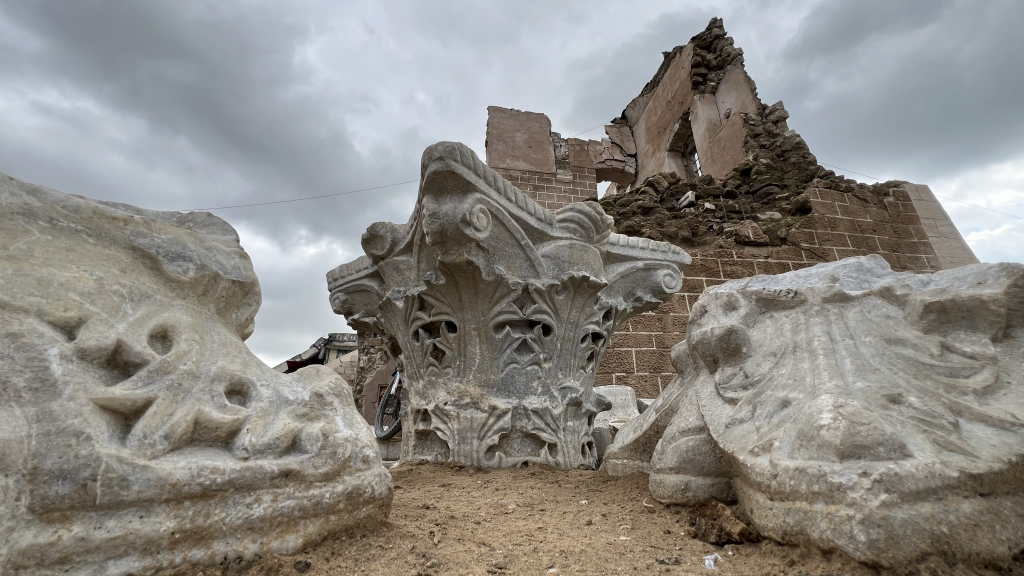
A portion of a destroyed column at Pasha’s Palace in Gaza City. Photo by Ruwaida Amer
The Gaza Strip’s history stretches back thousands of years, having witnessed the rise and fall of Egyptian, Greek, Roman, Byzantine, Canaanite, and Phoenician civilizations, culminating in the Islamic era, which saw the flourishing of the Mamluk and Ottoman periods. These civilizations left behind a diverse architectural and cultural legacy, making Gaza a cultural and historical center that reflects the deep-rooted history and heritage of the Palestinian people.
The majority of archaeological sites are concentrated in the Old City of Gaza, known as the “Old Town,” which dates back to the Phoenician civilization around 1500 BC. It includes the neighborhoods of Shuja’iyya, Zeitoun, Tuffah, and Daraj, areas that have been subjected to extensive aerial and artillery bombardment since the outbreak of the war, particularly in the last two months. The attacks have not been limited to bombing; the Israeli army has also bulldozed numerous archaeological sites and stolen rare artifacts, as happened at the Gaza Antiquities Storage Facility and the Canaanite port of Anthedon.
Local architect Mahmoud Sadiq, 29, shared his grief at the destruction of Pasha’s Palace with BreakThrough News, “I used to visit the archaeological sites before the war. They looked beautiful and had unique details, with many artifacts.”
“But during the war, everything was destroyed. The places became rubble. The sight is very ugly. There was no respect for the places. There was no distinction between archaeological sites, places of worship, and citizens’ homes.”
Using their hands and plastic containers, Palestinian workers are removing sand and crumbling plaster from inside the historic Pasha Palace in Gaza City. About a dozen workers, wearing fluorescent vests, are clearing rubble from around the palace museum. They pile up reusable stones in one heap and unusable rubble in another.
“The Pasha Palace Museum is one of the most prominent sites destroyed during the last war on Gaza City,” said cultural heritage expert and restoration supervisor Hamouda al-Dahdar, noting that more than 70% of the palace buildings were destroyed. Despite being located in the same complex, each building bears a unique history that is part of the story of Gaza. “We are not just talking about one ancient building, but a collection of buildings dating back to different eras,” al-Dahdar noted.
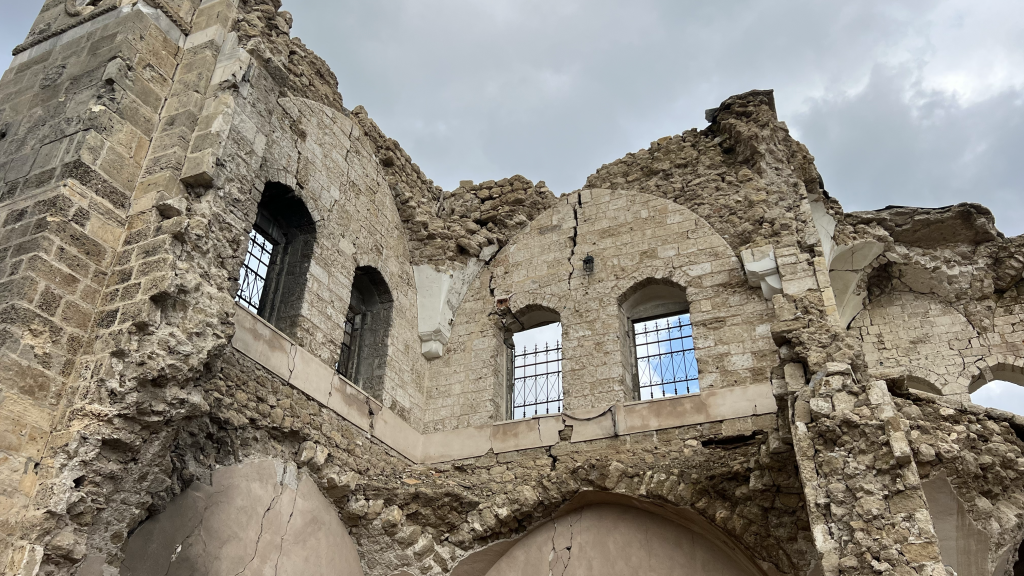
A wall remains standing at the site of Pasha’s Palace, which has suffered heavy Israeli bombing. Photo by Ruwaida Amer
He notes that his team managed to recover 20 artifacts dating back to various Roman, Byzantine, and Islamic periods. “Palestinian cultural heritage is the identity and memory of the Palestinian people.” He added, “We are salvaging the ancient stones in preparation for future restoration work, in addition to rescuing and extracting any artifacts that were displayed inside the palace.
Issam says Juha, director of the Center for Cultural Heritage Preservation, a Bethlehem-based non-profit organization in the occupied West Bank responsible for restoring the palace, says the main problem lies in getting materials into Gaza. “There are no more materials,” Juha adds, “and we are forced to deal with what remains of the rubble, collecting and sorting stones, with very limited intervention to reinforce the site.” Israel tightened its blockade on the Gaza Strip during the two years of war, causing a catastrophic humanitarian crisis and shortages of food and basic necessities in the Palestinian territory. A lack of construction equipment and machinery has now made the possibility of recovery extraordinarily difficult.
Juha says the ceasefire allowed workers to resume excavation work, explaining that, “before, the work was extremely dangerous, as people were threatened by drones that would survey the area and fire.”
Despite the difficulty and the dangers, the reconstruction work on Pasha’s Palace continues as part of the overall effort by Palestinian civil society in Gaza to rebuild in spite of ongoing Israeli bombardment.
BreakThrough News is building the media arm of the movement. We tell the untold stories of resistance from poor and working-class communities — because out of these stories we will construct a different narrative of the world, as it is and in real time.
Think to yourself, is this article something that would be published anywhere other than BreakThrough?
Five mega-corporations dominate the media landscape — controlling 90% of what we read, watch and listen to. People’s movements in every corner of the globe are changing history and shifting consciousness. But these movements barely receive any coverage from the corporate media. They need visibility. They need amplification. They need a media arm to break through.
Working-class people deserve better, we deserve media for and by us. We are not funded by billionaires or corporations – we are funded by you. Without you, BreakThrough would not be possible, so become a member and build the media arm of the movement with us.
To send a check to BreakThrough News, please make it out to BreakThrough / BT Media Inc. and send to 320 W. 37th Street, NY, NY 10018. Donations are tax-deductible in accordance with the law.
Ruwaida Amer is a freelance journalist from Khan Younis.