
Update: On January 20, 2026, the Day 1 Alliance, a trade organization representing GEO Group and CoreCivic, sent BreakThrough News a statement responding to this story. This report has been updated accordingly.
Millions of Americans’ 401(k) retirement funds and mutual funds are invested in immigration detention centers and private prisons with a lengthy track record of human rights violations, without many of the account holders even realizing it.
Mutual funds and exchange-traded funds (ETFs) own shares worth over a billion dollars in market value in GEO Group and CoreCivic, the two biggest private prison companies in the United States, an analysis by BreakThrough News reveals.
The Trump administration’s immigration enforcement crackdown is funneling millions in taxpayer money to these for-profit companies running Immigration and Customs Enforcement detention centers. Advocates and experts are sounding alarm bells over how ordinary Americans are invested in these corporations, often without any awareness.
The stock prices of these companies shot up drastically following Donald Trump’s victory in the 2024 presidential election. GEO Group and CoreCivic’s share prices went up by 66 percent and 62 percent respectively in the week following Trump’s win. Two days after the election, George Zoley, executive chairman of GEO Group, told investors, “This is to us an unprecedented opportunity to assist the federal government and the incoming Trump administration towards achieving a much more aggressive immigration policy”. Zoley said the company was “looking at a theoretical potential doubling” of all of their services, ranging from detention centers to a program monitoring immigrants released from detention.
Both companies have benefited enormously from the immigration enforcement overdrive that followed. There were more than 220,000 ICE arrests in the first nine months of the Trump administration in 2025, according to BreakThrough’s analysis of government data provided in response to a public records request by the Deportation Data Project. “Never in our 42-year company history have we had so much activity and demand for our services as we are seeing right now,” said CoreCivic CEO Damon Hininger during an earnings call with shareholders in May.
Mutual funds and exchange-traded funds (ETFs) own shares worth over a billion dollars in market value in GEO Group and CoreCivic, the two biggest private prison companies in the United States, an analysis by BreakThrough News reveals.
Investigative reports and oversight inspections have documented patterns of medical neglect, abuse, and unsafe conditions in detention facilities run by these companies.
“¡Nos tratan como perros en jaulas! (They treat us like dogs in cages!)” shouted detainees at an ICE processing center in Adelanto, California, during a monitoring visit by a rights group in June.
Speaking to BreakThrough about people being invested in these companies through their mutual funds and 401(k)s, Nora Ahmed, legal director of the American Civil Liberties Union in Louisiana, asked, “Do you want your retirement to have been on the backs of human rights violations and torture?”
As of January 2025, nearly 90 percent of people in ICE custody were held in facilities run by private contractors like GEO Group and CoreCivic, instead of the federal agency itself.
GEO Group and CoreCivic did not respond directly to BreakThrough’s requests for comment. Instead, the Day 1 Alliance, a trade organization for major private prison contractors that has GEO Group and CoreCivic among its member companies, sent BreakThrough a response boasting of “high-quality services at ICE Processing Centers,” including “around-the-clock access to medical care.” The statement also decried BreakThrough’s report as “ideologically-motivated.”
Four people died in ICE custody in the first 10 days of 2026.
A number of popular mutual funds and ETFs, run by the country’s largest asset management companies, are heavily invested in GEO Group and CoreCivic.
As of September 30, the close of the third quarter of 2025, three of the world’s largest investment management companies — Vanguard, BlackRock, and Fidelity — accounted for over half of the total market value in shares of GEO Group and CoreCivic owned by mutual funds and ETFs. Altogether, mutual funds and ETFs across the financial sector held over $1 billion in shares in the two private prison companies.
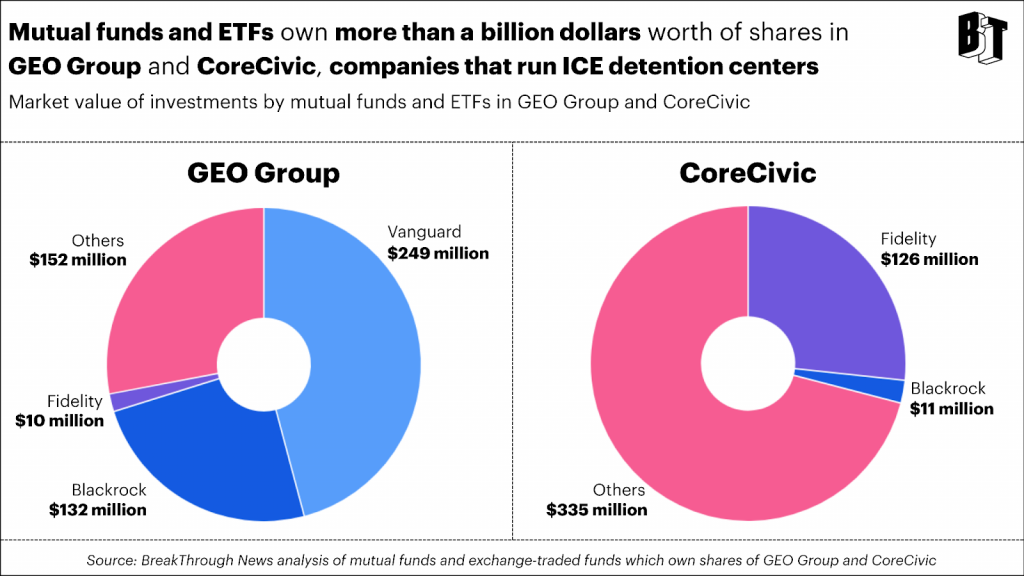
Over a hundred mutual funds and ETFs invested in GEO Group account for 35 million shares of the company, worth $543 million in market value. Close to half that amount is thanks to Vanguard, a leading investment management company whose mutual funds and ETFs own more than 12 million shares of GEO Group, totalling a market value of over $249 million.
Over $132 million in market value of shares invested in GEO Group are by funds and ETFs owned by Blackrock, an asset management company considered to be the world’s largest money manager, with $11.6 trillion in assets under management.
Vanguard, whose funds account for 46 percent of the market value of all mutual funds and ETFs invested in GEO Group, is pegged to be the world’s second largest money manager, with over $10 trillion in assets under management.
Of the $472 million in market value of CoreCivic shares owned by mutual funds and ETFs, $126 million belong to funds managed by Fidelity Investments, the third largest money manager in the world with over $5.5 trillion in assets under management.
“Ultimately, [the companies] are trying to maximize shareholder value,” said Jeff Migliozzi, Communications Director at the non-profit Freedom for Immigrants. “And detention centers are operating under this perverse incentive to maximize profits, which incentivizes these companies to incarcerate as many immigrants and for as long as possible.”
As of September 30, the close of the third quarter of 2025, three of the world’s largest investment management companies — Vanguard, BlackRock, and Fidelity — accounted for over half of the total market value in shares of GEO Group and CoreCivic owned by mutual funds and ETFs.
With protests against ICE and the Trump administration’s immigration enforcement crackdown continuing across the country, the actions of companies that work with the agency and those that invest in them are drawing greater scrutiny.
On Monday afternoon, Letha Wilson-Barnard, a retired pastor in Minneapolis, spoke to BreakThrough in front of the memorial for Renee Nicole Good, at the site where Good’s car had crashed after she was fatally shot by an ICE officer on January 7th.
Wilson-Barnard, who had come to pay her respects to Good, has a retirement fund with Fidelity. When told of the investment of funds managed by Fidelity in CoreCivic, she said, “I didn’t know that. You’re educating me to pay attention, to look and think about what I want to do to disinvest.”
She added that the fund was through her church pension group, and that she would discuss it with them. “This is similar to South Africa, when we were boycotting and paying attention to who was funding the apartheid.”
For many Americans, retirement funds are invested through their employer’s 401(k) default option, a target date retirement fund. These funds typically include a basket of investments that automatically shift from riskier assets to more conservative ones as you get closer to a specific retirement year.
Retirement funds commonly feature index funds — mutual funds or ETFs that track specific market indexes, like the S&P MidCap 400 or Russell 2000, using criteria such as market capitalization. The index funds could invest in all, or a sample of, the securities included in a market index. So, when a company like GEO Group or CoreCivic meets an index’s criteria—for instance, by hitting a certain market capitalization—it could be included in funds tracking that index.
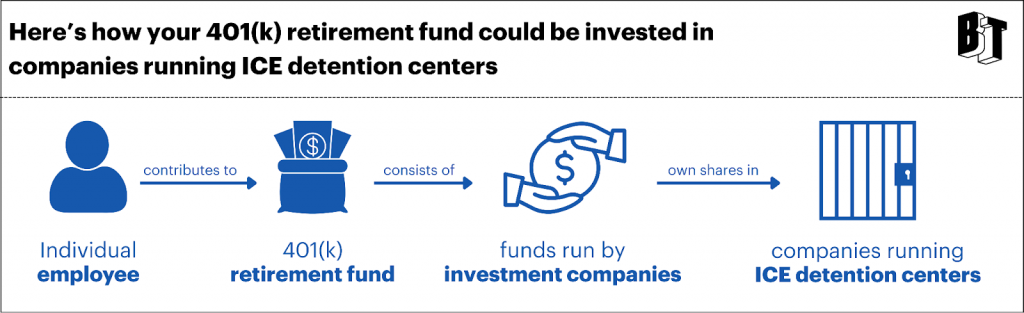
For example, as of September 30, 2025, the Vanguard Target Retirement 2060 Fund has investments in both GEO Group and CoreCivic, according to a tracker by Prison Free Funds that is designed to help individuals figure out if their funds are invested in private prisons.
If an individual is on the Vanguard Target Retirement 2060 fund, they are then indirectly invested in GEO Group and CoreCivic.
Similarly, a participant with a 401(k) fund from BlackRock such as the BlackRock LifePath Index 2045 Fund, will also be exposed to investments in the two private prison operators.
The passive nature of index investing means millions of Americans hold stakes in private prison companies without necessarily actively choosing to do so.
Billions of taxpayer dollars being spent on a massively expanded budget for ICE have triggered significant projected revenues for GEO Group and CoreCivic, with ICE being one of their biggest clients.
Environmental, social, and governance (ESG) funds are designed to offer investors an alternative. ESG ratings agencies have repeatedly flagged GEO Group and CoreCivic as high-risk on social and governance grounds and the companies are frequently excluded from ESG-screened funds, allowing investors to align their retirement savings with their values. But the space has also come under heavy political fire. Since 2021, at least 52 state-level anti-ESG laws have been enacted in 21 states, including 11 new bills in 2025 alone, according to a report by Pleiades Strategy, a research and advisory firm. Over the last few years, activist shareholders have also successfully pressured major institutional investors to divest from industries deemed ethically problematic, from fossil fuel companies accelerating climate change to manufacturers of civilian firearms.
Republican officials and conservative groups often brand it “woke” investing, and the resulting scrutiny has made some larger firms skeptical of using the ESG label. For example, due to the backlash against ESG, BlackRock went from starting 36 new ESG funds in 2022, to launching 23 in 2023 and only 4 in 2024.
The private prison industry has faced similar scrutiny, and in August 2019, in the wake of the #FamiliesBelongTogether coalition, eight banks committed to ending their ties with CoreCivic and GEO Group. Public pension funds in California and New York also formally divested from the two private prison operators. In 2017, then New York City Comptroller Scott Stringer cited the reported incidents of alleged human rights abuse as posing long-term reputational and financial harm.
“Our capitalistic system operates by virtue of what people are willing or not willing to call out,” Ahmed of the ACLU said.
Trump’s immigration enforcement crackdown has resulted in a windfall for GEO Group and CoreCivic, which are now flush with profits thanks to taxpayer-funded government contracts for more ICE detention centers.
In 2025, Congress gave ICE $75 billion over four years, approximately $18.7 billion each year. According to a report by the Brennan Center for Justice at NYU School of Law, this funding added to the $10 billion Congress already appropriated ICE for fiscal year 2025 in March. ICE’s cumulative budget of $28.7 billion in FY25 was nearly triple the agency’s entire budget for FY24.
Two-thirds of ICE’s funding – $45 billion over four years – will reportedly be used to detain immigrants, potentially more than 100,000 people per year. The $11.25 billion added to ICE’s annual detention budget is a 400 percent increase from last year.
Billions of taxpayer dollars being spent on a massively expanded budget for ICE have triggered significant projected revenues for GEO Group and CoreCivic, with ICE being one of their biggest clients.
Both GEO Group and CoreCivic state that they treat people in custody with dignity, provide extensive services, and rigorously follow all government standards. But inside the detention centers, the reality has been far darker, according to inspectors, watchdog groups, and detainees themselves.
ICE contracts accounted for 29 percent of CoreCivic’s revenue in 2024 and in the third quarter of 2025, revenue from ICE increased by $76.2 million, or 55 percent from the same period the previous year. “Our business is perfectly aligned with the demands of this moment,” CoreCivic CEO Hininger told investors in an earnings call in August.
GEO Group also benefits immensely from the administration’s deportation efforts. The company secured new contracts to house ICE detainees across five facilities, both company-owned and joint state-owned, totaling around 9,000 new beds to be filled. In total, these new ICE contracts are expected to generate more than $300 million annually once they reach full occupancy.
Reporting the first quarter results in May, Zoley, executive chairman of GEO Group, said, “We believe we have an unprecedented opportunity to assist the federal government in meeting its expanded immigration enforcement priorities.”
“Perverse financial incentives are the bedrock of incarceration,” said Stacy Suh, the program director at Detention Watch Network, an immigrants’ rights coalition. “The revenue and growth there is made on the destruction of human lives, tearing apart families, as directed by the Trump administration.”
In CoreCivic’s November earnings call, CEO Hininger told investors that the company’s detention beds “are the most humane,” and have the “highest audit compliance scores in their system.”
Both GEO Group and CoreCivic state that they treat people in custody with dignity, provide extensive services, and rigorously follow all government standards.
But inside the detention centers, the reality has been far darker, according to inspectors, watchdog groups, and detainees themselves.
Pregnant women denied emergency room visits, detainees forced to work for $1 a day to access basic toiletries, and a lack of adequate food and water — these are just some of the reported conditions in facilities operated by CoreCivic and GEO Group.
In one case brought by seven people detained in CoreCivic’s California City Detention Facility, an insulin-dependent diabetic man has been regularly denied doses of insulin, leading to elevated blood sugar levels and a large ulcer on the bottom of his foot, for which he has also been denied proper care. He has been “forced to cover [his foot wound] with soiled bandages and bloody shoes” and is worried that “his foot will require amputation in the absence of the medical care he needs.”
‘When there is a profit mechanism in place, there is every incentive to save money by failing to provide adequate care to people who are in their custody.’
For Migliozzi, the communications director at Freedom for Immigrants, stories like this are the norm.
“These abuses that are happening inside detention are not bugs in the system,” he told BreakThrough News. “These are actually features of the immigration detention system, which is very much designed in a way to make people so miserable…that they will actually give up on their cases and elect to ‘self-deport’ before they can have their day in court.”
Eunice Cho, senior staff attorney at the ACLU’s National Prison Project and a lead author of the report ‘Deadly Failures: Preventable Deaths in U.S. Immigrant Detention’, said her team reviewed government records and medical files for more than 50 people who died in ICE custody.
“Some detainees have never actually even been seen by a licensed medical doctor in their whole time that they were at the facility, even with very concerning and emergent symptoms,” Cho told BreakThrough News.
Her report documented immigrants in acute distress while in ICE detention. Cost-cutting and the profit motive in for-profit detention facilities directly translate to substandard care, she argued.
It is such conditions at detention facilities run by GEO Group and CoreCivic that have made advocates push for greater awareness about how ordinary Americans are invested in these companies.
“Private prison companies are accountable at the end of the day to the bottom line to their shareholders and maximizing profit off of caging people in detention facilities.” Cho said. “When there is a profit mechanism in place, there is every incentive to save money by failing to provide adequate care to people who are in their custody.”

“This is similar to South Africa, when we were boycotting and paying attention to who was funding the apartheid,” said Letha Wilson-Barnard, a retired pastor in Minneapolis, speaking to BreakThrough in front of the memorial for Renee Nicole Good. Photo: Meghnad Bose
GEO Group’s annual report acknowledges that “our business may face increased scrutiny related to our human rights and ESG activities,” and that their “reputation could be adversely impacted”, which could adversely affect their business and financial condition. Negative publicity also poses a business risk, including about an “escape, riot, other disturbance, pandemic outbreak, death or injury of a detainee, or perceived conditions and access to health care.”
CoreCivic’s annual report in 2024 said that “activist resistance to the use of public-private partnerships could impact our ability to obtain financing,” a risk that could materially hurt their business.
Under securities law in the United States, companies must disclose information of material significance to investors, meaning information a reasonable investor would consider important when making investment decisions.
“The SEC (Securities and Exchange Commission) mandate and the scope of securities laws is about protecting investors and the capital markets, not about protecting the world at large,” said Jill Fisch, a business law professor at the University of Pennsylvania.
As a result, legal experts question whether company disclosures tell the full story, when it comes to issues like the reality of conditions at immigration detention centers. Ahmed, of ACLU Louisiana, argued that the gap between what detainees report experiencing and what appears in SEC filings should trigger greater regulatory scrutiny.
“Once you start hearing what individuals within detention say about medical care and you look at the disclosures, there is a requirement for an investigation by regulators who are charged with monitoring companies that trade on the New York Stock Exchange,” Ahmed said. “Investors are relying on the fact that they’re investing in companies that are not engaged in unlawful human rights abuses.”
As protests swell across the U.S. in response to the ICE killings of Renee Nicole Good in Minneapolis and Keith Porter in Los Angeles, more 401(k) and mutual fund holders may look to divesting from private companies critical to ICE’s operations.
For investors who wish to avoid being invested in private prisons, directly or indirectly, the first step is finding out the details of their mutual funds, ETFs, and 401(k).
“You’re three clicks away from knowing where your money is going,” said Ahmed.
401(k) participants can login to their retirement account to view their fund holdings online and search for ticker symbols CXW (CoreCivic) and GEO (GEO Group).
Resources like Prison Free Funds can also be used to quickly give investors insight into what mutual funds, ETFs, and retirement funds their portfolio may hold. Investors can search for their retirement fund or mutual funds by name on the Prison Free Funds database, and see whether those funds are flagged for being invested in the private prison industry. For instance, on searching for the Vanguard Target Retirement 2060 Fund on the database, one can see that the fund is invested in private prison companies including both GEO Group and CoreCivic.
‘Investors are relying on the fact that they’re investing in companies that are not engaged in unlawful human rights abuses.’
“Everyone should be aware of what their money is supporting, and understand ways in which that investment is aligned or not with their values,” said Nadira Narine, who leads human rights initiatives at the Interfaith Center on Corporate Responsibility (ICCR), a coalition of faith-based and socially responsible investors.
She suggested asking plan administrators whether any “prison-free” or socially screened funds are available in the 401(k) lineup. “They can engage with their plan provider and ask questions about where their money is invested. There may also be screened funds that don’t include private prisons. Asking questions matters, and being clear that you want your participation in a fund to reflect your values matters.”
Narine, Ahmed and other experts enumerated various options available for those who do not wish to continue being invested in companies running immigration detention centers.
Investors seeking alternatives can ask their employers to offer retirement fund options that exclude private prisons.
Investors can also write to regulators like the SEC or state attorneys general, expressing concern about the companies’ disclosures and requesting investigations.
Investors can also visit sites like WhaleWisdom for a list of all mutual funds and ETFs with shares in GEO Group and CoreCivic, and check if any of the funds they are invested in appear on those lists.
“Money is not only power, money is speech,” said Ahmed. “We don’t just speak when we vote for elected officials, we very much speak when we put our money in certain places.”
Calling on asset management firms to disinvest from private prison companies that run immigration detention centers, Wilson-Barnard, the retired pastor, said, “It’s a moral issue.”
BreakThrough News is building the media arm of the movement. We tell the untold stories of resistance from poor and working-class communities — because out of these stories we will construct a different narrative of the world, as it is and in real time.
Think to yourself, is this article something that would be published anywhere other than BreakThrough?
Five mega-corporations dominate the media landscape — controlling 90% of what we read, watch and listen to. People’s movements in every corner of the globe are changing history and shifting consciousness. But these movements barely receive any coverage from the corporate media. They need visibility. They need amplification. They need a media arm to break through.
Working-class people deserve better, we deserve media for and by us. We are not funded by billionaires or corporations – we are funded by you. Without you, BreakThrough would not be possible, so become a member and build the media arm of the movement with us.
To send a check to BreakThrough News, please make it out to BreakThrough / BT Media Inc. and send to 320 W. 37th Street, NY, NY 10018. Donations are tax-deductible in accordance with the law.