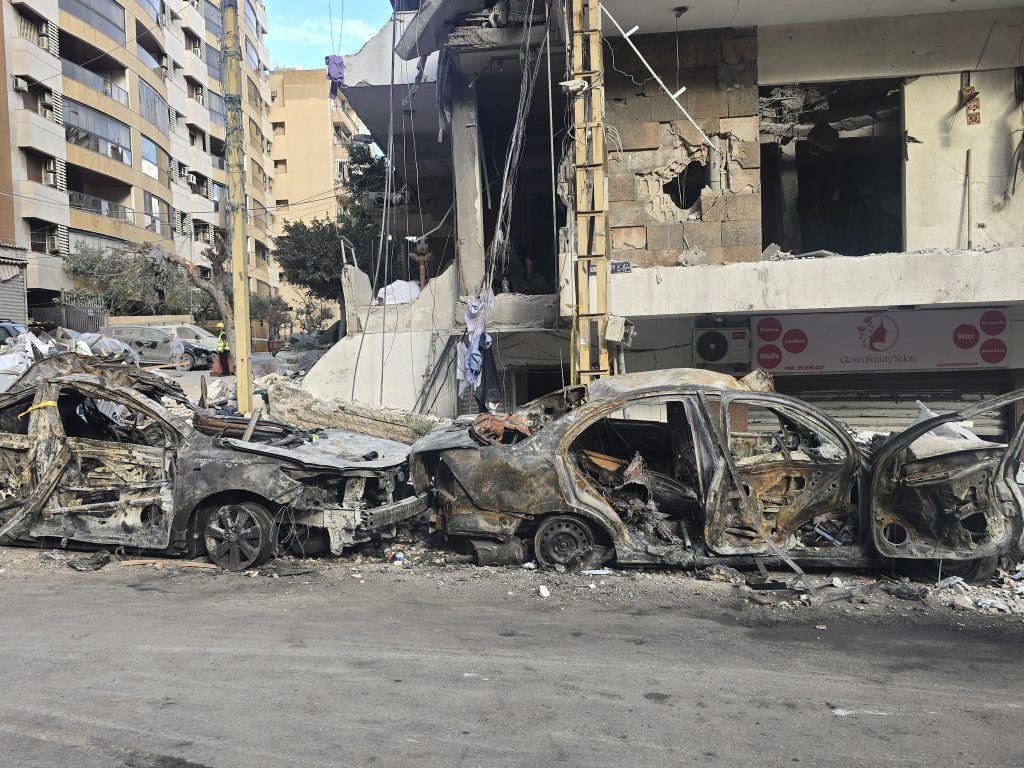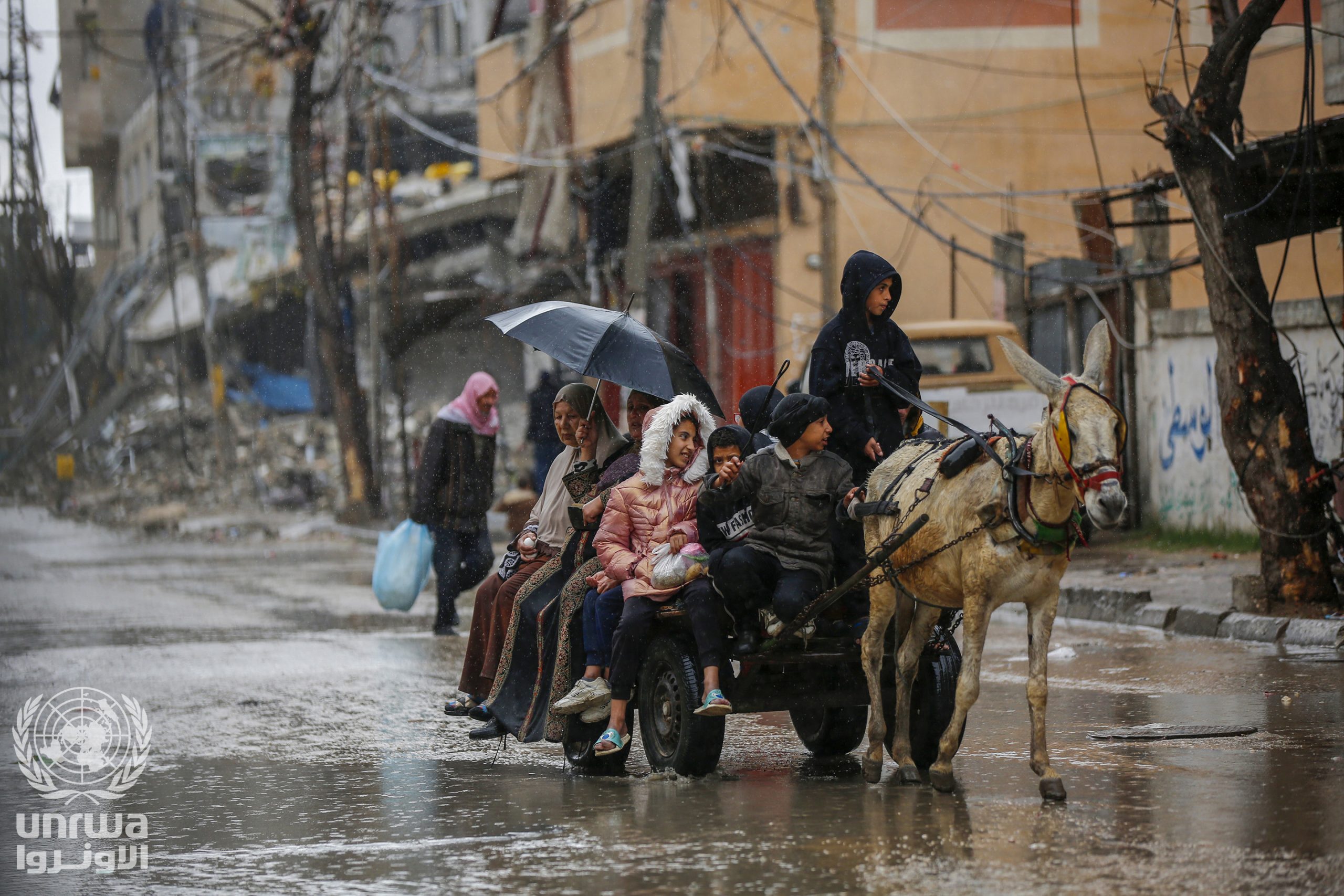
Displaced Palestinians continue to return to their homes destroyed by Israeli airstrike in Nuseirat Camp, Gaza Strip. © 2025 UNRWA Photo by Ashraf Amra
As of July 23, 2025, over 85% of Gaza’s population is now in the fifth stage of famine, the final classification of hunger before death. That means more than 1.8 million people are dying of starvation in real time. According to the World Health Organization (WHO) and the UN, this is one of the most advanced man-made famines in modern history. Doctors have reported that “skin and bones” is no longer an adequate description. Infants are dying in front of their mothers, and there is no formula to feed them. Aid workers have described children with “blank stares,” whose organs are beginning to fail.
But this manufactured famine did not emerge in a vacuum. It is the culmination of a 77-year system designed to transform a self-sufficient agricultural society into an aid-dependent population stripped of dignity and agency. To understand Gaza’s current starvation, we must trace the institutional history of how humanitarian aid itself became a weapon of control.
The United Nations Relief and Works Agency for Palestine Refugees, established in 1949, just one year after the Nakba, was not created to address the root cause of Palestinian dispossession, but to manage its consequences.
Before 1948, Palestine was a thriving agricultural economy and net exporter of citrus, with renowned soap production and glass manufacturing contributing millions to the region’s GDP. Palestinian farmers were stewards of their own land, labor, and economically self-sufficient and politically autonomous.
The Nakba changed everything. The expulsion of over 750,000 Palestinians from their homes resulted in economic transformation in addition to displacement. The mass expulsion resulted in a 40% loss of Palestinian industrial establishment and 55% loss of agricultural land. By 1950, this once self-sufficient society had been reduced to depending on United Nations Relief and Works Agency (UNRWA) food rations.
The United Nations Relief and Works Agency for Palestine Refugees, established in 1949, just one year after the Nakba, was not created to address the root cause of Palestinian dispossession, but to manage its consequences. The tent that once sheltered the displaced became permanent, and with it emerged a logic that continues today: survival without sovereignty, sustenance without self-determination. Over the decades, UNRWA’s largest donors, primarily the United States and European Union, were also the primary financial backers of Israel’s military expansion, effectively funding both the displacement and its management.
Instead of supporting pathways to return, UNRWA invested in building semi-permanent infrastructure like schools and clinics in camps, reinforcing a model of indefinite displacement rather than supporting a right of return. In Lebanon, for instance, there are 12 UNRWA camps. Palestinians in refugee camps do not hold a Palestinian passport and are still unable to return home; yet, inside these camps, they still carry the spirit of Palestine.
What began with the Nakba was systematized with Gaza’s blockade in 2007. Israel and its allies perfected their calculus of control: tighten the siege, fragment the economy, erase autonomy, and then point to the empty hand of the Palestinian and call it reliance.
A new economy has emerged in Gaza, but it trades not in supply and demand, nor in production or capital. It trades in suffering.
The absurdity of this cruelty was perhaps best exemplified by the prohibition of chocolate imports into Gaza, a ban serving no “security purpose” but to deny Palestinians the simplest joy. This policy, among others, epitomized the pattern of denying dignity where basics become luxuries.
Gaza’s GDP declined by 27% since 1994 due to multiple Israeli invasions. Exports were reduced to less than 15% of pre-2007 levels. By 2023, 64% of the population faced food insecurity and 80% received aid in some form. Today, those numbers had reached 60-70% loss of industrial and agricultural capacity respectively, at the time of the March ceasefire. Now, since Israel resumed its genocide, these figures are presumably closer to 100%.
In 2012, Israeli officials openly admitted to calculating the precise number of calories needed to keep Gazans alive but not thriving. After the 2014 military assault, Israel tightened the blockade further by banning cement, steel, and other essential building materials, deliberately halting reconstruction and leaving entire neighborhoods in ruin as extended punishment. Then, though on a smaller and less murderous scale than today’s starvation campaign, aid was similarly used as a tool of control, limiting the Palestinian right to dignity and self-determination.
The dependency wasn’t just economic, it was psychological. By 2019, 60% of Palestinian students in Gaza reported feeling hopeless about their futures, citing the aid-dependent economy and siege as factors. The international aid system inadvertently created ‘learned helplessness’, a sense of powerlessness arising from persistent trauma and lack of control over basic needs.
In the past, international law spoke of aid as a right. Today it continues to be an instrument of subjugation for Palestinians.
In my research study, published in the UCLA Journal of Islamic and Near Eastern Law, I argue this apparatus of aid has effectively redefined the concept of humanitarian access. No longer a right owed to populations in crisis, access is now conditioned on the very structures causing the crisis.
Looking at the current suffocation of Gaza’s “aid” structures, Israel has killed more Palestinians seeking aid than Israelis that were killed on October 7, 2023. Israeli forces have repeatedly fired on Palestinians gathered at aid distribution points, killing thousands. Death by “aid” goes back to the start of this genocide, including during the Flour Massacre in February 2024, when Israeli forces opened fire on civilians lining up for bread, killing over 100 and injuring hundreds more. On April, 21 more were killed at Kuwait Roundabout under nearly identical circumstances. Humanitarian corridors have become sites of mass execution, with a Human Rights Watch Report confirming that aid convoys are frequently delayed, denied entry, or weaponized as bait. In a startling image, early Gaza Humanitarian Fund (GHF) sites showed Palestinians corralled like livestock. A new economy has emerged in Gaza, but it trades not in supply and demand, nor in production or capital. It trades in suffering. There are checkpoints that function less like gates and more like guillotines, deciding who eats and who doesn’t.
More than 800 Palestinians have been killed by Israeli forces while attempting to receive humanitarian aid in the last month. Since May, the GHF, backed by U.S. and Israeli governments and implemented by private military-style contractors, has centralized aid into a handful of militarized, time-limited hubs, forcing Gazans into evacuation zones and forcing many to choose between life or dying hungry. The mobilization of this deadly aid is purposeful: Israel has systematically targeted independent aid agencies, bombed convoys, and destroyed UNRWA facilities. It has even attempted to link UNRWA to Hamas, in an effort to delegitimize one of the last remaining aid lifelines and justify its campaign of dismantling humanitarian infrastructure. With other channels crippled, GHF has emerged as the only operator through which aid can flow into Gaza. Agencies, including UNRWA, MSF, UNICEF, and the ICRC, have denounced the system as a weaponized, politically controlled mechanism—“slaughter masquerading as aid”. Thus, aid becomes a central tool of colonial violence, and of the reconfiguration of humanitarianism itself.
In the past, international law spoke of aid as a right. Today it continues to be an instrument of subjugation for Palestinians. The latest figures show more than 55,000 Palestinians have been killed in Gaza since the war began, including over 17,000 children, a generation turned into memory before they had time to become themselves. Many babies have died in incubators due to fuel shortages, lack of electricity, and the destruction of neonatal wards. A recent report by UN officials notes that almost all the people in Gaza face catastrophic food insecurity. Some eat leaves, others go days without.
Palestinians are made to feel ashamed for wanting life on their own terms. We do not want pity. We do not want sympathy. We want liberation.
Through the GHF, the Israeli government has seized control of all aid entering Gaza, and now uses that power to massacre Palestinians. The message behind the trigger is clear: aid will be delivered through Israel, controlled by Israel, and denied by Israel whenever it suits them. And when the day comes for a ceasefire or “reconstruction,” it will be used as leverage: to force Palestinians out, to fragment the social fabric further, to turn the right to return into a distant rumor.
For instance, Israel’s leadership has proposed creating a “humanitarian city” near Rafah, designed to house up to 600,000 Palestinians, effectively relocating Gaza’s population into a military-controlled zone under the guise of aid. The plan amounts to forced displacement and internment: many warn it echoes concentration-camp logic. The violence of starvation is not a means of ending war, it is a way to reduce the Palestinian population so much that more Palestinian land will be up for the taking. Israel has already taken control over 80% of the Gaza strip.
The law, which once sought to uphold dignity, is now used to ration it. And dignity, the one thing our people have never surrendered, has been rebranded as resistance. But it is not resistance to want food. It is not resistance to say: I deserve to live. Palestinians are made to feel ashamed for wanting life on their own terms. We do not want pity. We do not want sympathy. We want liberation. And in its absence, we want the world to stop pretending that starvation is a substitute for justice.
There is a story told by every aid truck. It is not one of generosity, but of dependency imposed. It says: you will eat what we allow. You will thank us for your crumbs. You will survive, but only if you forget who made you starve. But our people do not forget. Palestinians in Gaza endure, not because they are strong, but because they have no choice. And because somewhere, beyond the siege, beyond the silence, beyond even the sea, there is a future where our children eat not from the hands of their jailers, but from the harvest of their own land.
Ghassan Kanafani said, “everything in this world can be stolen except one thing: the love that emanates from a human being committed to a conviction or cause”. That is what the Palestinians carry. That is the dignity that cannot be occupied.
BreakThrough News is building the media arm of the movement. We tell the untold stories of resistance from poor and working-class communities — because out of these stories we will construct a different narrative of the world, as it is and in real time.
Think to yourself, is this article something that would be published anywhere other than BreakThrough?
Five mega-corporations dominate the media landscape — controlling 90% of what we read, watch and listen to. People’s movements in every corner of the globe are changing history and shifting consciousness. But these movements barely receive any coverage from the corporate media. They need visibility. They need amplification. They need a media arm to break through.
Working-class people deserve better, we deserve media for and by us. We are not funded by billionaires or corporations – we are funded by you. Without you, BreakThrough would not be possible, so become a member and build the media arm of the movement with us.
To send a check to BreakThrough News, please make it out to BreakThrough / BT Media Inc. and send to 320 W. 37th Street, NY, NY 10018. Donations are tax-deductible in accordance with the law.
Ahmad Ibsais is a Palestinian immigrant and first-generation law student using his words to advance the cause of his people. Ahmad has extensively published opinion pieces, poetry, and, now, has forthcoming legal scholarship centered on international human rights and Palestine. Ahmad also runs his own substack, State of Siege.