Palestine’s Statehood Moment: Can the UN Stop the Genocide and Save Itself?
From doctors to journalists, and from children to mothers, Israel’s imposed famine spares no one in Gaza.
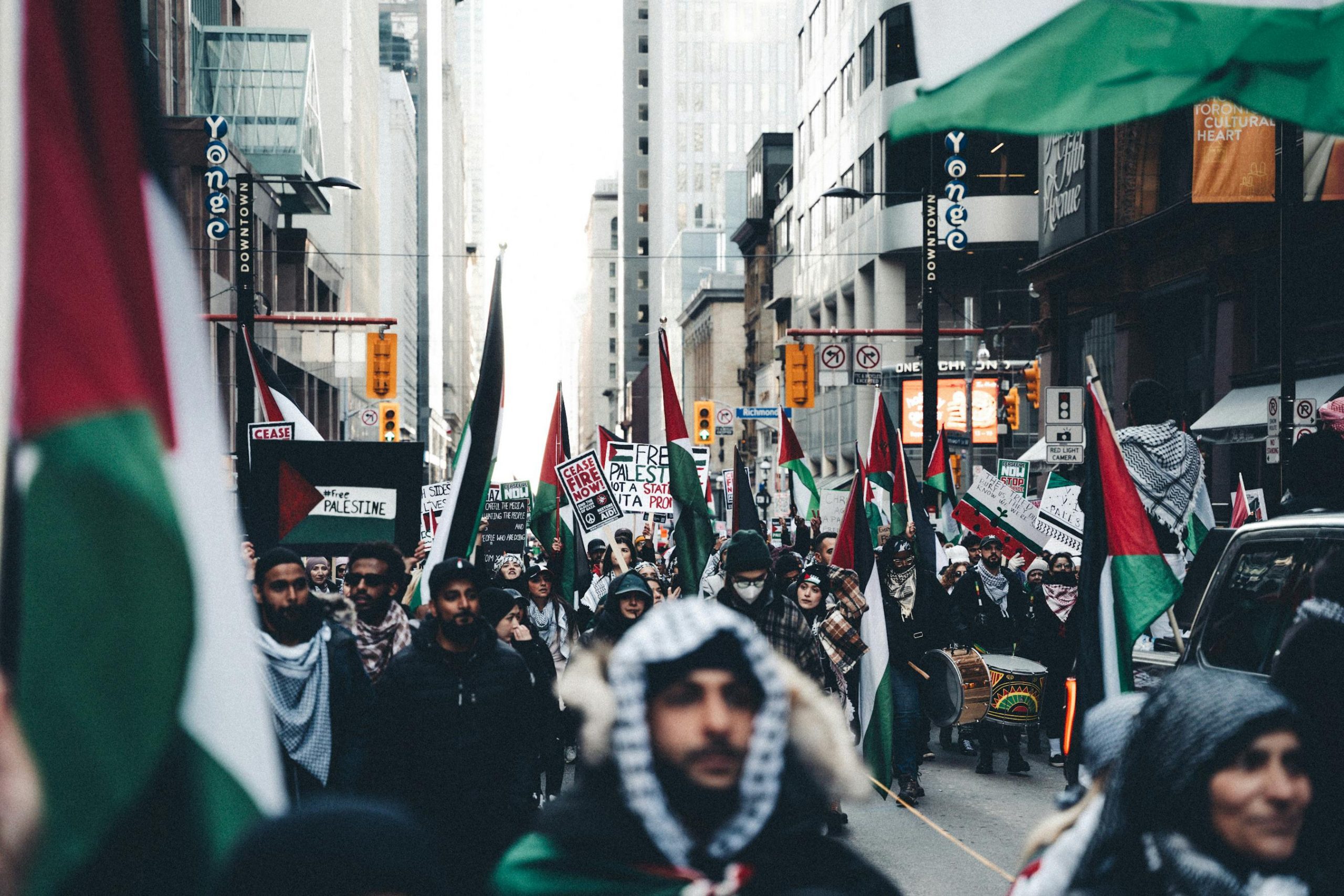
Protesters with Palestinian flags in Toronto. Photo by Mohammed Abubakr
This year’s United Nations General Assembly (UNGA) has officially begun in New York during a time of growing global criticism of the UN after nearly two years of accelerating genocide in Gaza.
Palestine had already emerged as the gathering’s most pressing issue in the weeks leading up to the UNGA, as Western nations, such as Belgium, France, and the UK, announced plans to recognize a Palestinian state.
This wave of recognition follows the New York Declaration, a resolution proposed by Saudi Arabia and France at the High-Level International Conference in July. The resolution calls for a two-state solution, an end to the war in Gaza, and demands that Hamas relinquish its power in the Gaza Strip.
One of the first agendas presented to world leaders at the UNGA was an official vote on the New York Declaration, where an overwhelming majority of states endorsed the resolution, with only 10 states opposed (including Israel and the US), and 12 abstentions. The UNGA resumed this conference On Monday, September 22, where six additional states declared their recognition of a Palestinian state—marking a watershed moment in Palestine’s history with the UN.
One of the first agendas presented to world leaders at the UNGA was an official vote on the New York Declaration, where an overwhelming majority of states endorsed the resolution, with only 10 states opposed (including Israel and the US), and 12 abstentions. The UNGA resumed this conference On Monday, September 22, where six additional states declared their recognition of a Palestinian state—marking a watershed moment in Palestine’s history with the UN. Hamas has called the UN vote “a welcomed step,” a point echoed by all the main factions and institutions of Palestinian politics, from the PFLP to the PLO.
In keeping with its prior conduct at the UN, the US once again wielded its permanent Security Council seat to veto a September 18 draft resolution demanding an “immediate, unconditional, and permanent ceasefire” in Gaza, along with an end to Israel’s blockade against aid entering the Strip.
Shahd Hammouri, a lecturer in Law and Legal Theory at the University of Kent, warned that the focus on Palestinian statehood could be used to “take the attention away from what really matter now – and this is ending the genocide. This can only happen through serious commitments to arms and energy embargo, as well as the deployment of protective presence.” Hammouri warns that any form of statehood that does not “respect the will of the Palestinian people” instead “paves the way for a police state in absence of the basic tenets of self-determination.”
Despite its shortcomings, Professor Akram also noted that recognition still carries weight.“Individual state recognition of Palestine is very significant as it both creates new obligations on states recognizing Palestine, as well as opens up a range of actions those states can be pushed to take with regard to Israel. Statehood recognition by more countries is a necessary, though not sufficient, step towards a series of others to ensure Palestinian self-determination and independence.”
Indeed, the reactions of the US government demonstrated displeasure with the move to recognition. In keeping with its prior conduct at the UN, the US once again wielded its permanent Security Council seat to veto a September 18 draft resolution demanding an “immediate, unconditional, and permanent ceasefire” in Gaza, along with an end to Israel’s blockade against aid entering the Strip. The US also blocked the Palestinian UN Delegation from receiving visas, forcing President Mahmoud Abbas to participate in the UNGA remotely.
In his speech last Monday, Abbas welcomed the endorsement of the New York Declaration. Abbas, a fierce opponent of armed resistance and Hamas, has clung to power in the PA without a democratic mandate from the Palestinian people for years. Having recognized Israel under the Oslo Agreement, the PA’s collaboration with the occupation and its corruption have made it incredibly unpopular among Palestinians,
We’re marching to demand the arrest of Benjamin Netanyahu. He is a war criminal with an ICC warrant out for his arrest, yet the U.S. government and the political establishment of New York City allow him to travel freely through our streets to address the UNGA.
Support for the PA has become a UN norm, but has been couched in more frequent condemnations of Hamas. Professor Akram calls this hypocritical. “The excessive focus on condemning Hamas and committing to preventing Hamas from being part of a future Palestinian government fails to recognize that Hamas was elected by the Palestinian people in 2006, and that Palestinians in their own state are free to choose their representation,” she said. “Nor does the Declaration give equal condemnation to a genocidal Israeli government and to the urgency of dismantling the apartheid laws and policies that have legalized Israel’s trajectory to the genocide and ethnic cleansing of Palestinians we are witnessing today.”
As Palestinians face bans and condemnation, Netanyahu is set to speak at the UNGA on Friday, September 26. The New York City chapter of the Palestinian Youth Movement (PYM), a transnational, independent, grassroots movement working towards Palestinian liberation, has organized a protest at 9 AM in Times Square during Netanyahu’s speech. PYM’s demands include sanctions on Israel and an end to the genocide.
PYM activist Nasreen Abd Elal told BreakThrough News about the importance of protesting Netanyahu’s speech. “We’ll be taking to the streets to show the people of Gaza that we have not forgotten them, and to tell the leaders of the world’s nations that they cannot meet in our city without facing this movement against global complicity with Israel’s genocide. We’re marching to demand the arrest of Benjamin Netanyahu. He is a war criminal with an ICC warrant out for his arrest, yet the U.S. government and the political establishment of New York City allow him to travel freely through our streets to address the UNGA.”
Abd Elal says PYM’s demands go beyond formal recognition, “We won’t accept scraps while Palestinians are dying under Israeli bombs and starving under Israeli siege. The demands of our movement are clear and practical: states must enact a comprehensive arms, trade, and energy embargo against Israel, and prosecute war criminals that enter their territory.”
The demands of our movement are clear and practical: states must enact a comprehensive arms, trade, and energy embargo against Israel, and prosecute war criminals that enter their territory.
Also set to occur on the 26th of September is a ministerial meeting held by the Hague Group, an organization of eight nations united in “coordinated legal and diplomatic measures” against Israel’s violations of international law. The gathering, which plans to “present collective and coordinated measures being implemented at national and international levels,” will take place during Netanyahu’s speech.
This meeting has been scheduled due to Israel’s failure to comply with a UN resolution adopted at last year’s General Assembly. The proposal maintained that Israel must end its illegal occupation of Palestine within a year, and failure to do so would result in collective measures. The 2024 resolution’s one-year deadline coincides with this year’s UNGA.
Professor Hammouri weighed in on the credibility of the 2024 resolution. “These resolutions are a step forward – but they are nothing in the absence of political will…The 2024 resolution did almost nothing, and its words were open to interpretation. The weakness of those responses is so severe that it risks the legitimacy of the whole international legal system.”
As the gears of international action turn slowly at the UN, Israel continues its brutal campaign of genocide, repression, and land theft in Gaza and the West Bank.
Abd Elal said efforts must continue “to organize a people’s arms embargo from below, by targeting companies, pension funds, and elected officials that enable or profit from the Gaza genocide. The PYM, for instance, has spent the past year organizing a transnational campaign against the shipping and logistics giant Maersk that has been delivering weapons to Israel throughout the genocide.”
Though comprehensive action by states to stop the genocide remains uncertain, Abd Elal is undeterred. “Grassroots movements…are essential to building the political will and popular pressure that can move state officials to action,” she said. “Though we’re facing down the U.S.’s powerful war establishment, our sustained anti-genocide campaigns can increase the political, economic, and reputational costs of enabling war crimes and ethnic cleansing.”