China responds to the blacklisting of major companies by adding 10 US firms to its export ban list
The repeated use of national security measures against hundreds of its major companies has been objected to by the Chinese as economic warfare, the suppression of its legitimate economic interests, and destabilizing to global supply chains.
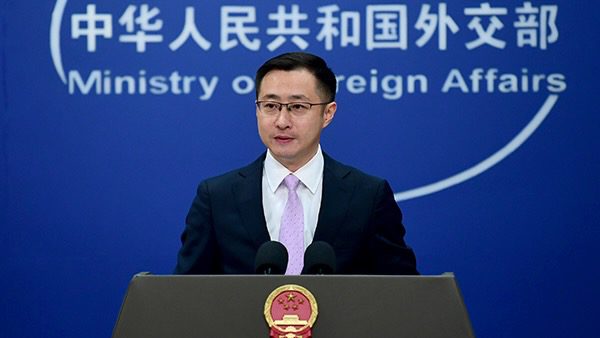
Foreign ministry spokesperson Lin Jian's regular press conference on June 17, 2026. Photo: MFA China
The Chinese Ministry of Commerce announced on Monday, June 22, its decision to put 10 US companies on its export control list, following the US government’s “wrongful act” of blacklisting major Chinese firms.
According to the Commerce Ministry, the move aligned with China’s export control law, as well as regulations on the export of dual use items.
“The measure was taken to safeguard national security and interests, and fulfil international obligations such as non-proliferation,” the ministry stated.
Among the 10 US entities on the export ban list, most are related to weapons manufacturing and technology sectors. It includes motor manufacturer Aveox Inc, rare earth mine operator MP Materials Corp, drone manufacturer Teal Drones, robotics firm Jaia Robotics, and others.
The order bars the Chinese companies from exporting any material of Chinese origin to these entities. It also bars companies in third countries from exporting any Chinese material to these entities in the future, apart from halting all ongoing contracts to do so.
In a related order, the Chinese Ministry of Finance barred all government procurement from 46 other US companies, including subsidiaries of weapon manufacturing giants such as Lockheed Martin, Raytheon, and Boeing.
Retaliation to US actions
In early June, the US had announced adding around 80 Chinese companies, some of them quite well known and among the largest in their respective sectors, such as the electronic car maker BYD, e-commerce giant Alibaba and search engine Baidu, in a black list called “entities identified as Chinese military companies operating in the US.”
The US officials alleged that these companies have direct links with China’s People’s Liberation Army (PLA) and pose a threat to national security.
China had objected to the move, calling it discriminatory and demanded the US end the repeated suppression of its legitimate business interests in the name of national security.
Last week it was reported in the media that the Trump administration had decided to add more than 100 Chinese companies, including the AI startup DeepSeek and memory chip maker CXMT, to its restrictive entity list.
Similar accusations of these companies having collaborations with the Chinese military were cited as reasons.
If a company is put on the entity list no US entity can sell goods, software, or technology to it without a prior license to do so. Such license requests are often denied.
No end in sight to Trump’s trade war
Reuters had reported however, citing some unnamed US officials, that the Trump administration refrained from putting these 100 companies on the entity list at the last moment, in an attempt to avoid further escalation in the ongoing trade war with China.
Responding to it, Lin Jian, official spokesperson of the Chinese Ministry of External Affairs reiterated during a regular press conference on Wednesday that, “the US should stop politicizing, instrumentalizing and weaponizing trade and tech issues.”
“China consistently opposes the US overstretching the concept of national security, abusing its entities list and other export controls, and suppressing Chinese enterprises,” Lin further added.
Monday’s Chinese retaliation is widely considered symbolic too. Most of the companies in the export ban list or procurement ban list have very little or no business with China, according to an Al-Jazeera report.
It is speculated that the Chinese move to avoid stronger measures may be an attempt to avert further escalation and to encourage decisions like the one taken by the Trump administration last week to avoid hostile actions against more Chinese firms.
After assuming power for the second time in January last year, Trump resumed the trade war against China that it had started during his first term. It has imposed arbitrary reciprocal tariffs on Chinese goods and restricted the export of high technology goods to the country, including crucial chips, along with blacklisting some of its major companies.
In retaliation, China has imposed counter tariffs and restricted the export of rare earth materials which are crucial for the defense, auto, and chipmaking industries.
Two consecutive meetings between Trump and Chinese President Xi Jinping, the first in October in South Korea and the second in May in Beijing, as well as a trade deal signed last year have failed to stop the economic war between the world’s two largest economies.