Ceasefire but not a grand bargain between the United States and Iran
In short, the agreement recognizes Iran as a regional power whose interests must be negotiated, not simply bombed away.
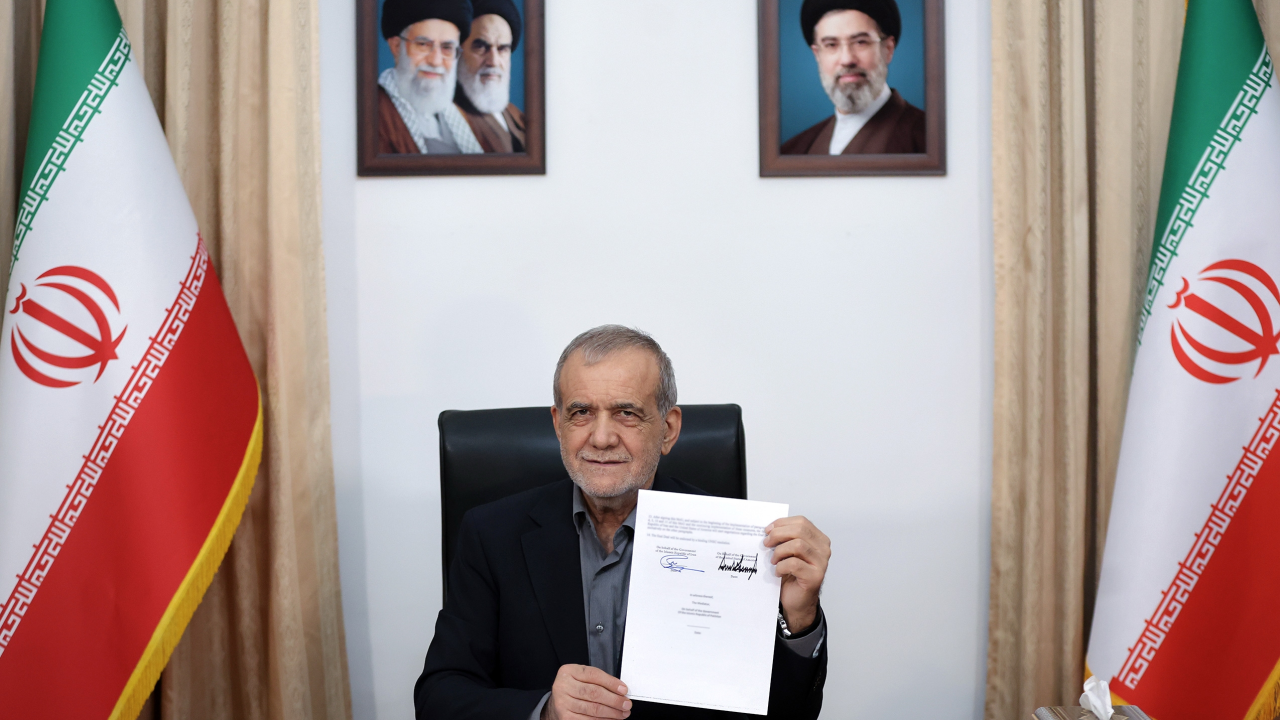
Iranian President Masoud Pezeshkian displays a memorandum of understanding signed with US President Donald Trump to end the war and begin negotiations on a broader agreement. Photo: AP
Lee en español aquí
The Iran–US Memorandum of Understanding (MoU) emerged not from reconciliation, but from exhaustion and strategic failure by the United States and its allies. It was the product of a war that had reached its political limits. Washington and Tel Aviv presented their illegal war of aggression as a necessary response to Iran’s nuclear energy program, missile capabilities, and regional alliances. Yet behind this language of security lay a broader objective: to weaken Iran decisively and restore a regional order centered on unquestioned US and Israeli dominance.
For more than two decades, successive US administrations had sought to contain Iran through sanctions, diplomatic isolation, covert operations, cyberwarfare, and targeted assassinations. The recent war represented the most intense expression of this strategy. The assumption in Washington and Tel Aviv was that overwhelming force would cripple Iran’s military infrastructure, fracture its state capacity, provoke internal instability, and perhaps open the way for political transformation.
That expectation was not fulfilled. Iran suffered extensive damage to military facilities, infrastructure, and economic assets. Civilian life was severely disrupted. But the Iranian state did not collapse. Its command structures continued to function, its armed forces retained retaliatory capacity, and its leadership preserved enough cohesion to withstand the assault. Despite the murder of several key leaders of the Islamic Republic, it remains in authority and its legitimacy has in fact been strengthened.
Equally important, Iran demonstrated that it could impose costs beyond its own borders. Missile and drone attacks reached Israeli territory and threatened strategic infrastructure across the Gulf Arab states. The conflict imposed by the US and Israel ended up with disrupted shipping routes, raised insurance costs, unsettled energy markets, and reminded governments across the world that instability in the Gulf cannot be contained within the region.
As the war continued, the gap between military power and political achievement became increasingly visible. The United States and Israel possessed overwhelming military superiority, but they could not convert battlefield pressure into decisive political outcomes. Iran remained intact; regime change did not occur. The Axis of Resistance – from Iran to the Mediterranean Sea – was weakened but not eliminated. Continued escalation promised greater destruction, but not strategic victory. Due to this fact, the MoU is not a final peace treaty. It is a provisional framework designed to halt direct hostilities, reopen channels of negotiation, and prevent the conflict from spreading further.
Its first and most immediate provision is a temporary cessation of direct military operations. The framework establishes a 60-day period during which the parties are expected to negotiate the terms of a more durable settlement. This pause does not resolve the underlying conflict, but it creates space to prevent accidental escalation and reduce the immediate risk of a wider regional war.
Second, the MoU centers on the Strait of Hormuz. This is the agreement’s most economically significant feature. Roughly one-fifth of globally traded petroleum passes through this narrow waterway. During the war, threats to shipping demonstrated both Iran’s geographic leverage and the vulnerability of the global economy to instability in the Gulf. The MoU treats maritime deconfliction not as a technical matter, but as a central pillar of regional and global economic stability.
Third, the agreement establishes a process for negotiations over Iran’s nuclear energy program. Crucially, it does not impose immediate dismantlement of Iran’s nuclear infrastructure. Instead, it opens discussions on enrichment levels, inspection mechanisms, monitoring arrangements, and the possible return of international technical oversight. This marks a shift from coercion to bargaining: Iran is not being treated simply as a target, but as a state whose consent is required for any durable nuclear arrangement.
Fourth, the MoU includes discussions on sanctions relief, oil exports, and the possible release or mobilization of Iranian financial assets. The details remain contested. But the principle is clear: economic strangulation did not produce surrender. A sustainable settlement will require some degree of economic accommodation.
Fifth, the agreement reportedly includes regional deconfliction mechanisms, particularly around Lebanon. This reflects the fact that the conflict was never only bilateral. Iran’s regional alliances, Israel’s military operations, US security commitments, and the fragile balance in Lebanon, Iraq, Syria, Yemen, and the Gulf are all connected. Any agreement that ignores this regional architecture will remain unstable.
The most revealing aspect of the MoU is what it omits. It does not demand regime change, it does not require Iran to abandon its missile program, and it does not force Tehran to withdraw entirely from regional political and security affairs. In short, the agreement recognizes Iran as a regional power whose interests must be negotiated, not simply bombed away.
The MoU exposes important differences between the strategic priorities of the United States and Israel. For Israel, the war was an opportunity to reshape the regional balance of power. Israeli policymakers have long regarded Iran as the principal obstacle to their strategic ambitions in West Asia. The weakening of Hezbollah, the fragmentation of resistance networks, and the isolation of Tehran were seen as necessary steps toward a regional order more favorable to Israel. The United States shared some of these objectives but operated under broader constraints. Washington had to consider not only military outcomes, but also oil markets, global trade, Gulf allies, domestic political pressures, and the risk of wider international involvement. As the costs mounted, US calculations increasingly diverged from Israeli maximalism.
The result is an agreement that many in Israel are likely to regard as insufficient. The war did not eliminate Iran as a strategic actor. It did not produce regime change. It did not destroy Iran’s capacity to influence events beyond its borders. Most importantly, it ended not with capitulation, but with negotiation. This outcome reveals a deeper problem for Israeli strategy. Military superiority can inflict enormous damage, but it cannot by itself produce political legitimacy or regional acceptance. Israel can strike targets across West Asia, but it cannot determine the political future of societies beyond its borders through force alone.
For the United States, the MoU represents the recognition of another reality: military dominance no longer guarantees political obedience. This lesson has been learned repeatedly in Iraq, Afghanistan, Lebanon, and now once again in relation to Iran.
The Gulf Arab monarchies are among the most important observers of this agreement. Throughout the conflict, Gulf governments were caught between competing pressures. They remain dependent on US security guarantees and have expanded overt or covert relations with Israel. At the same time, they understand that any regional war with Iran places their own economic and social stability at risk. The disruption of shipping routes and threats to regional infrastructure made this vulnerability unmistakable. The Gulf states possess immense wealth, but their economies depend on secure maritime trade, stable energy exports, foreign investment, and the confidence of global markets. A prolonged war endangers all of these.
The likely conclusion for Saudi Arabia, the United Arab Emirates, Qatar, Kuwait, and Oman is pragmatic rather than ideological. They will continue to work with Washington. Some will maintain or deepen relations with Israel. But they will also seek channels with Tehran and avoid becoming direct platforms for escalation. This trend was already visible before the war. The Saudi–Iranian rapprochement facilitated by China in 2023 reflected a growing recognition that regional stability cannot be achieved through permanent confrontation. The war has reinforced that conclusion. The Gulf monarchies have learned that neither Iran nor the United States is going away. Their future depends not on choosing one side permanently against the other, but on managing the contradictions between them while protecting their own interests.
Whether Iran has won depends on how victory is defined. If victory means avoiding destruction, Iran did not win. The country suffered severe economic losses, infrastructure damage, military degradation, and human costs. The burden of the war fell heavily on ordinary Iranians. But strategic outcomes are not measured only by damage suffered. They are also measured by political objectives achieved or prevented.
The central objective of the United States and Israel was not merely to damage Iran. It was to fundamentally weaken Iran as an independent regional actor. On that measure, the campaign fell short. Iran remains sovereign and the government of the Islamic Republic remains in power. Its military capabilities have been reduced but not eliminated. Its diplomatic relevance has been strengthened by the fact that negotiations now revolve around securing Iranian consent rather than imposing foreign dictates. In this sense, Iran achieved what many states facing overwhelming military pressure have sought throughout history: survival. Survival is not romantic. It is often costly, brutal, and incomplete. But in international politics, survival can be the most important measure of strategic success.
The larger significance of the war lies elsewhere. The conflict demonstrated once again that destruction is not the same as power. Military force can demolish infrastructure, kill combatants, and impose suffering. What it cannot always do is produce political transformation. The United States and Israel possessed vastly superior military capabilities, yet they could not secure the political outcome they desired. The Iran–US MoU is therefore not a story of decisive victory by either side. It is the story of a war that revealed the limits of coercion. Iran emerges battered but standing. The United States and Israel emerge powerful but unable to dictate terms. The Gulf states emerge more conscious of their vulnerability. The region enters a new phase in which negotiations, rather than battlefield victories, will determine the next chapter of West Asian politics. That is the deepest political meaning of the MoU: military power can destroy, but it cannot always rule.
Vijay Prashad is an Indian historian and journalist. He is the author of forty books, including Washington Bullets, Red Star Over the Third World, The Darker Nations: A People’s History of the Third World, The Poorer Nations: A Possible History of the Global South, and How the International Monetary Fund Suffocates Africa, written with Grieve Chelwa. He is the executive director of Tricontinental: Institute for Social Research, the chief correspondent for Globetrotter, and the chief editor of LeftWord Books (New Delhi). He also appeared in the films Shadow World (2016) and Two Meetings (2017).
This article was produced by Globetrotter and No Cold War.