Beirut’s Dahye Suburb, Lebanese Resistance Stronghold, Opposes Disarmament
From doctors to journalists, and from children to mothers, Israel’s imposed famine spares no one in Gaza.
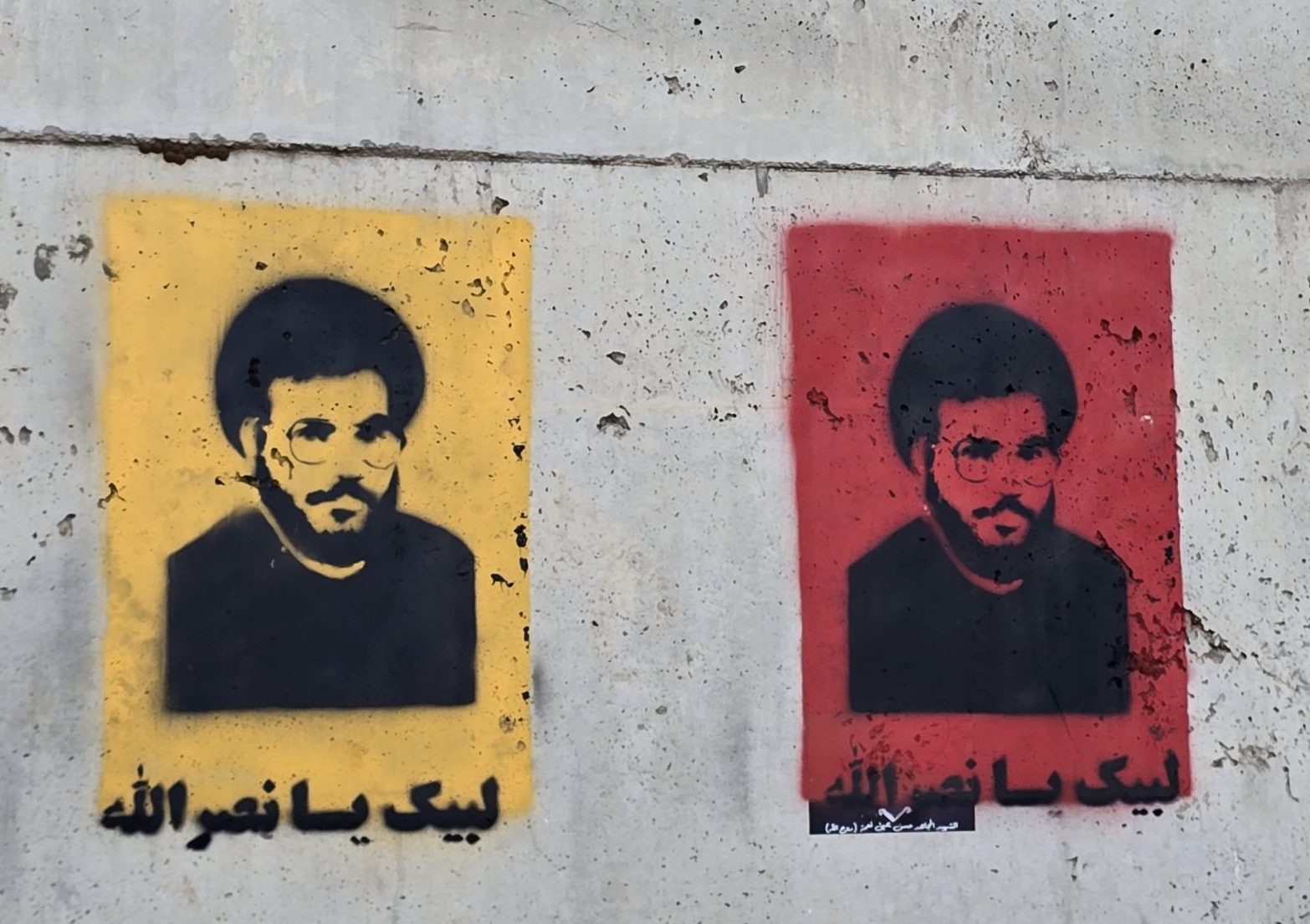
Graffiti portraits of Sayed Hassan Nasrallah, the former leader of Hezbollah, are displayed on a wall in Dahye, the southern suburbs of Beirut
What one first notices about Dahye, Beirut’s southern suburbs, is the tightly stacked buildings that snugly lean into one another, almost embracing; the air, thick with the piercing scent of diesel; motorcycles weaving between cars with a dancer’s rhythm; and sweet jasmine climbing across bullet ridden apartments, rebellious and fragrant. Life in Dahye moves fast, and yet its labyrinthine alleyways and bustling streets maintain a soft dignity that mingles with the heavy debris of flattened buildings, once full of families.
Even within Lebanon, Dahye is too often seen through the cracked lens of prejudice. Yet this proud neighborhood, which over half a million people call home, stands at the very heart of the country’s political and strategic confrontation with Israeli aggression. Since the opening of the Lebanese front in solidarity with Gaza on October 8, 2023, this densely populated and resilient district has shouldered the weight of coordinated military strikes, economic precarity, and relentless media vilification.
For residents like Zahraa Fadlallah, a registered nurse and mother who works at Al Sahel General Hospital in Bourj al-Barajne, Dahye’s resilience is written in the veins of her people. On October 21, 2024, Israel issued an explicit threat against Al Sahel Hospital—one of Dahye’s key medical facilities—claiming the facility sat atop a Hezbollah gold reserve. Similar disinformation tactics have been deployed to justify Israeli attacks on healthcare facilities in Gaza.
Recounting the Israeli attack for BreakThrough News, Fadallah describes an unwavering sense of duty in the face of mortal peril. “We have a saying that fear isn’t in your hand,” Fadallah said. “But at that time all we could think of was how much blood would be needed should they hit the area, and how to better facilitate the strongest support system for our people. In a time like this, no one thinks just of himself. When Israel threatens to hit specific buildings in Dahye they are threatening all of us and trying to plant fear in our hearts.”
Fadallah explains that the airstrikes and communication attacks—which came in two waves—showed not only her fellow countrymen’s will to live and survive, but their “spirit of resistance.” “We had families come in vans to the hospitals in Dahye, even though Israel threatened to bomb different areas, just so they could give blood. We had to turn some away because we were overwhelmed with donations, and they would cry. I had a man tell me he was willing to donate his eyes or his hands to any of those injured in the communication attacks.” During the most cataclysmic terror attack in Lebanese history, the people of Dahye wove their own network of solidarity, ensuring no one was abandoned to endure the cost of Israel’s attacks alone.
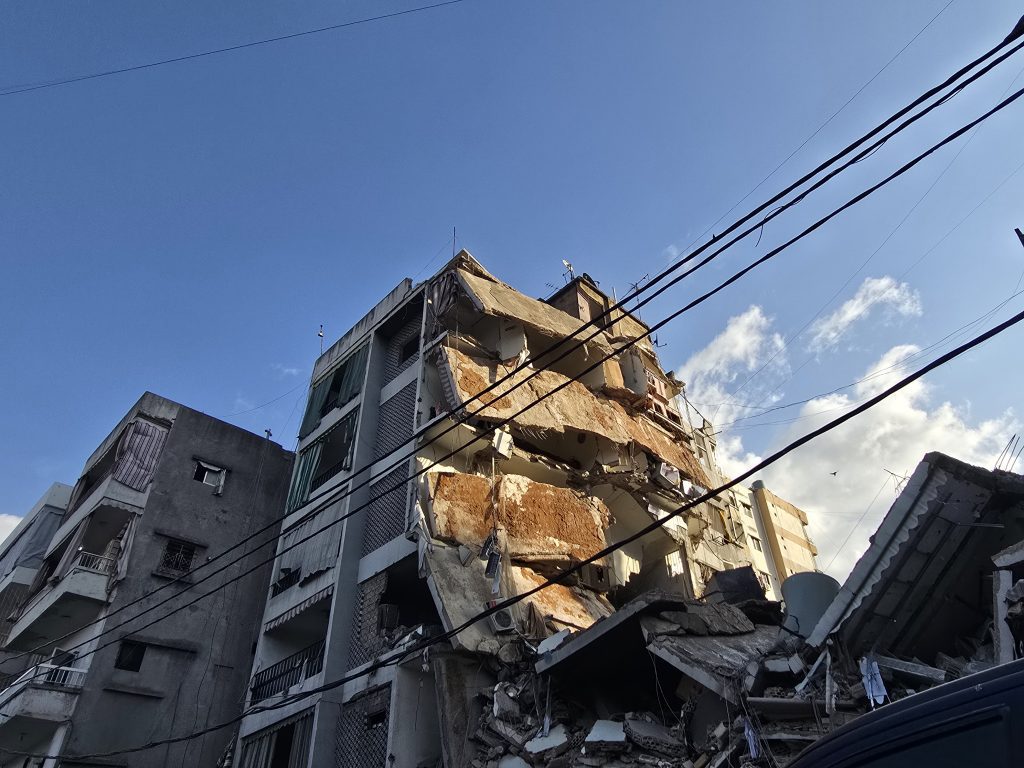
Walking through the suburb’s neighborhoods—the dry hum of Israeli drones still piercing the skyline’s tender veil from above—one cannot help but feel the weight of every stone beneath one’s feet, heavy with the memory of countless footsteps. Despite Israeli attempts to besiege its people and write its will across these stones, the pulse of Dahye remains steady and unrelenting, its people firmly anchored like cedars.
Dahye’s modern identity is rooted in decades of confrontation against both internal and external forces that have attempted to marginalize it. Originally a mosaic of smaller agricultural villages on the outskirts of Beirut, the demographics of the southern suburbs have been transformed over the past decades by the Lebanese Civil War, and the Israeli occupation of south Lebanon, both of which resulted in the internal displacement of thousands of families, who, in Dahye, wove a tightly knit working class community bound by shared hardship and the determination to rebuild.
In an interview with Breakthrough News, Lebanese political writer and researcher Hasan al-Dor, whose family comes from the southern Lebanese village of Majdal Zoun, emphasizes that the Dahye became a safe haven to those displaced by Israeli attacks and occupation from the villages of the south and the Beqaa Valley.
Al-Dor explains, “Since the 1980s, Dahye has become a symbol of resistance and steadfastness, and its presence was further strengthened after the July 2006 War [against Israel], eventually becoming one of the most prominent centers of political decision-making in Lebanon and in the region due to the strong leadership and influence of Hezbollah’s former Secretary General Sayyed Hassan Nasrallah.” When describing the people of Dahye, al-Dor refers to them as “a people of great affection, love, respect, and hospitality.”
Over the years, the people of Dahye have emerged with hardened political consciousness, born out of decades of economic scarcity and state-sanctioned neglect that was determined to marginalize them from Lebanon’s political and economic life. In the 1970s and 1980s, most residents came from forcibly uprooted families who had little more than their own labor and a will to survive. The 1982 Israeli invasion and subsequent occupation of south Lebanon intensified the community’s role as a vital base for resistance movements like Hezbollah and Haraket Amal, two pillars of the Lebanese Resistance, which found in Dahye both manpower and moral legitimacy. By the 1990s and 2000s, this political awareness crystallized into a formidable collective identity that viewed resistance to Israeli aggression and defense of the land not as lofty or abstract ideals, but as urgent, lived imperatives that are inseparable from the community and nation’s survival.
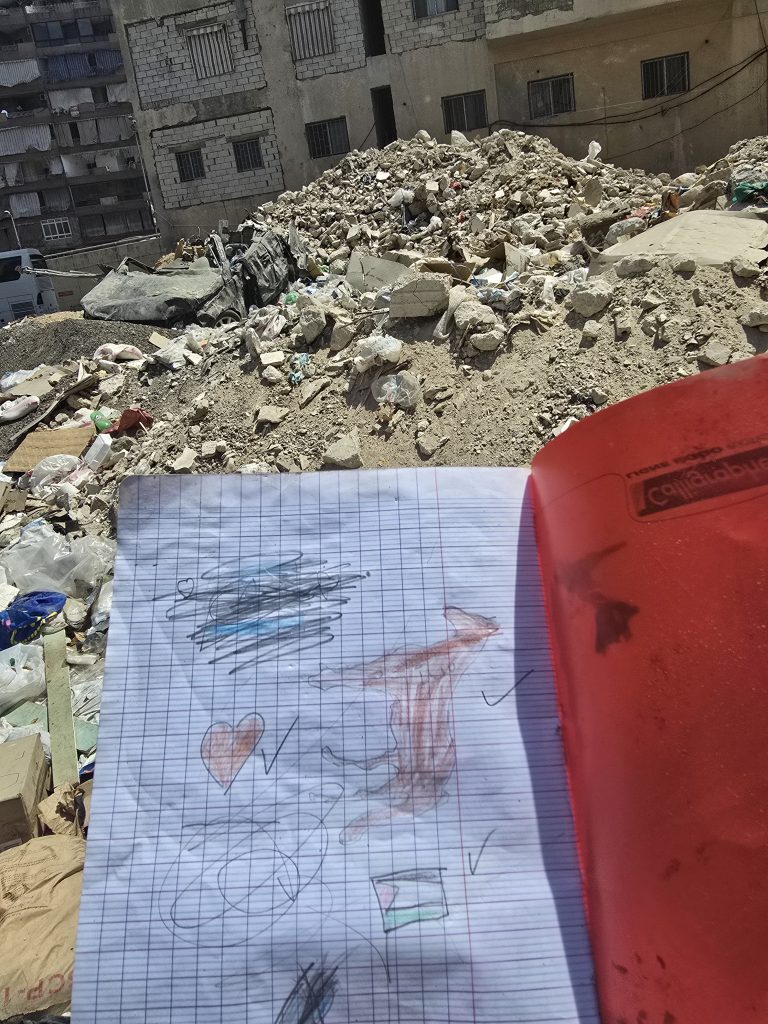
Today, many residents of Dahye work without stable wages, often taking part in the country’s informal economy, mainly as drivers, or street vendors. A part of the broader architecture of neglect in Dahye is the lack of social services and infrastructural investment by state institutions, from the lack of waste maintenance to the absence of a public electrical grid. The pressing needs of the community are often solely provided by local networks run by welfare services associated with the Lebanese Resistance which handle the health, education, and reconstruction assistance provided to locals. After Israel bombed residential and commercial buildings in Dahye, surveyors associated with the Lebanese Resistance visited people’s homes and took estimates of the damage, later providing these households with compensation.
Ali, a university student from the village of Deir Kifa in the district of Tyre, has made it his mission to unearth the historical vibrancy of Dahye and combat media demonization. Through the Instagram page History of Dahye, he documents the suburb’s cultural and social history: old villages swallowed up by the city, the dialects carried over from south Lebanon, and the ancient and diverse traditions that have unified Dahye for decades and helped form its unique identity.
While some prefer to confine Dahye to sectarian stereotypes, Ali argues that the southern suburbs are a collective space united, overwhelmingly, in love. What makes Dahye unique to Lebanese society, Ali says, is that it has faced war, siege, and marginalization, yet has emerged stronger, while also maintaining its social and spiritual identity. “It is also a space of faith and worship, with mosques, Hussainiyas, churches, and with religious occasions that bring people together, and where Christians and Shia stand united as one.”
After the announcement of the US-led proposal to disarm the Lebanese Resistance, uncoordinated protests engulfed Lebanon. In the consciousness of Lebanon’s resistance community, internal and external threats of disarmament are not perceived as the path to strengthen the Lebanese Army, but as the latest maneuver in an ongoing colonial strategy aimed at severing the Indigenous people of this land from their historical agency. For them, to accept such a demand would lead to the erasure of their collective identity, and what MP Hajj Muhammad Raad, who leads Hezbollah’s Loyalty to the Resistance Bloc in the Lebanese Parliament, called suicide, “and we will not commit suicide.”
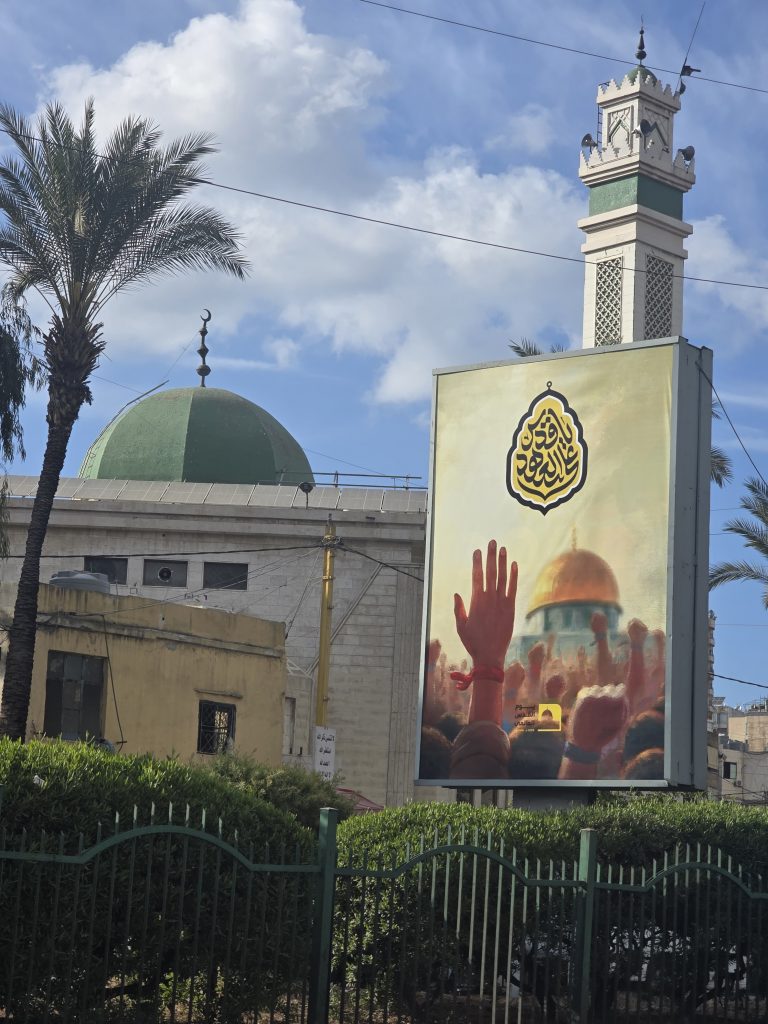
For Palestinian refugees in Dahye, who form part of its social fabric alongside Maronite Christians, Sunnis, and the majority Shia Muslims, “The Lebanese Resistance is our resistance, and we are against the disarmament of what is truly the only thing that stands in the way of the Israeli plan to expand its occupation,” Khalid al-Jarrar, a local street vendor, tells BreakThrough News. Al-Jarrar, whose family was displaced from the Palestinian city of Jenin, sees Dahye as his second home. Among countless other merchants, al-Jarrar sells a collection of goods he’s gathered from flea markets and trash rummaging. His face glows with a youthful radiance, betrayed only by wrinkled eyes, as he stands proudly in the slow drift of his weather-worn awning’s shade.
“The hospitality of Dahye is renowned,” al-Jarrar says. “We have a shared history with Lebanese residents of Dahye, as we both come from displacement and share the pain of Israeli occupation. We see each other as one people, and we are against any sectarian generalisations that are only meant to split us apart.” Palestinians in Dahye have erected banners and posters dedicated to Palestinian and Lebanese martyrs alike who have fallen on what Hezbollah describes as “the path to [liberate] Jerusalem.” “It is a great honor for us to have Sayyed Hassan Nasrallah, the crown on the head of all Arabs, lay down his life for our people. His loss was felt by our people here and in occupied Palestine,” al-Jarrar said.
To people like al-Jarra, armed resistance is part of the culture of life; a stubborn love for the land, born from a certainty that only days and nights separate them from liberation. Beneath the scars etched across Beirut’s southern suburbs, there remains a steadfast resolve formed under the profound weight of its unique history. Dahye’s determination serves as a living manifesto for concepts like self-determination and sovereignty, which belong not just to states and factions, but have been internalized by the people themselves as their right and duty, as caretakers of the land.