Anti-fascist historian Marc Bloch is inducted into France’s National Panthéon
The medievalist scholar was captured by the Gestapo while participating in the French Resistance and was later tortured and executed by firing squad.
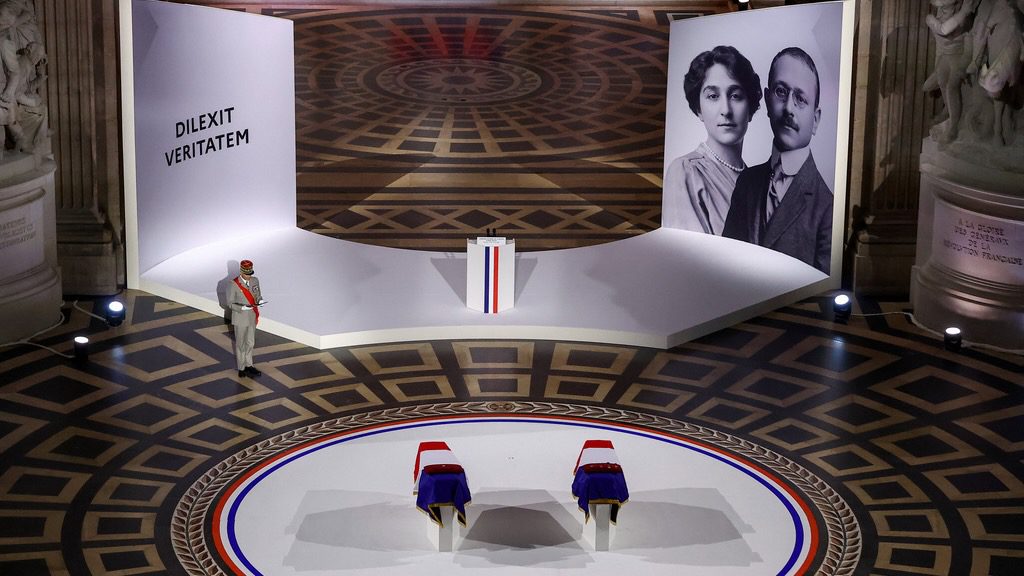
Historian and resistance fighter Marc Bloch is inducted into French pantheon. Photo: AP
Those of us who studied history in university will likely remember the day a professor told us about the historian who changed the course of historical studies by moving away from the traditional way of recounting the past, which, until then, had focused on great figures, a military history of famous generals, and an almost obsessive examination of diplomatic documents.
This historian, along with other greats of the field, had set out to study the past in terms of its deep social interrelationships, drawing on methods from other sciences such as sociology, economics, and even psychology.
Up to that point, nothing in the story could inspire even the least enthusiastic of the students. But then the teachers told us about this historian’s life – or rather, about his death. A great lover of history and the French people, during World War II (after being removed from his professorship for being Jewish) he wrote a sort of academic testament in which he masterfully demonstrated what a historian’s work entails, but he never finished it because he decided to join the Resistance against the Nazis and their collaborators.
He was captured by the Gestapo, who tortured him for several hours before putting him before a firing squad. It is said that his last words were “Vive la France!” before the thunderous sound of German rifles ended the life of one of the most brilliant minds of the 20th century.
The legacy and the Panthéon
His name was Marc Bloch, and a few days ago the French government decided that his remains should be interred in the Panthéon, a place where the remains of some of the most important men and women in French history rest. Voltaire, Rousseau, Victor Hugo, Jean Jaurès, Marie Curie, Simone Veil, Aimé Césaire, among others, are part of a place that seeks to honor and immortalize the spirit of a nation – a place to which the historian is now added.
Bloch was born on July 6, 1886, in Lyon, into a Jewish family, although Bloch himself would say that the only time he would openly state that he was Jewish was when an anti-Semite was present. He fought in World War I, where he rose to the rank of sergeant and later to captain due to his valiant service, for which he was awarded the national Order of the Legion of Honor.
After the Great War, he returned to university classrooms, first in Strasbourg and then at the Sorbonne. In 1929, together with Lucien Febvre, he founded the now-famous “Annales d’histoire économique et sociale,” a journal that embodied the aspiration for a new way of telling history, focused on a vision of the past that moved away from mere biographies of great figures and accounts of major battles.
He wrote the now-classic history books “The Royal Touch: Monarchy and Miracles in France and England, Feudal Society,” and “Strange Defeat: A Statement of Evidence Written in 1940,” among others. But his most celebrated book is probably “The Historian’s Craft,” the aforementioned academic testament that seeks to synthesize his vision of the historian’s craft – a text that is absolutely indispensable for anyone interested in historical studies and that marked a turning point in the discipline.
And perhaps the most curious thing of all is that his most famous book is incomplete. Facing the nefarious Vichy regime, Bloch (who had already lost his property and his university positions because he was Jewish) decided to leave everything behind and join the French Resistance against the Nazis and the French collaborators. Precisely because he was a great historian, Bloch understood that although history is written in books, in moments of life such as those of World War II, it demands to be written even with one’s own spilled blood.
A symbol of resistance
The anti-fascist Bloch thus became a symbol of the militant historian – one who, most radically, breaks away from any conception of the academic as an immune sage detached from reality. This image of Bloch, forged over time, inspired thousands of history students to approach the past with the seriousness required of those who dare to change a reality that, by all accounts, falls short.
Furthermore, he definitively shattered the old myth of the historian as that unblemished being who, neutral in his aspirations, chooses not to get involved in history so as not to taint a judgment that was supposedly meant to remain pristine. Bloch knew that pursuing impartiality in the face of history was impossible, so he decided to give his life for a nation he loved deeply.
Macron and his intentions
President Emmanuel Macron has thus decided to induct another anti-fascist into the Panthéon. He had previously honored politician Simone Veil, artist Josephine Baker, and Armenian poet Missak Manouchian – all of whom, alongside Bloch, suffered and fought in their own way against the racist and predatory machinery of the Third Reich.
In his official speech, Macron highlighted Bloch’s “ardent defense of secularism.” “With heart and reason, a true republican, an ardent and tireless defender of secularism, Marc Bloch suffered the consequences of the state-sanctioned anti-Semitism instituted by Marshal Pétain’s government … Marc Bloch unites France and history, the Republic and science, government and reason. This approach and this connection remain today the best antidotes to the poisons of historical revisionism.”
Macron hopes to send a clear message against the far right, which appears to be growing by the day in France. In fact, the Bloch family requested that no representatives of any far-right political party be present at the induction of their ancestor into the Panthéon, a right that party leaders would normally have at such ceremonies.
This is because, curiously enough, intellectuals in France still play a very prominent role in public debate, and the far right’s reinterpretation of history – especially that which, in one way or another, vindicates the French far right to a greater or lesser extent (including those who collaborated with the Nazis and others) – has gained traction in recent years.
However, Macron is also facing criticism suggesting that his political decisions have facilitated the rise of the far right, such as when he dissolved parliament or, despite certain unofficial promises, decided to form a government without the participation of the left, which had pulled off a surprise victory at the polls despite the far right’s advance.
Despite this, the move has been applauded by most of the left, the center, and even by that nationalist wing of the French right that sees this medieval historian as a shining symbol amid a regression to very dark times for France. Bloch has thus become the heir to those who view the past as a fundamental tool for transforming the present.
And although he was a medieval historian, he was well aware of the dangers looming over France in the 1930s and 1940s precisely because he understood that history is sometimes a beast that seems very slow, but which at any moment can deliver a devastating blow that changes everything. Today, his example sheds light on the dark days of those who will come face to face with other beasts that are quickening their pace.