Ulrike Eifler: ‘The workplace is a place where we have to fight against war’
IG Metall's Ulrike Eifler spoke to BreakThrough News about trade union resistance to militarization and strengthening the international anti-war movement.
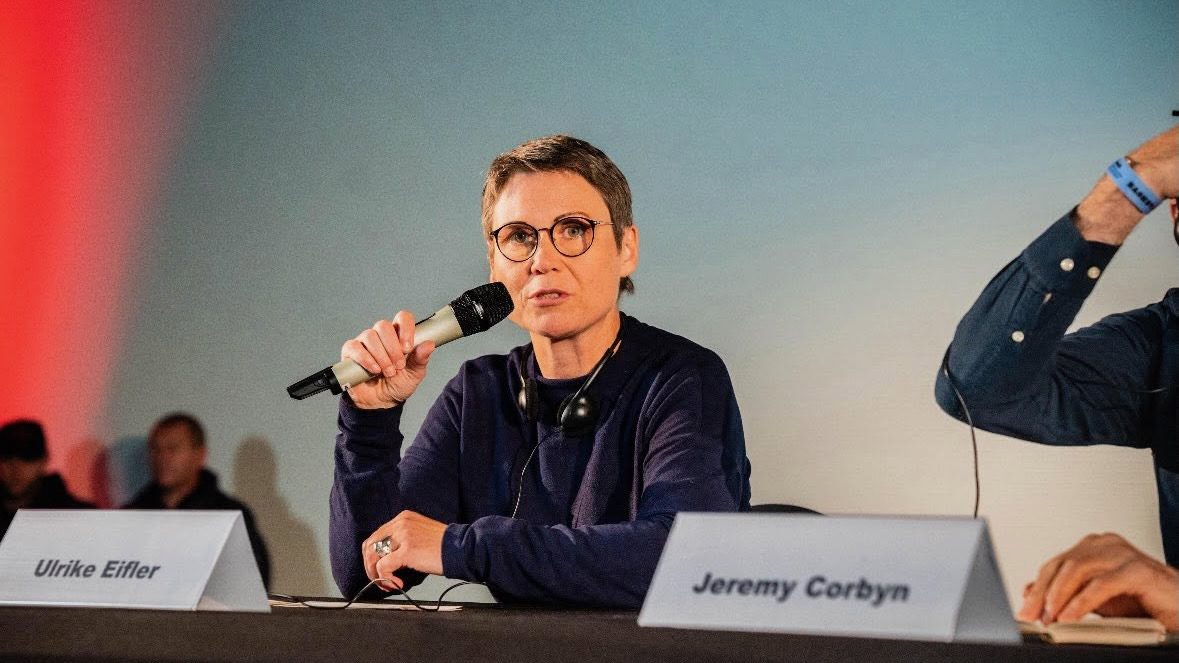
Ulrike Eifler of the industrial union IG Metall. Photo: Ulrike Eifler/FB
Germany has rapidly assumed a leading role in Europe’s ongoing rearmament drive, channeling billions of euros into modernizing its armed forces, bringing conscription back onto the political agenda, and prompting major industries to pivot toward arms production.
While Friedrich Merz’s federal government claims that this military buildup will ultimately benefit the population, resistance is growing at the grassroots level. Students and trade unions are increasingly engaging in discussions and actions against war preparations.
In an interview with BreakThrough News, Ulrike Eifler of the industrial union IG Metall reflects on the current situation and outlines strategies for strengthening the peace narrative within the labor movement in Germany and internationally.
BreakThrough News: The shift toward militarization in Germany is already having a tangible impact on the workforce. How has this transformation affected the German working class?
Ulrike Eifler: Germany is a country where militarization is felt very strongly, more so than in other countries. This is my impression from discussions with comrades abroad. From my perspective as a trade unionist, I would say we can already see the impacts of militarization on society and the world of work.
Several professions and sectors of society and the labor market are being militarized. Teachers must invite soldiers into their classrooms for recruitment. Employment agency staff are required to steer the unemployed toward the military. And nurses are required to undergo evacuation training and learn how to treat war injuries.
Following decades of marketization of the healthcare sector, we are now facing its militarization. This places an immense burden on nursing staff. Last summer, at a meeting at Berlin’s Charité hospital, the Berlin Hospital Association, the Berlin Senate, and the Bundeswehr prepared employees for a scenario involving significantly increased strain – the federal government anticipates 1,000 wounded soldiers per day in case of war. Consequently, the recommendation to nursing staff was to strengthen their personal resilience: a bit more exercise or yoga might help them prepare for this situation, apparently. Very cynical, I’d say.
But [in the case of war] the strain on nursing staff will also increase because the very nature of their work would change. The goal would no longer be to lead people to health and improve their quality of life, but rather to patch them up for their next deployment at the front. The professional identity of healthcare workers is being turned upside down. The same applies to other professions.
Read more: Militarization is spreading through Germany’s health sector
Militarization is restructuring the relationship between capital and labor and intensifying it in ways we could not have imagined during the era of capitalism prior to these war preparations. I believe we have to adapt our strategies so they reflect the fact that the workplace is now also a place where we have to fight against war.
This development is not yet being sufficiently discussed within trade union circles – though I must admit we have already made enormous progress in the debate. Still, I would say that anti-militaristic positions of trade unions outside Germany are clearer than those in Germany itself. Judging from previous experience, that could prove to be a big problem: during the last financial crisis in Europe, we saw austerity measures imposed all over the region partly because local politicians didn’t feel enough pressure from trade unions here. So it’s very important to have strong class struggles in Germany alongside strong class struggles elsewhere.
One of the greatest challenges in organizing resistance to armament currently stems from attacks by the federal government: these aim not only to dismantle the welfare state but also to break the backbone of the unions. There is also the government’s aggressive attempt to co-opt the unions into its policies of social cutbacks and war preparations. This strategy builds on the decades-old practice of so-called “social partnership” between capital and labor, a relationship traditionally managed and pacified through joint dialogue. The government is now attempting to revive this approach. This must be prevented at all costs, as the aim is to weaken the unions.
Finally, unions are currently also struggling to generate their own answers to the societal crises. [In this situation,] the political left must not simply join social protests: it needs to place them within the context of current preparations for war. Doing so would also strengthen the unions.
BT: A common argument put forward by governments and employers is that military-driven reindustrialization will secure or create jobs, even amidst economic stagnation following decades of austerity. What do you make of this military Keynesianism?
UE: The deepening industrial crisis in Germany demonstrates that the argument that investment in the arms industry could save the industrial sector is flawed. The federal government’s industrial strategy centers on expanding the arms industry through state contracts, guaranteed government orders, and subsidies. Billions upon billions have been poured into the defense sector over the past four years. Yet 15,000 industrial jobs are currently being lost every month. Last year, 120,000 jobs were lost; the year before, 100,000. That means the government’s strategy is failing.
Comparative studies show that investments in education, infrastructure, or socio-ecological transformation lead to greater growth and more jobs. Investments in armaments generate virtually no growth; instead, they heighten the risk of war. Germany’s experience thus serves as a prime example of how a focus on the arms industry accelerates deindustrialization rather than preventing it.
Read more: Germany and the EU embrace military Keynesianism
Secondly, I think we need to say clearly that “military Keynesianism” can work only if war actually breaks out. This implies that uninterrupted arms production must be guaranteed by shifting to a war economy. However, such a transition is incompatible with labor and trade union rights. The eight-hour day, occupational health and safety regulations, collective bargaining, the right to strike, and even the very existence of trade unions stand in the way of uninterrupted wartime production – and are thus placed at risk.
If you want job security in the context of military Keynesianism, you have to switch to a war economy, and that means abolishing all labor rights, even the right to organize in a union. We have to read very carefully what the government is telling us. And that, in my opinion, means that the existence of the trade union movement is at a very critical point right now.
Here, too, internal trade union discussion remains insufficient. Initial, significant resolutions opposing militarization and rearmament have emerged from unions in major industrial enterprises such as Ford, Volkswagen, and ZF. These efforts need to be broadened. At the same time, the trade union debate requires an alternative to the federal government’s stance – one that makes it clear that industrial policy lacking a commitment to peace is not in the interest of working-class people.
BT: What is the connection of unions to other initiatives in the broader peace movement, including the student movement, which employs strikes as a means of opposing war and rearmament?
UE: There are some initial, yet truly significant initiatives. In Munich, trade unions joined forces to form an initiative for increasing social expenditure instead of arms expenses and organized an initial demonstration in autumn 2024 against rearmament and cuts to social services. In Bavaria, the education union GEW filed a lawsuit against the law requiring teachers to invite soldiers into the classroom. And within IG Metall, advisory services regarding conscientious objection to military service are available in some locations.
Furthermore, at its federal congress this May, the German Trade Union Confederation (DGB) took a clear stand against NATO’s 5% spending target and the federal government’s concept of making society “war-ready.” Particularly noteworthy, however, was the DGB federal congress’s resolution opposing military conscription. Following a debate at the congress, the entire trade union family now rejects conscription, aligning itself with the youth. The importance of this cannot be overstated, as it places the unions in opposition to the federal government on a central issue regarding preparations for war.
Read more: German students expand their strike against conscription and militarization to 150 cities
The school strike movement is probably the most interesting and radical part of the German peace movement at the moment. The students who took to the streets against conscription feel very clearly that they are part of war preparation, and they refuse to participate, even under intense pressure. There are examples where school directors threatened punishment if students attended strikes, or where students were locked in their classrooms by teachers. Even the secret service came to try to intimidate them. So there is a lot of pressure, and it also has a logic: a government that prepares for war can’t afford a whole generation on the streets, politicized by the question of peace and war.
Initial contacts between school strikers and trade unions are taking place in some cities. This practice needs to be expanded in the coming weeks and months: the DGB decision is only valuable if it compels us to stand with the youth and protect them. I witnessed a very powerful example of this when I was at the school strikes in early May: a woman working at a home for the elderly came to the microphone and said, “I deal with elderly people every day who are still feeling the consequences of World War II, and they are fearful now. These experiences of war are so terrible that we have a responsibility to avoid repeating them forever.” I think experiences like these show that we have to unite different parts of society and support the students.
BT: You recently attended the International Conference Against War in London alongside hundreds of activists and movements. What key insights did you take away from that meeting?
UE: The London conference successfully brought together the anti-war movement and segments of the labor movement. There was a massive presence of trade unions and trade union confederations, from Spain to Britain to Italy and Greece. This is crucial because, without unions, we cannot halt our governments’ preparations for war.
Several events were mentioned at the conference that will be important to support: October 10, the action day against the genocide in Gaza; November 21–22, action days across Europe against militarization and conscription; and the dockworkers’ international day of action. That date isn’t fixed yet, but it’s really important to support the dockworkers because, at the moment, they are the only branch organizing anti-war action in their workplace. They are the only branch where we have strikes against rearmament. Our goal must be to expand these actions to other sectors.
Read more: Mediterranean dockworkers launch historic international strike
Additionally, from my perspective, there are three defining issues that can help us further unite the anti-war movement and the trade unions. First, attacks on public services and welfare – measures that not only serve to finance rearmament but are also part of war preparations. [Keeping in mind the experiences in Germany,] I would say this is not only an attempt to destroy our welfare state, but also an attempt to break the backbone of the trade union movement, our experiences, and our past class struggle.
Second, the militarization of the workplace: while this upends professional activities, it also offers us the opportunity to turn the workplace into a central arena of struggle.
And third, an end to the genocide in Gaza. The ongoing killing and death in Gaza, combined with Western support for the Israeli government, deeply stirs people, prompting them to take a stand, choose sides, and become politically active. At the same time, the expansion of Israeli military operations into Lebanon demonstrates that Gaza was not an exception, but a blueprint. International law is playing an increasingly marginal role. And the very governments that disregard international law also fail to respect workers’ and trade union rights and dismantle social safety nets. It is on the basis of this debate that the anti-war movement and the trade union movement can be brought together.
BT: Finally, there is also a trade union conference for peace that will take place in Würzburg at the end of July. How does this conference build upon the discussions held at previous events and other forums over the past few months?
UE: This will be the fourth trade union conference of this kind. To date, it has helped us initiate and sustain an internal union debate regarding the impact of war preparations on the working class. The trade union congress resolutions I mentioned earlier are the result of this work. Until now, the nature and agenda of these conferences have focused on preventing the trade unions from becoming complicit in policies preparing for war.
However, I believe we have reached a point where merely debating the issue is no longer enough. Hundreds of events addressing this topic have taken place within the unions over the last three years – an impressive track record. Now we need to move from quantity to quality. We need genuine movement and mobilization against the war. Yet this does not happen on its own; it must be built up. It is therefore crucial to focus on establishing an alliance structure, like the ones in Britain or France, that can support us in organizing protests. Furthermore, the stance of the international trade union movement needs to be discussed more extensively within German trade unions.
Ultimately, I believe that organizing and holding an international anti-war conference – similar to those seen in Paris and London – could play a vital role in shifting the balance of power within our unions and also across the country. I’m sure that could change a lot.