Three years into the genocide in Gaza, Israel remains ‘key partner’ for EU
Several European politicians visited Israel this week, reaffirming support for the occupation's "security" and signaling continuation of partnership.
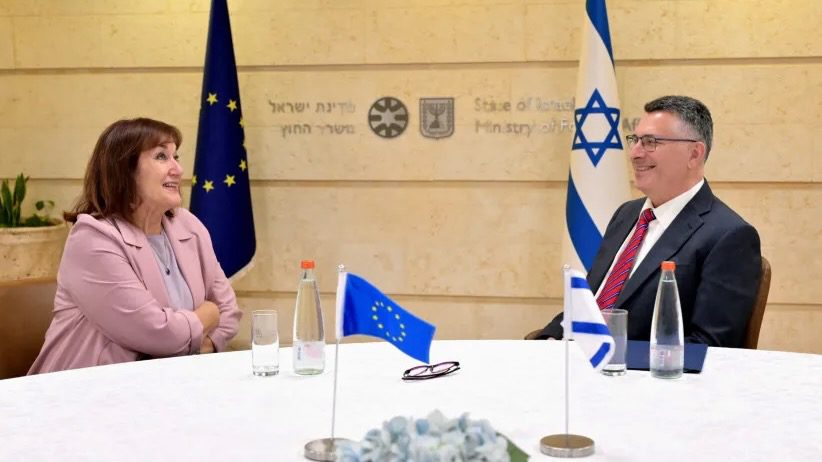
Israeli Foreign Minister Gideon Sa'ar meets European Union Commissioner for the Mediterranean Dubravka Šuica. Photo: Israeli Government Press Office
Israeli authorities hosted several politicians from European countries this week, signaling continued ties despite threats to sever communications with high-ranking EU officials over alleged comparisons of Israel’s treatment of Palestinians to apartheid South Africa.
On June 22, Israeli Foreign Minister Gideon Sa’ar met with Dubravka Šuica, the EU Commissioner for the Mediterranean, as well as Željka Cvijanović, the Serb member of Bosnia and Herzegovina’s presidency. During her visit, Šuica also met Israeli President Isaac Herzog, while Cvijanović attended a meeting with Prime Minister Benjamin Netanyahu. Both guests reaffirmed their support for Israel’s so-called security.
EU maintains support for Israel’s “right to security”
“I am pleased to be in Israel, one of our key partners,” Šuica wrote on social media, still ignoring calls from over a million EU citizens to end the EU-Israel Association Agreement. “We discussed ongoing challenges and how we can address them together. I underlined that the EU fully supports Israel’s right to security.”
“With Isaac Herzog, we discussed EU-Israel relations, including open challenges and potential new opportunities to strengthen our cooperation on areas of shared interest,” the EU Commissioner added. “Israel is a key partner. We share deep ties and a common interest in a stable and secure Middle East.”
Šuica also met Palestinian Authority representatives. However, critics argue the bloc’s primary intention remains preserving relations with the occupation, despite a slightly stricter narrative on settler violence emerging in official EU stances. Progressive politicians and activists also criticized Šuica’s participation in Donald Trump’s “Board of Peace” meetings, warning it legitimizes a colonialist approach to Palestine.
Read more: Wanted war criminal Benjamin Netanyahu and over 60 world leaders reportedly invited by Trump to “govern” Gaza
Additionally, the EU Commissioner’s visit drew criticism from well-known figures inside the EU. Former High Representative for Foreign Affairs Josep Borrell – the man who once compared Europe to a garden to be protected from the jungle represented by the rest of the world – highlighted the hypocrisy of Šuica sitting with Sa’ar days after he threatened to cut ties with current High Representative Kaja Kallas. Reports suggest Kallas had compared Israel’s treatment of Palestinians to apartheid-era South Africa during a private meeting with Mexican officials. Kallas has avoided confirming these statements publicly, appealing for “respectful and constructive” exchanges following Sa’ar’s announcement.
Shared islamophobic tropes from Israel to West Balkans
Željka Cvijanović expressed more explicit support for Israeli authorities than Šuica. Current representative of the Republika Srpska entity in Bosnia and Herzegovina’s presidency, Cvijanović hails from the same party as Milorad Dodik, who is known for denying war crimes, amplifying separatist narratives, and forging ties with authoritarian political groups.
In this context, Israel has long maintained strong relations with the Republika Srpska. Cvijanović met with Netanyahu in a diplomatic setting without Bosnian flags, prompting the Bosnian Ministry of Foreign Affairs to issue a formal note of protest. The visit sparked outrage in Bosnia and Herzegovina, with critics warning that Cvijanović was aligning with an entity accused of war crimes and promoting islamophobic narratives.
This concern was linked to Sa’ar’s remarks about the “need to safeguard Christian minorities in Bosnia and Herzegovina,” as well as Cvijanović’s speech at the JNS Summit. There, she praised Israel for building “democracy” in the region and called for intelligence sharing and “strengthening security partnerships.”
“This is a struggle between civilization and extremism, between free societies and violent ideologies,” Cvijanović said, equating Israel with “free societies.” “It is about choosing now between those who want coexistence and those who want domination, between those who defend life and those who glorify death,” she stated, propagating a distorted image of West Asia.