The generation that refuses to crawl: Gen Z is a class struggle
The young people in the streets are not asking merely to survive inside the cracks of a decaying system. They want to live, to work, to use what they have learned, and to contribute to society with dignity.
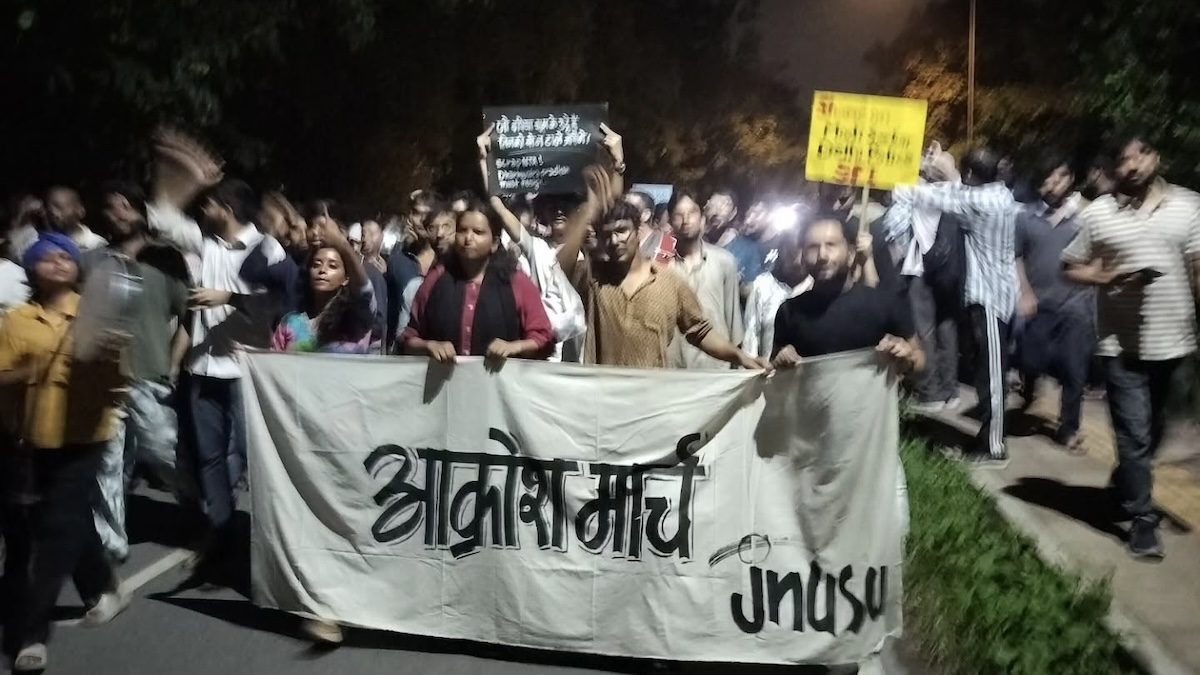
Students protest at JNU. Photo: AISA
On July 20, thousands of young people attempted to march from Jantar Mantar to Parliament. They carried placards, shouted slogans, and demanded the resignation of Union Education Minister Dharmendra Pradhan over repeated examination irregularities, paper leaks, cancelled tests, and the government’s refusal to accept responsibility for the devastation inflicted upon students. The Delhi Police answered them with barricades, batons, and tear gas. Some protesters were detained, while others reorganized themselves into smaller groups and continued towards Parliament. The movement had crossed an important threshold: what began as satire on social media had entered the streets as a confrontation with state power.
The protesters call themselves the Cockroach Janta Party (CJP). The name arose after a derogatory judicial remark compared activists and unemployed young people to cockroaches and parasites. Rather than retreat before the insult, the young turned it into a badge of collective defiance. If those who rule India see its unemployed youth as cockroaches, then the cockroaches will assemble. The name mocks the Bharatiya Janata Party, but it also captures something of the experience of a generation that has been told repeatedly that it is excessive, ungrateful, unemployable, and somehow personally responsible for the failure of the economic system, which they see as a precarious system that should give them jobs, but which – as the ruthless capitalist system – treats them as disposable.
Since its first major Delhi protest on June 6, the movement has spread to cities including Pune, Mumbai, Bengaluru, Lucknow, and Nagpur. Its supporters established a camp at Jantar Mantar, where climate activist Sonam Wangchuk undertook a hunger strike in solidarity with their demands before being forcibly removed to the hospital. The immediate questions are serious enough: the integrity of entrance and recruitment examinations, compensation for the families of students who have taken their own lives, the reform of an examination system riddled with corruption, and the resignation of the education minister. Yet behind these demands lies a much larger social crisis, since an examination paper is not simply a sheet covered with questions. For millions of working-class families, it represents years of savings, sacrifice, study, and hope. When that paper is leaked or the examination is cancelled, an entire household’s fragile plan is torn apart.
The media has eagerly described the Cockroach movement as India’s first “Gen Z protest.” There is some truth in this description. Its language was born on social media, and it therefore deploys memes, satire, parody, short videos, and self-deprecating humor with great skill. Many of its participants have known no government other than that led by Prime Minister Narendra Modi. Their political vocabulary has developed under conditions in which television news has largely surrendered to power, dissent has been criminalized, and the internet has become both a mechanism of surveillance and one of the few remaining spaces in which anger can circulate rapidly. But the term “Gen Z” explains far less than it appears to explain. It is a marketing category masquerading as sociology. It groups together the daughter of an agricultural laborer and the son of a billionaire merely because they were born within the same span of years. Generations do not sit for examinations, search for jobs, deliver food, or borrow money for coaching fees, but social classes do. The decisive question is not when these young people were born, but what kind of economic order they have inherited and what place, if any, that order has prepared for them.
The young protesters are not in revolt because they possess shorter attention spans or a special cultural aversion to authority. They are in revolt because capitalism cannot integrate them into dignified economic life. They have been told to study, acquire degrees, learn new skills, remain competitive, and become “entrepreneurs.” Their families have borrowed money, sold land, postponed medical treatment, and reduced household consumption to pay for education and coaching. At the end of this punishing journey, many discover that the promised job does not exist. Others find only temporary contracts, unpaid internships, platform work, or jobs whose wages bear no relation to their qualifications.
Even the official figures reveal the scale of the problem. The government’s Periodic Labour Force Survey for 2025 placed unemployment among those aged fifteen to twenty-nine at 9.9%, rising to 13.6% among urban youth. It also found that one-quarter of Indians between fifteen and twenty-nine were neither employed nor in education or training. These headline figures obscure extensive underemployment, unpaid family labor, and the desperation that forces people to accept any activity whatsoever as work. Only 23.6% of Indian workers were in regular wage or salaried employment, while 56.2% were classified as self-employed, a category that stretches from prosperous professionals to street vendors and unpaid workers on family farms.
The India Employment Report produced by the Institute for Human Development and the International Labour Organization provides an even clearer picture. In 2022, unemployment among young graduates stood at 29.1%, nine times the rate among young people who could not read or write. Nearly 82% of the workforce was in the informal sector, while almost 90% was informally employed. Real wages for regular workers had either stagnated or declined, and platform employment had expanded as a digitally supervised extension of informal labor, largely without social security. The report found that the average wait for a first job exceeded one year and that many technically qualified young people were doing work unrelated to their training.
This is the bitter paradox at the heart of the protests. Education has expanded the aspirations and capacities of young Indians, but the economy has not expanded the number of decent jobs available to them. The more they study, the more clearly they see the gap between what society promised and what it can provide. Their degree becomes evidence not of their inadequacy but that of an economic model organized around finance, capital-intensive production, privatization, and the enrichment of a small corporate elite.
The crisis did not begin with the Modi government, but twelve years of BJP-rule have deepened it. Demonetization and the poorly designed Goods and Services Tax (GST) damaged small businesses, which have historically absorbed large numbers of workers. Public-sector recruitment has been delayed or reduced, vacancies remain unfilled, and secure employment has been replaced by contractual labor. Manufacturing has not grown at the scale necessary to employ the millions entering the labour market each year. Meanwhile, public education has been weakened, and the coaching industry has expanded, turning anxiety into an immensely profitable commodity. The government celebrates GDP growth, highways, digital payments, unicorn companies, and the wealth of Indian billionaires, but none of these statistics answers the question heard in countless homes: where is the job?
Paper leaks must therefore be understood as more than administrative corruption. They are concentrated expressions of a larger class injustice. Millions compete for a small number of positions because secure work has been deliberately made scarce. Each applicant must pay fees, travel long distances, buy study material, and sometimes spend years in coaching centers. When an examination is compromised, the state speaks about technical glitches and investigative committees. For the candidate, however, time itself has been stolen. An upper-age limit approaches; family debt accumulates; another year disappears.
The government would like to isolate the protests as the emotional outburst of an impatient generation. It will alternate between ridicule, repression, promises of consultation, and attempts to divide the movement. The young will be told that they lack experience, that foreign forces are misleading them, or that their protest damages the nation’s image. But there is nothing anti-national about demanding that a country provide its youth with useful work. What damages India is an order in which young people are needed as consumers, data points, delivery workers, and electoral crowds, but not welcomed as workers with rights, citizens with voices, and human beings entitled to a future.
The Cockroach movement’s energy is important, but spontaneity and digital reach alone cannot overcome entrenched power. Its lasting strength will depend upon whether it links examination reform to the struggle for employment, public education, labor rights, and economic redistribution. The students at Jantar Mantar share a future with contractual teachers, scheme workers, delivery riders, factory apprentices, unemployed graduates, and rural laborers. The movement must resist attempts to describe organized politics, trade unions, and established student organizations as relics belonging to another generation. The experience accumulated by the organized working class is not a burden upon youthful revolt; it is one of the resources that can give such revolt endurance and direction.
The name “cockroach” carries an unintended historical truth. Cockroaches survive because they are difficult to eliminate. But the young people in the streets are not asking merely to survive inside the cracks of a decaying system. They want to live, to work, to use what they have learned, and to contribute to society with dignity. Their anger is generational in its appearance but profoundly class-based in its content. The task before the Left is neither to romanticize this anger nor to lecture it from a distance, but to enter into dialogue with it, help it identify the structure behind its suffering, and join its immediate demands to a program capable of creating millions of secure and socially useful jobs.
The tear gas outside Parliament cannot answer the question posed by the protesters. India’s rulers may push them behind barricades and call them insects, parasites, or troublemakers. But a society that refuses to make room for its young will eventually discover that the young have decided to remake society itself.
Vijay Prashad is an Indian historian and journalist. He is the author of forty books, including Washington Bullets, Red Star Over the Third World, The Darker Nations: A People’s History of the Third World, The Poorer Nations: A Possible History of the Global South, and How the International Monetary Fund Suffocates Africa, written with Grieve Chelwa. He is the executive director of Tricontinental: Institute for Social Research, the chief correspondent for Globetrotter, and the chief editor of LeftWord Books (New Delhi). He also appeared in the films Shadow World (2016) and Two Meetings (2017).
This article was produced by Globetrotter.