Peace is an indispensable condition for development
The "Hands Off Asia" conference closed with leaders resolving to build solidarity, a people's culture, and collective struggle in the face of escalating imperialist threats against the region.
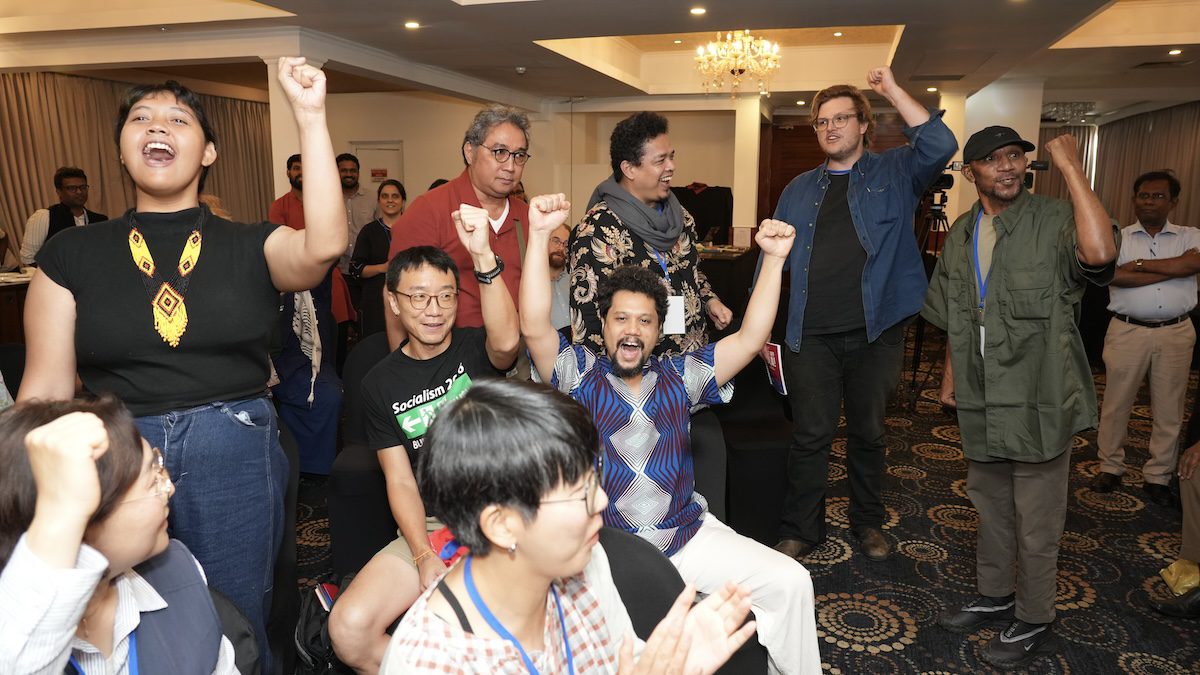
Hands Off Asia conference. Photo: IPA
Speaking at the closing session of the “Hands of Asia” conference on July 18, Vijay Prashad made a strong call for peace in the Asian region, saying that peace is an indispensable condition for development.
Asia is a region where millions still live in poverty and a $100 billion is needed to eradicate the extreme poverty of its people. Yet, he noted, the governments of Asian countries together spend around $600 billion on military expenditure, describing it as a sheer waste.
Prashad said Asian countries should not be forced to join camps either with or against the United States. They do not want to participate in blocs or counter-blocs. Instead, he said, what Asia needs is for the US to stop the militarization of the region and end its coercion of Asian nations to join efforts to contain countries it considers its enemies. Not joining military blocs does not preclude solidarity with fellow nations resisting imperialism, nor does it prevent Asian countries from resisting imperialist pressure and intervention against their own countries.
Read more: In Colombo, Asia redefines sovereignty
Prashad pointed out that today’s “Hands Off Asia” carries forward the legacy of the “Hands Off Russia” campaign of 1919 as well as the legacy of the “Hands Off China” campaign of the 1920s, which opposed Western intervention aimed at breaking the Russian revolution and China’s national liberation struggle, respectively.
Speaking on the first session of the day, “Building People’s Culture” and “Communications in the Battle of Ideas,” Prof. Sushanta Das of the Workers Party of Bangladesh pointed to the need for left forces to intellectually and culturally counter the growing politicization of religion and hyper-religiousization in Asian societies, including in the sphere of education. Citing the example of Bangladesh, where, according to him, madrasas have over the years superseded the formal education system. He said that in Bangladesh, neoliberalism has married religious fundamentalism and that, for US imperialism, which has a long history of working with and nurturing religious fundamentalist forces, this has created a favorable situation to draw Bangladesh into its militarization plans in Asia.
Read more: Conservative BNP sweeps Bangladesh elections with over two-thirds majority in the parliament
Sudhanva Deshpande, an activist with the Indian street theater group Jana Natya Manch and managing editor of LeftWord Books, cited the example of the Soviet Union sending books that were cheaper than food to Global South Countries, said that books need to be made accessible to the poorest sections of society, enabling them to engage with left, progressive, and scientific ideas.
Quoting Amílcar Cabral – “However warm the water in the well, it cannot cook your rice” – he stressed the need to develop domestic theory and the importance of left publishing in fostering it, especially in an environment where a handful of publishers dominate international publishing.
Pointing out that India’s largest right-wing publishing house publishes nearly 1,000 books a year and sells around 9 million copies annually – he said, the left can overcome its limited resources by working together, sharing resources, and building solidarity among publishers.
Andi Nurkhafifah, of Perempuan Mahardhika from Indonesia, speaking of the convergence of militarism and femicide in Indonesia (particularly in the struggle of Papuan people), emphasized the “revolution inside the revolution,” where national liberation struggles against imperialism and capitalism should necessarily encompass the fight for women’s liberation and empowerment.
In the second session, “People’s Alternatives, Resistance and Socialist Horizons,” Dr. Kumar of the Socialist Party of Malaysia said that alternatives to the current exploitative system must take into account the possibilities and constraints of the existing situation. In Malaysia, where the economy is heavily export-oriented and a large share of GDP depends on exports, an immediate reversal of the current model would cause severe economic disruption and hardship. The left, therefore, when the opportunity arises needs a transitional program. At the same time, while implementing such programs, it must ensure that its leaders are not co-opted.
Stressing the importance of fighting for reforms within the existing system, he argued that, in a context where many people have become politically apathetic and passive, small victories can build confidence and energize people for larger struggles.
While the struggle against imperialism remains the primary axis of the fight, he said that the issues faced by socially oppressed groups, including LGBTQ communities and oppressed castes, must also be incorporated into the broader movement without being reduced to identity politics.
Clifton D’Rozario, an activist of the Communist Party of India (Marxist-Leninist) Liberation, talked about the need for the Indian Left to move beyond the trap of Economism. He explained that the class question is also a social question and that struggles cannot be limited only to the economic sphere. They must include struggles against both economic and social oppression, such as class, caste, and gender discrimination.
Read more: Anatomy of a general strike: how workers in the Indian state of Karnataka shut down production
He mentioned the experience of organized Dalit women sweepers in Karnataka, who face class, caste, and gender oppression. They fought not only for their employment rights from the government but also against the prejudice, discrimination, and dehumanization they faced in society.
Luiz Zarref, of the MST in Brazil, pointed out that international solidarity among the Global South should go beyond letters and messages of support and move towards more concrete actions. He said that the political schools being organized through solidarity between organizations in Africa, Latin America, and Asia through the IPA network are good examples of such solidarity in action.
Dama Sharma of the All Nepal Women’s Association and a member of Nepal’s Constituent Assembly, who was also a guerrilla during Nepal’s People’s War, said that the People’s War showed that women can carry weapons and fight for the collective. She highlighted how collective action can challenge even the worst forms of oppression.
Speaking at the closing plenary session, Prof. Lu Xinyu of East China Normal University stated that what we are witnessing is not simply a Cold War between two superpowers, but a struggle between efforts at hegemonic domination and a path of national liberation and alternative development.
G. Weeresinghe, general secretary of the Communist Party of Sri Lanka, cited various agreements with the US that Sri Lanka is being pressured to sign in order to be drawn into its Asian militarization agenda. He highlighted Sri Lanka’s vital geographical position in the Indian Ocean, at the center of East-West trade, with its ports visited by around 6,000 ships annually as part of this trade network.
Speaking about Sri Lanka’s debt crisis, he noted that in March 2026, when the IMF program ends, the country will face the beginning of repayments on a $54 billion debt while holding only $6.4 billion in reserves. He stressed the need to reindustrialize Sri Lanka, develop cooperative sectors, expand the ocean economy, and strengthen Global South trade relations as an alternative economic path.