Germany’s ‘summer of reforms’ to accelerate militarization
The German federal government has announced a “summer of reforms” to advance ongoing militarization trends.
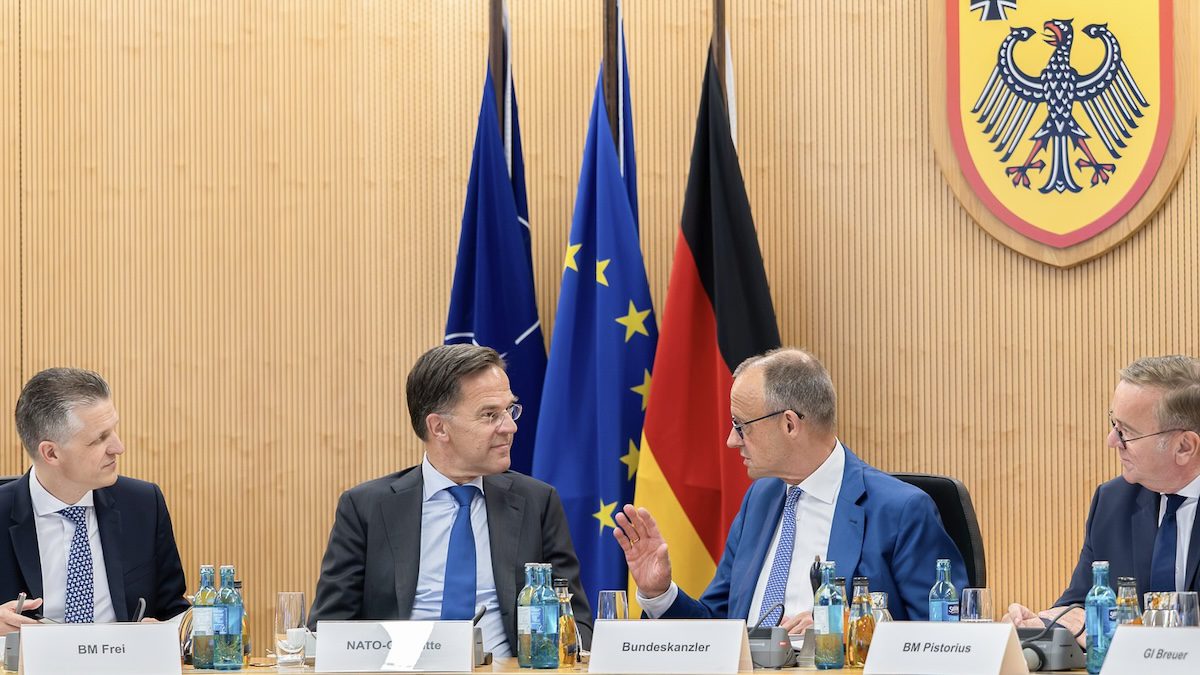
German Cabinet met in Berlin, July 1, 2026, at the Federal Ministry of Defense. NATO Secretary General Rutte attended the meeting as a guest. Photo: BMVg/Steve Eibe
In the shadow of the FIFA World Cup, the German government – a coalition of the conservative Christian Democratic Union (CDU) and the Social Democratic Party (SPD) – is pushing through a self-described “summer of reforms” that it promises will revive the stagnating economy and keep Germany “competitive” in a changing world. In practice, Chancellor Friedrich Merz’s program amounts to a comprehensive offensive against workers’ rights, social provision, and democratic participation.
In recent months alone, the government has advanced plans to slash health services, push back the retirement age, extend the working day beyond eight hours, and begin privatizing pensions. The latest “reform package,” unveiled in early July, goes further still: sick leave regulations are to be tightened to discourage workers from calling in sick, and businesses are to be given greater powers to hire workers on precarious fixed-term contracts.
This broad offensive must be understood in the context of Germany’s deliberate shift towards military Keynesianism. Shortly after announcing the latest reforms, Merz’s cabinet passed a federal budget for 2027 in which military spending is set to hit a record 140 billion euros – an increase of almost 180% since 2021. This is to be financed through cuts to healthcare (minus 34 billion euros), education (minus 7 billion euros) and transport (minus 5 billion euros), alongside massive borrowing. Unlimited debt for military spending was made possible by the previous parliament in early 2025, which rushed through a constitutional amendment enabling this just weeks before its legislative term expired.
Read more: Germany and the EU embrace military Keynesianism
To justify these drastic measures, finance minister and vice-chancellor Lars Klingbeil (SPD) argued that “we can’t defend ourselves against Putin with a balanced budget.” Increasing military spending without taking on debt would be like “flying to the moon without a rocket,” he added, without elaborating on why Germany is attempting to “fly to the moon” in the first place.
The alleged Russian threat (relentlessly invoked as a sword of Damocles hanging over Europe) has become the primary instrument for silencing opposition to the government’s plans. Militarization is presented as both a cure-all for Germany’s ailing economy and an unavoidable response to “Russia’s aggression against Europe.” Yet the timeline tells a different story: the previous government – a coalition of the SPD, Greens and liberal Free Democrats – had already announced plans for a massive military build-up in November 2021, well before the escalation of the war in Ukraine. The outbreak of a full-scale war with Russia merely served as the pretext for what leading German politicians have long pressed for: enhanced military might to aggressively pursue economic and geopolitical interests abroad.
Growing discontent
The erosion of living standards is, however, fuelling a broader crisis of legitimacy for Germany’s major parties. Merz currently holds the lowest approval ratings of any sitting chancellor since polling began, with five out of six Germans expressing dissatisfaction with his performance. Over 80% of the population also believe that wealth is unfairly distributed in the country. It is within this climate that support for the far-right Alternative for Germany (AfD) continues to rise. The latest polls show the party now sitting comfortably in first place, with the backing of over 25% of the electorate.
This trend should not, however, be mistaken for genuine enthusiasm for the AfD’s policies. Public polling conducted in April revealed that the vast majority of AfD supporters oppose cuts to pensions, elderly care, and health insurance – even though the party’s own platform calls for an acceleration of precisely these measures. Support for the far-right is less an ideological commitment than an expression of protest: a search for an electoral alternative to the parties that have governed Germany for decades. The AfD’s advantage is a structural one. As the only major party never to have governed at either federal or state level, it retains the ability to present itself as the sole true opposition. The other parties have only reinforced this narrative. By constructing a so-called “firewall” against the AfD – with The Left (Die Linke), the SPD, the Greens and the CDU all uniting in a self-proclaimed “democratic” camp – they have handed the far-right exactly the outsider status it can exploit.
Read more: Ulrike Eifler: ‘The workplace is a place where we have to fight against war’
Meanwhile, the trade unions remain largely integrated into the government’s militarization drive. Traditionally tied to the SPD, union leadership has refrained from challenging the government’s offensive and have instead propagated the notion that workers too can benefit from the transition to a militarized economy. Yet cracks are appearing. When Trade Union Federation (DGB) Chairwoman Yasmin Fahimi commended the government’s latest reforms in early July for “sending the right signals for employment, growth, and tax relief,” an open letter from within the leadership of the services union Ver.di pushed back, demanding greater resistance. The unions mobilized for anti-austerity actions in late June, with further protests planned for September. Crucially, however, these calls rarely identify the connection between austerity and militarization. By refusing to challenge the logic that necessitates the cuts in the first place, the union leadership has left its own argument fatally weakened.
Upcoming state elections
Three of Germany’s eastern states go to the polls in September: Saxony-Anhalt, Mecklenburg-Vorpommern, and the capital itself. In the first two, the AfD is leading decisively – polling at 41% and 36% respectively. In Berlin, the field is more contested, as the AfD runs neck and neck with Die Linke and the Greens.
The discontent gripping Germany at the national level is acutely felt in Berlin, where a CDU-SPD coalition also governs and holds the lowest approval rating of any state government in the country. Housing is dominating the election, as rents have almost doubled in the past decade. The “summer of reforms” has also left its mark here: in Merz’s latest reform package, the government has also committed to banning the socialization of real estate corporations. This would not only violate Germany’s constitution, which explicitly permits socializations, it would also suppress the result of the city’s 2021 referendum. Nearly 60% of voters backed the expropriation of the large housing companies that own a significant portion of Berlin’s apartments. Merz and Klingbeil claim that socialization initiatives deter private housing construction. a claim that rings hollow in a city where private investors have spent decades building luxury apartments and driving rents through the roof.
Read more: German students expand their strike against conscription and militarization to 150 cities
Die Linke, which hopes to replicate the success of Zohran Mamdani in New York City, is currently polling just ahead of the AfD in Berlin. It is likely to re-enter government in coalition with the SPD and Greens, aligning itself not only with the party seeking to ban socialization, but with the forces most committed to militarization. In doing so, Die Linke’s Berlin branch is opting to sidestep the defining question in Germany today: the drive towards war with Russia and its effects on people’s livelihoods.
Most telling is a figure from Berlin’s latest polling: 21% of voters (the largest single block) said they do not trust any of the parties to solve the most pressing problems. A deep crisis of confidence in the established political order is simmering below the surface. Yet as long as the trade unions are not sites of active resistance and the search for alternatives stays confined to the ballot box, it is the AfD that stands to gain – a party that, despite its anti-establishment rhetoric, has no intention of breaking with the militaristic and anti-worker course charted by the current government.