Palestinian factions: We categorically reject unilateral disarmament
The factions set the withdrawal of the Israeli forces from the Gaza strip as a prerequisite for advancing to phase two of the Gaza ceasefire deal.
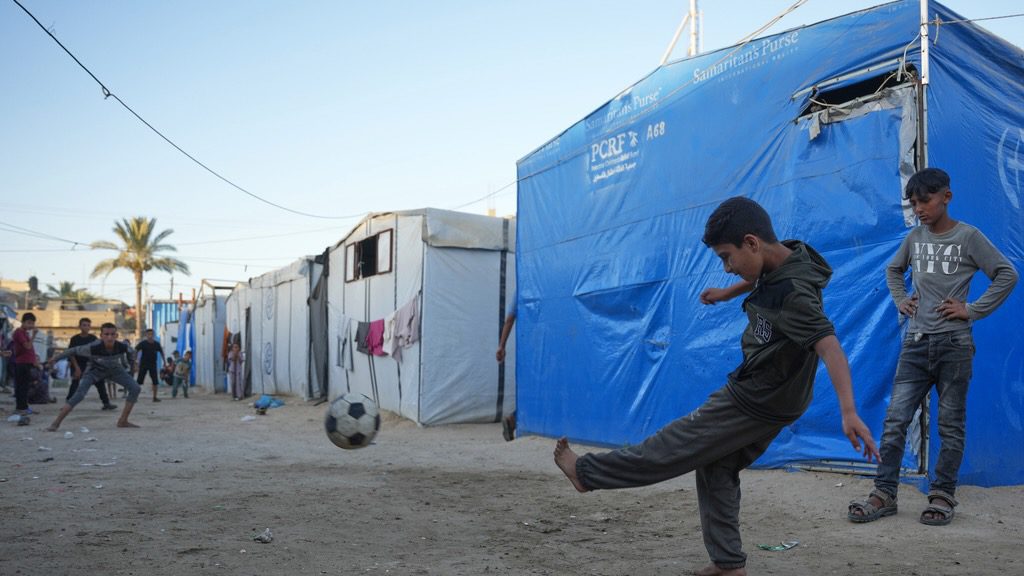
Palestinian youth play soccer in Deir al-Balah, central Gaza Strip, Saturday June 13, 2026. Photo: AP/Abdel Kareem Hana
Over eight months after US President Donald Trump announced the launch of phase one of his ceasefire deal for Gaza, modest progress seems to have been reached towards phase two.
During the first phase, Israel committed around 3,300 violations in the besieged enclave, killing almost 1,000 people and injuring thousands of others. The entry of humanitarian aid into Gaza, as well as emergency medical evacuations, have been significantly restricted.
However, the Trump administration has held Hamas accountable for obstructing progress toward the next phase of the deal. For many, this approach aims to pressure the movement and other Palestinian resistance factions to lay down arms, even as Israel continues its genocide in Gaza.
Read more: Hamas demands that Israel implement phase one of Gaza ceasefire
Mladenov’s biased “roadmap” for Gaza
Since being appointed by Trump, Nickolay Mladenov, the high representative of the Board of Peace for Gaza (a body criticized by Palestinian groups as advancing US and Israeli interests in Gaza), has effectively maximized pressure on the Palestinian resistance through both his public statements and the 15-point roadmap he revealed last month.
According to Mladenov, the roadmap is designed to implement Trump’s 20-point “comprehensive plan,” which includes reconstruction, demilitarization, the flow of humanitarian aid, the deployment of an international force, and Palestinian self-governance in the Gaza Strip.
Mladenov claimed that the proposed roadmap “rests on the principle of reciprocity.” Yet, analysts argue that it tends to frame the delay in disarming Palestinian factions as the sole obstacle hindering phase two of the deal.
Although the roadmap mentions that the killing has not stopped in the Gaza Strip despite the ceasefire, it does not point to the Israeli Occupation Forces (IOF) as the perpetrator. Neither does it stipulate the cessation of Israeli violations as a primary condition for phase two of the deal.
Moreover, it heavily focuses on decommissioning Palestinian weapons rather than demanding that Israel unconditionally withdraw from the Gaza Strip.
Under international law, the Gaza Strip is recognized as part of the Occupied Palestinian Territory (OPT), where sovereignty ultimately belongs to the Palestinian people. The plan, however, prioritizes disarming Palestinians over ending the occupation, which in turn reflects a bias toward Israel that is evident throughout the proposal.
Mladenov’s roadmap uses the October 7 attacks as a pretext to justify and whitewash the mass killing and destruction, which Israel’s genocidal aggression has caused for around three years.
This was stated bluntly, without mentioning Israel’s 78-year occupation, which for decades had systematically exterminated Palestinians before October 7 erupted as a response to the oppression.
This oppression has been fueled by unwavering US support and the inefficiency of a decaying international community, which both bolstered Israel’s impunity.
While Mladenov raved about the return of all Israeli captives – whose number does not exceed 251 – he ignored the fact that about 10,000 Palestinians have been held in Israeli jails, most arrested many years before October 7. The return of these Palestinian hostages does not seem to concern the newly-appointed high representative for Gaza at all.
Weapons in Gaza will be passed to Palestinian committee
While Mladenov’s plan exposes a blatant alignment with Israel, analysts view it as a positive development that the decommissioning of weapons in Gaza is kept within the hands of the Palestinians themselves.
As per the roadmap, all weapons will pass to the National Committee for the Administration of Gaza (NCAG), including those held by the Palestinian resistance and local Israeli-led militias. The NCAG is a transitional, technocratic Palestinian administration tasked with running daily affairs in post-war Gaza.
“Decommissioning of weapons will be gradual, sequenced and time-bound, against an agreed timetable. It will be monitored and supported. It will be Palestinian-led, with weapons transferred to the NCAG. All armed groups, and the text says that explicitly, including the militias, take part, to decommission all weapons and all militant infrastructure,” the eighth principle of the roadmap reads.
Palestinian factions categorically reject unilateral disarmament, insist on IOF’s withdrawal from Gaza
After weeks of extensive consultations with mediators and guarantors of the ceasefire deal from Egypt, Qatar, and Türkiye, Palestinian factions submitted a unified, official response to Mladenov’s roadmap on Saturday, June 13.
In their response, the factions categorically rejected any unilateral disarmament, insisting that it cannot be a prerequisite and must be implemented only after Israel ends its military actions in Gaza and stops its violations of the ceasefire deal.
They affirmed that the IOF must completely and immediately withdraw from the Gaza Strip, and dismantle any outstanding security zones or dividing corridors.
The factions required the immediate entry and full activation of NCAG in Gaza, and formed an internal handover committee in Cairo to pave the way for a smooth transition of civil governance and public services.
The demands of the Palestinian factions also included compelling Israel to fully implement the humanitarian protocols of phase one. This includes ceasing all military incursions, opening all border crossings, and allowing the unrestricted distribution of fuel and aid.
Furthermore, Palestinian factions refused linking the reconstruction of Gaza to the demilitarization process, asserting that humanitarian rebuilding should be implemented independently, without being connected to political and security-related issues
Omar Assaf hails Palestinian factions for linking armed resistance to the existence of occupation
BreakThrough News spoke to Palestinian political activist, freedom fighter, and former prisoner in Israeli jails, Mr. Omar Assaf, to get his insights about the response of the Palestinian factions to Mladenov’s plan.
Assaf stated that Palestinian factions have handled ceasefire negotiations with a high degree of responsibility since the beginning of Israel’s genocidal aggression on Gaza to protect the interests of their people. This sense of responsibility is demonstrated during their recent consultations in Cairo, and in the response they submitted to Mladenov:
“The factions gave clear responses to all the issues raised, particularly concerning the weapons of the Palestinian resistance,” the prominent Palestinian activist noted. “They linked the possession of weapons to the existence of occupation. As long as Palestinian independence and statehood are not achieved, our homeland remains under occupation, and in accordance with international law, people under occupation have a legitimate right to defend themselves and their rights.”
From Assaf’s point of view, the wording of the response, which was unanimously supported by the Palestinian grassroots and all national movements, represented a major breakthrough. It was also welcomed by mediators, especially the part that indicates passing the weapons to a Palestinian committee, rather than to the Israeli occupation or other external parties.
The veteran Palestinian freedom fighter praised the factions for insisting on dismantling the Israeli-backed militias in Gaza as a major requirement for proceeding to Phase Two.
Regarding the deployment of the International Stabilization Force (ISF), Assaf said that this force should play the role of a peacekeeping force that must protect the Palestinian people, “instead of acting as another occupying power on Palestinian soil.”
Assaf affirmed that the ball is now in Washington’s court regarding the roadmap’s success, arguing that the factions’ response offered a viable solution to several key issues, including demilitarization.