Dr. Hussam Abu Safiya appears in court for the first time after 18 months of arbitrary detention
Abu Safiya maintained that he was only doing his job “in accordance with international law and humanitarian standards," when he was detained and demanded his immediate release.
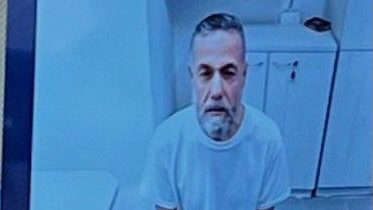
Dr Hussam Abu Safiya appears in Israeli court. Photo: Israeli authorities
In yet another attempt to break the will of Palestinians and their supporters around the globe, Israeli occupation authorities released new footage of Dr. Hussam Abu Safiya in hand and foot shackles. The footage, taken during his first appearance before an Israeli court on Wednesday, June 10, shows his health condition remarkably deteriorating.
My detention is “unjust” and arbitrary and I demand my immediate release, Abu Safiya maintained.
This is the second time that footage surfaced revealing the dire situation of the prominent Palestinian physician under Israeli custody. In February 2025, Israeli media aired a video of Dr. Abu Safiya shackled inside the prison, two months after his arrest. The video drew widespread condemnation from rights groups and activists at the time.
Almost a year and a half later, Wednesday’s trial marks the first time Dr. Abu Safiya appeared before an Israeli court since he was arrested on December 27, 2024, without charge.
Following 45 days of interrogation, the Israeli authorities could not build a case against Dr. Abu Safiya due to lack of evidence. Therefore, the Israeli Occupation Forces (IOF) ordered him to be detained under the “unlawful combatant law” instead of conducting a standard legal trial.
Read more: “A person creates history, and history is built upon the stands one takes”: Dr. Abu Safiya says from prison
Inhumane conditions of detention
For over two and a half years, Dr. Hussam Abu Safiya has endured extremely inhumane detention conditions, including solitary confinement, physical abuse, medical neglect, being forcibly stripped, being deprived of enough food, and potable water, and being incommunicado.
His appearance before the Israeli Supreme Court on Wednesday further exposed Israel’s systemic cruelty. It highlighted not only the actions of the Israel Prison Service (Shabas) toward Palestinian detainees, but also the complicity of other institutions, particularly the judiciary.
Dr. Abu Safiya did not appear physically before the court during the appeal hearing, but via a video link, and when his lawyer, Nasser Odeh, requested that his shackles be removed the court refused.
Odeh confirmed that Dr. Abu Safiya still suffers from the same harsh detention conditions, despite the repeated appeals submitted to the court to compel the prison administration to improve these conditions.
“Dr. Hussam is still being held in military confinement in Nafha prison. He appeared via screen handcuffed and shackled. The court refused to remove the shackles. He did not receive medical treatment and did not get the medications he needed as a result of his chronic illnesses,” Odeh noted.
“We requested the court to compel the prison administration to provide medical services to Dr. Hussam Abu Safiya. The prosecution claimed that up to this point, it has no information regarding his health condition or the services provided to him. The court ordered the prosecution to provide an update on Dr. Hussam Abu Safiya’s health status as soon as possible, and we are continuing to follow up on this matter,” the lawyer continued.
Regarding Dr. Abu Safiya’s solitary confinement, Odeh said:
“We remain convinced that this isolation is a punitive measure aimed at deterring Dr. Hussam Abu Safiya and other detainees from going to Israeli courts and the Supreme Court in particular. The prosecution claims that this isolation is part of a security measure taken by decision-makers in the intelligence services of the prison administration. We demanded the disclosure of information and evidence proving that the doctor posed a danger while with other detainees in the departments. The court did not respond to this request and refused to disclose this evidence, which the prosecution claims exists as a confidential file.
The lawyer also shared more details of a physical assault that the doctor was subjected to while being transferred from a prison to another two months ago, leading to severe back and neck pain.
Odeh reaffirmed that Dr. Hussam has not been provided yet with any medical treatment for the injuries he sustained, or the chronic illnesses he suffers from, including skin diseases and vision problems that he developed because his eyeglasses were confiscated.
The attorney shared further details about the calamitous mistreatment the doctor is still enduring inside Israeli jails, saying:
“He is being denied adequate food both in quantity and quality. He is being denied access to potable water. He is being prevented from seeing his lawyer. He is being prevented from seeing the Red Cross. He is being subjected to systematic and daily abuse and violence.”
Dr. Abu Safiya labels his detention “unjust and arbitrary”
According to lawyer Nasser Odeh, Dr. Abu Safiya denied the charges against him, considering his detention “unjust and arbitrary.” He also demanded that the court order his immediate release.
“I am a pediatrician, and I provide medical services and care to the patients, the injured, and the vulnerable people in the Gaza Strip. I performed my work in accordance with international law and humanitarian standards. My detention is unjust and arbitrary, and I demand that the court order my immediate release,” Odeh cited Dr. Abu Safiya stating.
He also indicated that Dr. Hussam’s detention ruling has been postponed, and a decision from the court is expected within hours or days.
Dr. Abu Safiya sent a plea to Anas al-Sharif, unaware that he had been assassinated
While the new developments that surfaced following his trial have already been tragic and overwhelming, the details that Dr. Abu Safiya’s son, Elias, revealed about his father days earlier were no less distressing.
Elias Abu Safiya told Al Jazeera in an interview that his father managed to send the family a message through a human rights lawyer who was allowed a rare visit to see him two months ago.
Besides recounting the disastrous circumstances of Dr. Abu Safiya and other Palestinian political prisoners, Elias said that a request from his father related to the late Palestinian journalist Anas al-Sharif represented the most painful part of his message.
“If you managed to reach out to Anas al-Sharif, ask him to remind the world about our cause and our suffering,” Elias quoted his father’s request.
“My father thought that journalist Anas al-Sharif was still alive. He has perceived him as a voice that can deliver the message of the oppressed people to the world,” Elias said about the renowned journalist, who was assassinated by Israel alongside five other Palestinian journalists near Al-Shifa Hospital, in Gaza in August 2025.
Read more: Israel kills six Palestinian journalists, including Al Jazeera correspondents Anas al-Sharif and Mohammad Qreiqe
Elias pointed out that his father’s request demonstrates how long he has been isolated from the outside world, and how he hoped he would be able to inform the world about the suffering of the Palestinian prisoners.