Peru’s future hangs in the balance as vote count inches along
Peru’s presidential candidates have remained cautious and reserved as they wait for the official result to be announced.
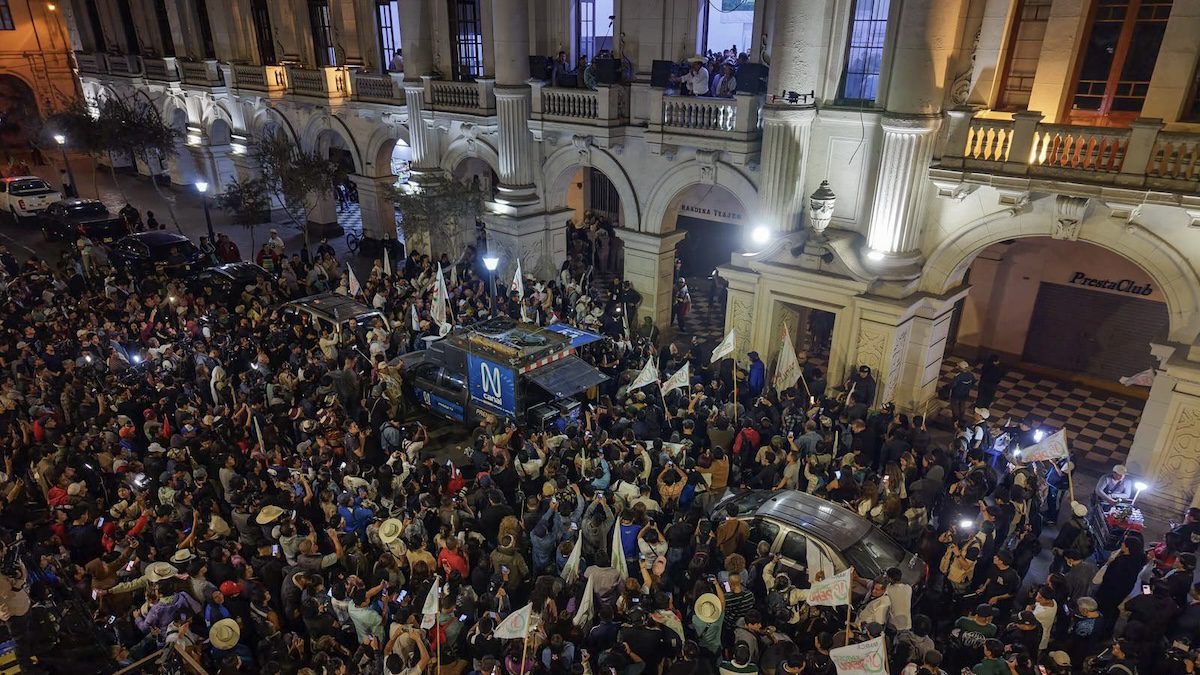
Roberto Sánchez speaks to supporters from balcony. Photo: Roberto Sánchez / X
On June 7, Peruvians returned to the polls to elect their president. As of 12:20 pm in Lima, Peru, with 93.617% of the ballots counted, right-wing candidate Keiko Fujimori of Fuerza Popular (FP) is in first place. She holds 50.017% of the vote thanks to a narrow lead of nearly 6,000 votes over Roberto Sánchez of Juntos Por el Perú (JP), who currently stands at 49.983%.
However, as the hours pass, Fujimori’s lead over Sánchez is shrinking. This is because the votes being tallied most quickly by the National Office of Electoral Processes (ONPE) are those from the cities, especially Lima, which accounts for nearly one-third of the country’s population and where Fujimori won comfortably.
However, just as happened in the 2022 presidential election and in this year’s first round, votes from the poorest areas farthest from the capital are gradually coming in and adding to the tally of the left-wing candidate, who has specifically appealed to rural and working-class communities in Peru’s interior to build his political platform.
This is why the ONPE, Peru’s national electoral authority, was unable to declare the runner-up until well into the process of counting and recounting votes from contested ballots. In the end, it resulted in a victory for the left-wing candidate, despite the anger of the far right.
And while a significant portion of Peru’s traditional media attempted to present the exit poll data as an almost immutable figure (50.03% for Fujimori and 49.7% for Sánchez), the reality of a country clearly split into two distinct realities once again proves the skeptics right. On the night of June 7, Fujimori led Sánchez by more than 100,000 votes. That lead has shrunk by nearly 90% in 12 hours.
Furthermore, it is clear that the vote counts from urban areas were tallied within a few hours, while those from rural areas are still taking time to come in. And it is precisely in many of these predominantly peasant, indigenous, and rural areas where Sánchez is “crushing” Fujimori, maintaining the vote share that Castillo secured four years earlier against the same right-wing candidate.
However, it is still too early to say who will claim victory. It will undoubtedly be a neck-and-neck race to determine the winner of the country’s presidency. “An exit poll does not elect presidents. Votes do. Let us await with calm and confidence the official count of EVERY BALLOT across Peru and abroad. Thank you to those who participated in this democratic process. Every vote counts. Every ballot counts. Every Peruvian counts,” Sánchez told his supporters, calling on them to remain vigilant against any attempt to manipulate the will of the people.
For her part, right-wing candidate Fujimori has also maintained a cautious tone after learning the results of the exit polls: “We are in a technical tie. At this moment, there is no winner in this race. For that reason, it will be a long wait until we know the winner.”
What options is Peru choosing from?
On the right side of the political spectrum, Keiko Fujimori, daughter of dictator Alberto Fujimori, made it to the runoff for the fourth time in an attempt to secure a presidency that has always eluded her. Her father’s controversial legacy – which she has positioned herself as the heir to – has given her a stable voter base, but has also sparked fierce opposition from the left and a significant portion of the right.
On the political left emerged Roberto Sánchez, a psychologist who has declared himself the most loyal follower of Pedro Castillo, the last president to win an election and who is currently detained for attempting to convene a constituent assembly to abolish the neoliberal constitution in favor of a popular one with a state more present in the economy and oriented toward the welfare state. Following the coup against Castillo, thousands of Peruvians protested for several months and were repressed by the government of Dina Boluarte (more than 50 deaths were reported).
Thus, both candidates appealed to a political past to gain the support of a citizenry that split its vote among the more than 30 presidential candidates in the first round on April 12. Keiko Fujimori came in first with just 17.19%, while Sánchez received 12.08%, closely followed by the far-right candidate, Rafael López Aliaga, who received 11.91%.
Both Fujimori and Sánchez have focused their efforts on winning the support of the vast majority of Peruvians who did not vote for them in the first round. And they have done so by appealing to voters’ fear of the other candidate. Keiko has claimed that Sánchez represents communism, a claim that Sánchez has denied on several occasions. For his part, Sánchez asserted that Keiko represents the Fujimori-style authoritarianism that already ruled the country for a decade in the 1990s and left a grim legacy of human rights violations and the imposition of a predatory and radical neoliberalism.
Now, only time will tell. Both candidates and their teams are keeping a close eye on the official results and any possibility of challenging the tally – vote by vote – to secure a potential victory that, for now, remains a tense mystery for the nearly 35 million Peruvians, as well as for the region’s geopolitics, which this election could shape in one way or another.