Five years after Saied’s power grab, economic crisis and democratic decline fuel discontent in Tunisia
Tunisia’s political crisis is deepening five years after Kais Saied’s power grab, as economic pressures, declining public services, and restrictions on political freedoms fuel renewed opposition.
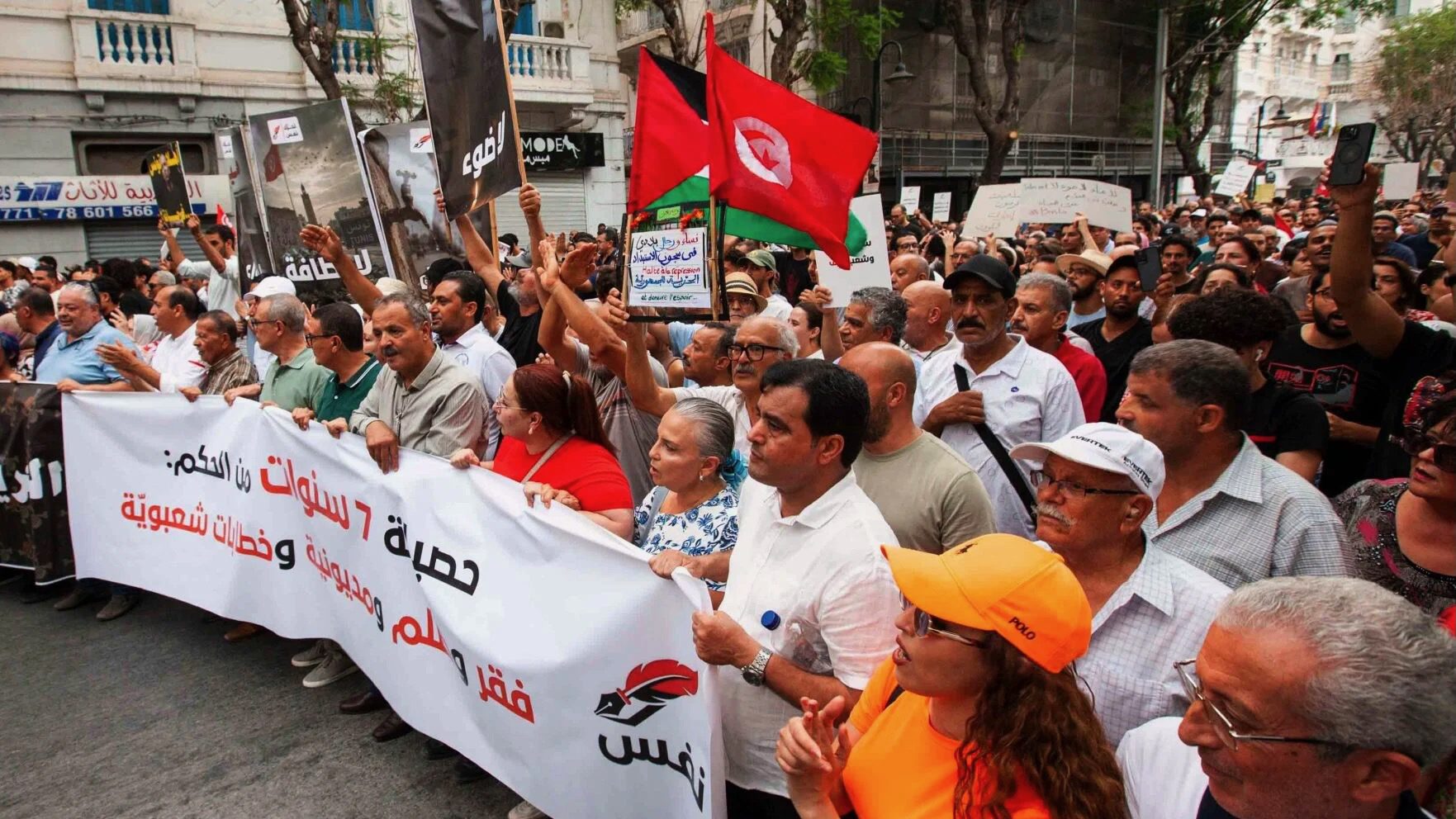
People take part in a demonstration against President Kais Saied, in downtown Tunis, Tunisia, Saturday, July 25, 2026. Photo: AP
Tunisians took to the streets on July 26 to mark the fifth anniversary of President Kais Saied’s consolidation of power, calling for his resignation and expressing opposition to increasing restrictions on political freedoms, worsening economic hardship, and declining living conditions.
Protests mark five years since Saied’s power grab
Saied came to power on July 25, 2021, following which, he suspended parliament, dismissed then-Prime Minister Hichem Mechichi, lifted parliamentary immunity, and assumed broad executive powers. At the time, Saied defended the move as a necessary step to end years of political paralysis, corruption, and economic stagnation.
However, opposition parties, movements, and civil society groups characterized the measures as a coup, arguing that they undermined the democratic institutions established after Tunisia’s 2011 revolution.
Since then, Saied has continued to rule with expanded presidential authority. He introduced a new constitution in 2022 that significantly strengthened the powers of the presidency while reducing the role of parliament. In 2024, he secured a second presidential term in an election marked by turnout of approximately 28%, one of the lowest levels since the revolution. Several leading opposition figures were imprisoned or prevented from participating, while major opposition parties boycotted the vote, questioning its credibility.
The anniversary protests reflected growing public frustration over Tunisia’s political direction and economic challenges. Opposition groups argue that the government has failed to deliver on promises of reform and economic recovery made in 2021.
Workers’ Party says Tunisia has “no water, no light, no freedom”
The Workers’ Party of Tunisia, whose leader had recently received death threats online, released a statement which described the current political situation as a continuation of authoritarian rule and declared that Tunisia had become a country of “no water, no light, no freedom.”
The party says that the republican aspirations proclaimed at Tunisia’s independence had been undermined by successive governments and that the situation had worsened since what it called the “populist coup” of July 25, 2021.
According to the Workers’ Party, the promises of “reform,” “rescue,” “serving the interests of the people and the nation,” and “protecting national sovereignty” made by Saied’s government had been exposed as “empty slogans.” It argued that, instead of resolving the country’s problems, the past five years had produced what it described as “an even more horrific form” of authoritarian rule.
The party said Tunisia’s economic crisis had deepened across multiple sectors, pointing to rising public debt, growing dependence on foreign financing, persistent budget and trade deficits, declining productive capacity, and pressures on energy and food security.
It argued that these economic challenges had intensified social problems, contributing to higher unemployment, poverty, inflation, and declining purchasing power as prices increased while wages remained under pressure.
The statement also highlighted problems affecting public services, saying shortages of essential goods and medicines, alongside “frequent power and water outages,” had become major sources of public frustration.
Beyond economic concerns, the Workers’ Party accused the authorities of expanding political repression. It alleged that the government had responded to criticism through “more political repression, security escalation, vindictiveness and trials,” claiming that the judiciary had been transformed into “a functional tool” serving executive interests. The party also accused authorities of restricting political activity, trade unions, civil society organizations, and independent media.
Opposition sees momentum building alongside deepening crisis
Although it acknowledged that mass mobilization has declined in recent years, the Workers’ Party argued that opposition to the government has not disappeared. “The struggle movement has experienced a significant decline … but its embers have not been completely extinguished,” the statement said, pointing to renewed activity among people, movements and other social groups.
Read more: From Gabès to Sfax: industrial pollution in Tunisia between deferred decisions and accumulated crises
The party called for what it described as “a comprehensive, republican, national, democratic and popular alternative” to the current political system. It urged progressive organizations and democratic forces to unite around demands for the release of political prisoners, the return of exiled opposition figures, greater judicial independence, media freedoms, and improvements in wages, healthcare, transportation, housing, water, and electricity services.
Five years after Saied’s consolidation of power, Tunisia remains deeply polarized. While the president continues to exercise sweeping executive authority, opposition parties and social movements appear to be regaining momentum amid growing public frustration over the government’s inability to resolve the country’s persistent economic and political crises.