Israeli cabinet approves deployment of ISF in Gaza
Palestinians categorically rejected the development, considering it an attempt to consolidate the Israeli occupation of the Gaza Strip.
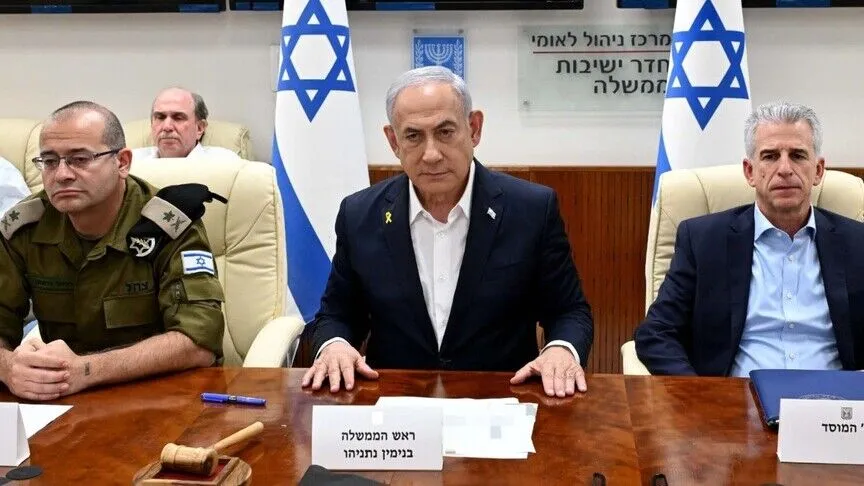
Benjamin Netanyahu sits with the Israeli Cabinet. Photo: Anadolu Ajansi
The Israeli Security Cabinet gave an initial approval on Sunday, July 27, to a limited pilot deployment of the International Stabilization Force (ISF) in the Gaza strip under the Board of Peace-led plan, brought forward by US President Donald Trump.
Read more: Cryptocurrency, billions of dollars, and five countries to send troops: what’s new in Trump’s “Board of Peace” for Gaza
The ISF: a covert occupation of Gaza
For many, the move drew controversy because the conditions imposed by Israel would further entrench its occupation of the war-torn enclave.
Although Trump’s plan suggests that the ISF would eventually comprise 20,000 soldiers, the cabinet endorsed the entry of only 200 troops over an unidentified period. These troops would operate “in full coordination” with Israeli Forces.
Netanyahu’s government also decided that the ISF personnel should be from what it defined as “friendly countries,” namely states “with which Israel has a peace agreement, and which are not acting against the State of Israel or its officials in international forums.”
Uganda and Morocco seem to be the first candidates to contribute in these troops, while Indonesia is expected to be excluded due to not having diplomatic ties with Israel, despite promising to contribute with around 8,000 soldiers.
Meanwhile, Türkiye is likely to be kept out of the ISF because of its censure of Israel’s genocidal aggression on Gaza, and for hosting Hamas leaders.
The cabinet also restricted the operation of the ISF geographically to “a pilot humanitarian zone” that will be established beyond the “Yellow Line” in the Rafah area, in southern Gaza. The Yellow Line is a 45-kilometer military demarcation boundary, which separates the Israeli-controlled eastern zone from the Hamas-controlled western zone.
The ISF personnel would deploy there once Israeli forces withdraw to other areas of Gaza under their control, noting that Israel continues to occupy 70% of the Gaza Strip.
As per the cabinet’s decision, Israel will not withdraw from the Yellow Line “as long as Hamas is not completely disarmed and the strip is not fully demilitarized.”
Palestinian factions had already rejected the deployment of ISF in Gaza as a “foreign guardianship”
The proposal of deploying an international force in the besieged strip had already been met with categorical rejection by the Palestinian Islamic Jihad, the Popular Front for the Liberation of Palestine (PFLP), and Hamas last October when Trump first revealed his 20-point plan for Gaza.
“We renew our rejection to any foreign guardianship, and we stress that the nature of the administration of the Gaza Strip and its institutions are an internal Palestinian matter to be determined by the national component of our people directly,” the three factions said then in a joint statement.
The recent Israeli decision regarding the limited entry of the ISF into Gaza once again provoked the ire of Palestinian political leaders.
Mahmoud Khalaf, a leader in the Democratic Front for the Liberation of Palestine (DFLP) told local news agency Ma’an, that “the Israeli decision was issued unilaterally, it did not result from negotiations with the Palestinian side, and does not fall within any understandings related to Nikolay Mladenov’s plan or the initiatives proposed for ceasefire and stability.”
“The decision does not include any commitment to the withdrawal of the IOF from the Gaza Strip, but rather aims to impose new facts on the ground without Israel bearing any political or legal obligations related to ending the occupation,” Khalaf added.
He also warned that “the step reflects Israel’s desire to consolidate its control over the Strip.”
The cabinet’s decision was a nominal move to ease Washington’s pressure, say analysts
The Israeli cabinet approval of the ISF’s arrival in Gaza came only two days prior to Netanyahu’s meeting with Trump, which took place on Tuesday, July 28.
Consequently, the decision was described by analysts as a nominal move, which they say aims to ease the pressure of the Trump administration on Israel regarding the advancement into phase two of the US-brokered Gaza ceasefire deal.