Settler violence escalates in the West Bank. Understand why it is concentrated east of Ramallah
The past week saw the killing of three Palestinians, including a teenage footballer, at the hands of illegal Israeli settlers and the IOF.
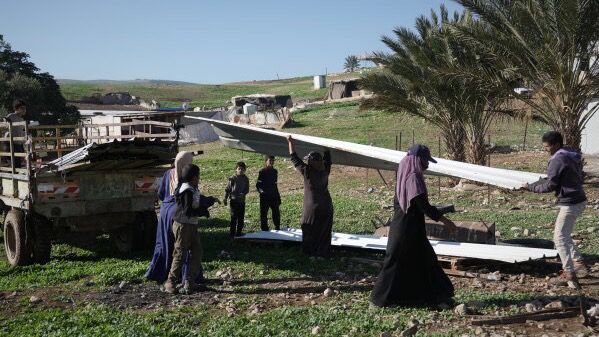
Palestinian residents of Ras Ein al-Auja village, West Bank pack up their belongings and prepare to leave their homes after deciding to flee mounting settler violence. Photo: AP
For decades, Israel has employed settler violence against Palestinians in the occupied West Bank as part of its program of ethnic cleansing. However, such violence has sharply increased since the far-right ultra-nationalist government, led by Israeli Prime Minister Benjamin Netanyahu, came to power in 2022.
While settler violence has affected the entire occupied territory over the last couple of years, it has been heavily concentrated in villages east of Ramallah, including Al-Mughayyir, Turmus Ayya, Deir Dibwan, Deir Jarir, Kufr Malik, Mazraa Al-Sharqiyah, and Khirbet Abu Falah.
A convergence of geographic, political, and strategic factors has made this area one of the primary flashpoints for displacement and the takeover of land in the occupied West Bank.
Ramallah’s eastern countryside overlooks the Jordan Valley to the east and the central West Bank to the west, making it a critical visual and geographical crest.
A continuous chain of Israeli settlements and wildcat outposts were established on the hilltops around these villages in order to isolate Palestinian agricultural communities, cutting them off from their surrounding pasturelands, and connecting infrastructure.
The local economy of villages east of Ramallah remains deeply rooted in traditional rain-fed agriculture, notably olive orchards and livestock grazing. This in turn made the area a target for systematic settler violence during harvest periods, severely undermining the long-term economic viability of the land for indigenous farmers.
The semi-nomadic Bedouin and Palestinian herding communities along the eastern Ramallah slopes have also been systematically targeted by aggressive settler groups, who destroy their crops, seize their animals, block their water supply and attack them physically.
Read more: Paradise lost: a Palestinian farmer on settler violence and dispossession
Three Palestinians killed in villages east of Ramallah in one week
On Sunday, July 19, the Israeli Occupation Forces (IOF) and illegal settlers launched a coordinated attack against Palestinians in Deir Jarir town, northeast of Ramallah in the central occupied West Bank.
Odah Abdul-Rahim Farakhna (53), and Ahmad Adul-Rashid Abu Mokho (26) were shot dead, while a third person was injured in the assault.
B’Tselem, an Israeli non-profit organization that documents human rights violations committed by Israel in the occupied Palestinian territories, slammed the offensive on Deir Jarir, accusing Israel of promoting ethnic cleansing in the West Bank.
“The killing in Deir Jarir is one example of how Israel promotes ethnic cleansing in the West Bank: settlers invade and steal, while the military and police accompany them and shoot Palestinians who try to protect their homes and property,” Yuli Novak, the executive director of B’Tselem noted.
The deadly attack on Deir Jarir was preceded by another tragic incident in Al-Mughayer village, northeast of Ramallah.
Palestinian footballer Fadi Hamdallah Al-Nasaan (17) died on Saturday, July 18, due to injuries he sustained after being shot by the IOF one week earlier during a raid on Al-Mughayer.
According to the Palestinian Football Association, Al-Nasaan is one of 1,013 Palestinian athletes, including 568 from the football community, who have been killed by Israel since October 7, 2023.
Meanwhile, the latest death toll published by Shireen Observatory indicates that at least 79 Palestinians have been killed due to Israeli violence in the occupied West Bank since the beginning of the year. This includes 21 children, five women, two elderly people, three prisoners, and one journalist.