Suspension of political parties seeks to undermine Ecuador’s largest opposition force, warn critics
Left critics argue that the ban on the AMIGO party in Ecuador is an effort to ensure there is no strong opposition party that can contest elections.
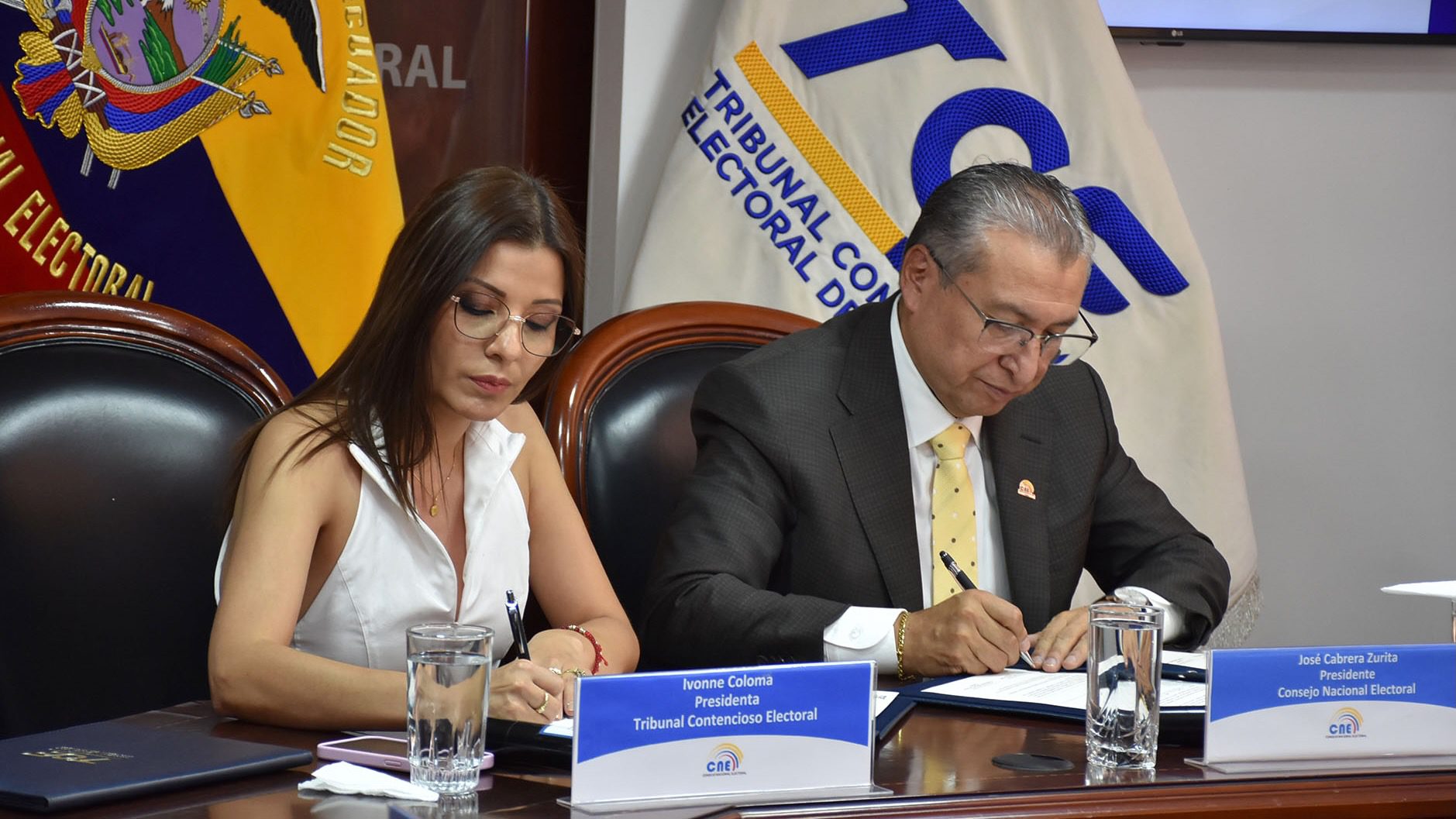
Ecuador’s Contentious-Electoral Tribunal (TCE). Photo: X/TCE
Last week, Ecuador’s Contentious-Electoral Tribunal (TCE) decided to temporarily suspend the AMIGO political party, thereby barring it from participating in the upcoming local elections to be held on November 29, 2026. Why? According to the body, it upheld a complaint filed by the prosecutor in charge, Carlos Alarcón, regarding alleged money laundering by party leaders, although the bulk of the evidence has been classified as confidential.
However, several critics of the current regime claim that this is yet another political maneuver by the right-wing Daniel Noboa administration to ban the participation of the main opposition political force, the Citizen Revolution (RC), which brings together supporters of former progressive Ecuadorian President Rafael Correa, who served from 2007 to 2017 and currently lives outside the country due to several criminal cases against him, although the former president claims these are acts of “lawfare.”
A series of bans of political parties
Although election authorities claim they have acted without political pressure from the government, the truth is that the Correístas insist that the suspension of the AMIGO movement is part of a string of bans aimed at ensuring Noboa wins at all costs following the clear defeat his administration suffered in the last referendum of 2025.
This is because AMIGO had become a party that had signed an alliance with the RC so that the latter could participate in the upcoming regional elections. On March 6, the TCE announced that it would suspend the RC party for nine months, leaving the main political opposition force to the Noboa administration without a party.
Immediately after the suspension, Gabriela Rivadeneira, former president of Congress and current president of the RC, said they were expecting some form of political censure, so they were in talks with other parties to participate in the elections. After announcing that AMIGO would be that party, the electoral body decided to suspend it, leading many to see a clear intention and strategy to exclude Correísmo from the upcoming elections.
Added to this are the accusations of political persecution leveled by various opposition groups. For one thing, the mayor of Guayaquil, Aquiles Álvarez – who won the mayoral election thanks to an alliance with the RC – was arrested several months ago and is currently in custody without having been convicted. On the other hand, Mayor Cristian Zamora was suspended and temporarily removed from office in Cuenca. The mayor of Quito, Pabel Muñoz, for his part, has had to navigate several allegations against him that could jeopardize his bid for reelection. In this regard, several opposition politicians have stated unequivocally: the aim is to use the ordinary and electoral justice systems to prevent them from participating in the elections.
Read more: “A setback for democracy”: Two more opposition parties banned in Ecuador
Ecuador drifts toward dictatorship
In light of these circumstances, several online journalists and politicians from both the left and the right, among others, have gone so far as to speak of an authoritarian drift by the government, and some have even called this situation a “dictatorship” – especially in light of the National Electoral Council’s refusal to allow the collection of signatures for a possible recall of Noboa’s mandate, which several citizens requested under the protection of the Constitution. The highest electoral authority, for its part, stated – following a forceful complaint by Noboa, who sent dozens of boxes of documents – that there were no grounds to initiate the process.
Among those critical of the latest developments is right-wing politician and former presidential candidate Henry Cucalón, who said: “Democracy is about participation and must work for everyone. A level playing field, even for those who think differently. How can teams be suspended when the tournament is already underway, with teams already selected and preparing to participate? Autocracies will always be reprehensible, no matter which side they’re on.”
“This isn’t about supporting impunity – never that. But wanting to replace the battle of ideas – which is essential to defeating an ideological-political adversary – with a war of dirty tricks and a contest over who can abuse their power the most, all to eliminate alternatives, is something Ecuador doesn’t deserve … Of course, if you align yourself [with those in power], you can have your entire family in the Assembly, or the Prosecutor’s Office might overlook you, and as a reward, funded by public money, the state propaganda machine will applaud you and offer you protection. “I reject this stale but ‘new’-sounding way of doing politics,” Cucalón concluded.
A targeted campaign against the Citizen Revolution
For his part, Quito Mayor Muñoz, a member of the RC, said that the alliance with AMIGO was the fifth one the RC had formed in order to field its own candidates, because the previous ones had always been boycotted: “This should be a concern not only for members of the Citizen Revolution, but for every Ecuadorian … This isn’t directed against any particular party, but against democracy itself, because everyone has the right and freedom to support whomever they choose in an election … If things continue this way, in the future we’ll end up with a ballot that has only one box.”
Read more: Noboa authorizes presence of the US military in Ecuador and promises total immunity
Regarding whether Correa-aligned candidates will be able to participate in the upcoming elections, Rivadeneira said: “Several political organizations have called us in the last few hours and opened their doors to us … to be honest, I’m afraid to say it. As we were saying a moment ago, we didn’t want to announce Amigo because as soon as they found out, they were going to sanction it. Honestly, we want to protect the identity of these organizations.”
Messages such as “For the right to choose who best represents us” and “Respect democracy!” were displayed on July 20, when several dozen citizens protested against the electoral authority in front of the National Electoral Council’s headquarters – an entity that, by the end of the day, complied with AMIGO’s suspension despite pressure from citizens.
For now, it remains to be seen whether the RC will ultimately be able to field its candidates and which party will step forward to mediate, despite the potential threats that, according to parties such as AMIGO and RETO, any political organization wishing to participate in the upcoming elections will have to face.