‘Hands Off Asia means socialism today,’ says Vijay Prashad at Colombo conference
Over 70 delegates from 43 organizations and 17 countries have gathered in Sri Lanka to discuss the many dimensions of true sovereignty and the process of its collective construction.
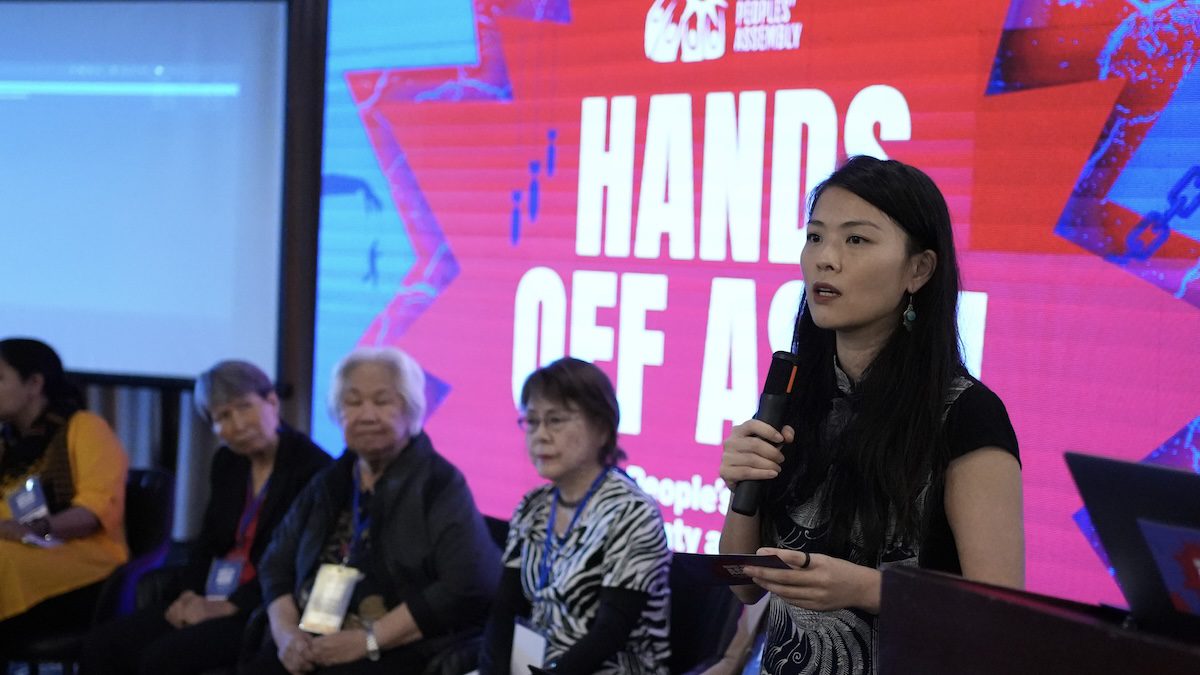
Tricontinental Researcher Tings Chak speaks at the "Hands Off Asia" Conference. Photo: IPA
Asia is home to about 60% of the world’s population and is increasingly the motor of the world’s economy. The continent also has a long tradition of revolutionary national liberation struggles and left and progressive movements.
Today the people and governments of Asia today find themselves in the crosshairs of a New Cold War, gasping for breath under the yoke of the International Monetary Fund (IMF) and bearing the burden of tens of thousands of US troops stationed in close to 400 bases spread across the region. In this context, what does genuine sovereignty mean for the people of the continent, and how can progressive organizations join hands to construct this sovereignty? These questions were at the center of “Hands Off Asia: A People’s Call for Sovereignty and Solidarity,” a conference organized by the International Peoples’ Assembly and the Tricontinental: Institute for Social Research from July 16–18, 2026 in Colombo, Sri Lanka.
Read more: Hands Off Asia conference aims to build common resistance against hyper-imperialist interventions in the region
On the first day of the conference, attended by over 70 delegates from 43 organizations from 17 countries, speakers delved into the various dimensions of sovereignty and the challenges before the forces of the left, the architecture of confrontation devised by US imperialism, and the dynamics of regime change and destabilization operations across the continent.
Asia’s quest for sovereignty
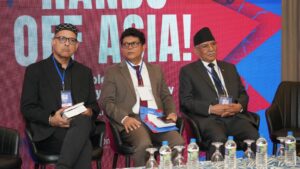
The opening plenary was addressed by Pushpa Kamal Dahal (Prachanda), former Prime Minister and Chairperson of the Nepali Communist Party; Dr. Dammika Patabendi, Sri Lanka’s Cabinet Minister of Environment; and Vijay Prashad, Executive Director of Tricontinental: Institute for Social Research.
Read more: Asia’s peoples call for sovereignty and solidarity
Prachanda and Dr. Patabendi recalled the political trajectory of the left in their respective countries and asserted that political change alone does not guarantee sovereignty. In an era in which the mechanisms of domination have become more sophisticated, democracy must encompass meaningful participation in political, economic, and social life for all sections of society, especially the disadvantaged, Prachanda pointed out. He highlighted the lessons from Nepal’s journey, noting that great victories have taken place when progressive forces are united, and said that the Bandung spirit remains vital today, with Asia’s future depending on its ability to choose collaboration over confrontation. Dr. Patabendi cited the long journey of the left-wing Janatha Vimukthi Peramuna, which faced brutal repression but continued to accompany the people in their struggles, and the ruling National People’s Power (of which the JVP is a constituent), which placed the people at the center of the national reconstruction project after the economic crisis that ravaged the country.
Laying out the agenda for the conference, Vijay Prashad said that the central political challenge for the people of Asia was to construct popular power and regional cooperation against the constraints imposed by imperialism. “Hands off Asia is more than closing bases; it means allowing the people of Asia to determine their destiny. Hands Off Asia means socialism today,” he said.
The militarization of Asia
The first panel discussion of the day, on the theme “The Militarization of Asia and the Architecture of Confrontation,” brought together speakers with vast experience and insight in resisting the imperialist footprint on the continent. Speaking about Iran’s historic fightback, Dr. Setareh Sadeqi Mohammadi from the University of Tehran said her country had shattered the myth of US invincibility. She noted that Iran was able to exercise a spatial veto in the Strait of Hormuz while ensuring that US bases in the region were no longer shelters for those hosting them. “We need to use our strategic geography in order to pressure the US imperial system,” she said.
From Japan, Dr. Keiko Yonaha from No More Battle of Okinawa explained the long trajectory of the Okinawan struggle against US bases and the dangers posed by threats of war around Taiwan. She flagged frequent military exercises between the US and Japan, arms sales, and constant talk of potential attacks by China as factors that increase tensions in the region rather than provide safety to the people. The country may be lurching toward war if the LDP government remains in power, she said, adding that Japan needs to fight for the right to self-determination, the right to self-government, and national dignity.
Filipino activist Corazon Valdez Fabros from the International Peace Bureau and STOP the War Coalition discussed how her country is being turned into a logistics and base platform for US-led war planning in the Asia-Pacific, with military spending and dual-use infrastructure displacing social needs. She focused on the “war tax,” US Defense Secretary Pete Hegseth’s demand that Asian allies spend up to 3.5% of their GDP on the military. She explained how the US is trying to ramp up arms sales in the region by ensuring interoperability of military technology, which would force countries in Asia to buy its weapons. “The United States plays the role of the international policeman … [while] the Philippines, for that matter, provides the physical real estate, the land that is being occupied, that will be occupied and used, providing access to strategic runways and dual-use logistical corridors.” She also provided two vital contemporary examples: the Luzon Economic Corridor, which has clear dual-use potential, and the Pax Silica initiative, which is explicitly being framed as a counter to China. “Our call is for the Philippines to have true neutrality and to adopt an independent foreign policy … it is a community of people and not a combat zone,” she said.
The assembled delegates also heard a unique perspective from Taiwan from Dr. Meei Shia Chen of the Diaoyutai Education Association, who has spent close to five decades resisting US military and ideological control. She explained the depth of US political, military, and ideological control over Taiwan and the pushback by a small but committed group of activists. Dr. Chen said that the education system, media, study abroad programs, and training of pro-American elites are among the methods through which the US seeks to maintain its hegemony, alongside the cultivation of anti-communism and anti-Chinese sentiment. She also narrated the story of resistance by her organization, which has been fighting against the handover of the Diaoyutai Islands by the US to Japan and the harassment of fishermen from the area.
Bangladesh may not have any permanent US bases, but recent developments around two ports have raised cause for concern, said Bangladeshi scholar Dr. Farheen Alamgir from Monash Business School, Australia. The leasing of Chittagong port and the shift from a Chinese-financed deep-sea port to Japanese-backed Matarbari, raise questions about sovereignty, Quad politics, and the indirect routes of US influence, she said. Dr. Alamgir spoke about how militarization is more than direct violence, as it also embeds military values, institutions, and interests into development, privatization, labor regimes, and state practice. She cited a range of examples – from the privatization of jute mills to the nuances of the class composition of the 2024 protests – to ask whose anger is represented in the language of mass politics and whether the agenda of the working class is being erased in the process.
The experiences of the 2024 protests in Bangladesh, similar protests in Nepal, and experiences in Thailand and Timor-Leste were the subjects of the second panel of the day, “Hegemonic Recomposition: Regime Change, Political Destabilization, and Imperial Interference.” Speakers examined how genuine grievances are redirected, how popular anger is separated from class politics, and how weakened or fragmented left forces create openings for external pressure.
Nur Ahmed Bakul of the Workers Party of Bangladesh opened with the events of July and August 2024, which led to the overthrow of the government in Bangladesh. He said that while the movement drew on wider frustration over economic hardship, political polarization, governance failures, and anger among sections of the younger generation, these genuine grievances were later shaped by forces linked to US imperialism, the religious right, sections of the NGO sector, and parts of the intellectual community. He warned that the struggle now was over more than just a change of government but encompassed the historical and constitutional legacy of the 1971 Liberation War, secularism, national sovereignty, and the political space available to progressive and left-democratic forces.
Balram Prasad Banskota of the Nepal Communist Party placed the Nepali experience inside a wider regional pattern. Imperialism, he argued, no longer depends only on direct military intervention or open repression. It now works through the fragmentation of parties, unions, peasant movements, youth organizations, and public opinion. He warned that public anger over unemployment, migration, housing, corruption, and economic insecurity is real, but can be detached from class analysis and turned into a conflict between generations or a demand for technocratic “new faces.” Against this, he called for renewed ideological education, stronger youth and women’s leadership, internal democracy, digital strategy, and forms of organization able to connect immediate anger to political economy.
From Thailand, the DinDeng collective described the monarchy-military complex as the central structure of ruling-class power. They traced Thailand’s repeated coups, the use of lèse-majesté law, judicial interventions, and the weakening of elected governments to a long class conflict between the rural poor and the Bangkok-centered elite. Their account showed how welfare measures and rural development programs gave poor and rural communities some material basis for political agency, and how military, royalist, and bourgeois forces moved repeatedly to contain that threat. They also warned that newer liberal formations can replace class politics with the language of clean administration, aesthetics, and middle-class respectability.
Agustino Perez of the Socialist Party of Timor spoke from the position of a small country navigating unequal power. He described Timor-Leste’s struggle after independence to defend its resources, especially oil, gas, and maritime rights, against pressure from Australia. For Perez, sovereignty is not secured by formal independence alone; it has to be defended through diplomacy, international law, popular pressure, and solidarity. His intervention widened the panel’s frame by showing how imperial pressure can operate through resource agreements, border negotiations, financial dependence, and the constraints placed on small states.
The first day’s deliberations revealed the depth of US maneuvering across the region, as well as the resolve of people’s movements in countering these relentless assaults. In the subsequent days, the delegates will continue these deliberations while also seeking to develop a shared program of demands that goes beyond closing of US military bases to include economic sovereignty, the cancellation of unfair debt, fair trade, and the right of people to decide their own future.