ICE killings fuel nationwide protests
Recent killings at the hands of federal agents have fueled protests across the US. Despite the mounting pressure, President Trump reversed a DHS pause on ICE traffic stops.
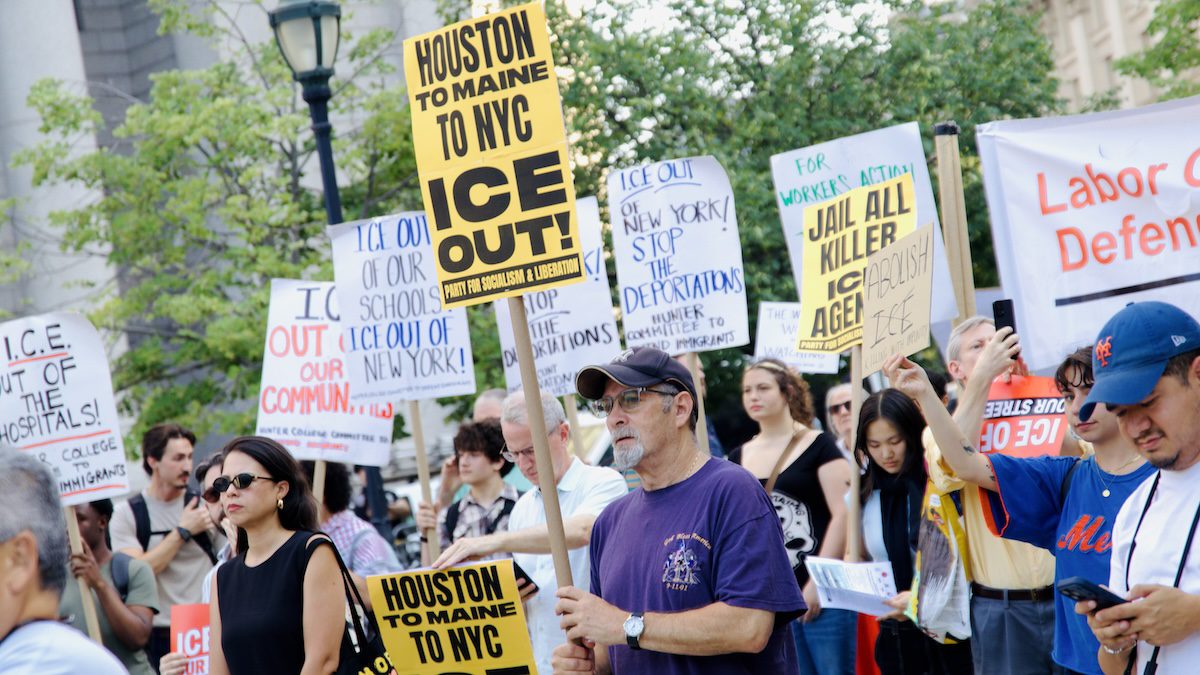
Protesters in New York City protest ICE killings. Photo: Jaylen Strong
Less than one week after Immigration and Customs Enforcement (ICE) shot and killed Houston father and construction worker Lorenzo Salgado Araujo, ICE agents fatally shot Joan Sebastian Guerrero in Biddeford, Maine, on Monday, July 12.
According to witness accounts and video footage, ICE agents rammed their vehicle into the 26-year-old Colombian’s car and approached the driver-side door. Moments later, they shot him and proceeded to drag his limp body out of the vehicle, handcuffing him on the pavement, where his body was left for five hours. Guerrero’s three-year-old daughter and partner were in the car and witnessed the killing.
He was authorized to live and work in the United States and had a social security number. According to the Department of Homeland Security, Guerrero was not the target of a warrant that ICE had at the time. Spontaneous protests erupted immediately after the fatal shooting in Biddeford.
Read more: Houston father killed by ICE amid surge in arrests
Another man was killed on Tuesday, July 14, when he was hit by a semi-trailer truck as he attempted to flee ICE, who was pursuing him on a road in St. Augustine, Florida.
Protests that are growing after the killings in Biddeford and Houston are now converging into a broader national movement. Communities are demanding independent investigations, justice for the victims, and the abolition of ICE altogether.
Trump overturns pause on ICE traffic stops despite mounting pressure
Amid the accelerating backlash, on Tuesday, July 14, the Department of Homeland Security (DHS) ordered an immediate halt to all traffic stops by ICE. It also announced that one officer on each ICE arrest team will now wear a body camera. Less than a day later, however, US President Trump apparently overturned the pause.
In order to remove “criminals” from the country, Trump wrote in a Truth Social post, “we CANNOT give up one of ICE’s most important and effective Crime Fighting tools, THE TRAFFIC STOP!”
Houston Mayor John Whitmire expressed opposition to Trump’s comments in an interview with CNN on Wednesday morning. “I thought certainly a pause was appropriate. In fact, I would go a step further.”
Whitmire called for a “90-day moratorium to allow DHS, Homeland Security to review their policies, their model.”
Since US President Donald Trump took office in January 2025, ICE has carried out a reported 11 fatal shootings, with several more fatal ICE-involved incidents. At least 55 people have also died in ICE custody during Trump’s second term. Recent weeks have seen a renewed surge in arrests and operations by the DHS agency, following tens of billions of dollars in additional funding thanks to the US Congress.
As ICE killings mount, organizers have already announced dozens of demonstrations for a nationwide day of action on Saturday, July 18.
Minnesota’s warning for the Trump administration
Despite Trump’s rejection of the halt on ICE traffic stops, DHS faces a serious challenge. The movement against ICE in the US has already demonstrated how quickly localized outrage can develop into a nationwide political crisis.
In January 2026, Minneapolis, Minnesota became a political flashpoint of historic proportions.
Backed by inciteful rhetoric against the Somali community, the government launched “Operation Metro Surge.” Thousands of federal agents flooded Minneapolis–St. Paul, resulting in the ICE killing of Renee Nicole Good on January 7. In response, Minnesota delivered one of the largest strikes seen in modern US history. Over 100,000 people marched through downtown Minneapolis on January 23 in sub-freezing temperatures, as hundreds of businesses shuttered their doors.
The very next day, federal agents shot and killed Alex Pretti, a Veterans Affairs nurse that was observing and documenting an ICE operation in Minneapolis. A second strike was immediately called. One week after the first historic shutdown of Minneapolis–St. Paul, the people of Minnesota did it again. This time, the entire country answered the call. Major cities across the United States saw historic shutdowns and mass marches, alongside another 100,000-strong march through downtown Minneapolis.
A national uprising like the one seen in January is likely the exact scenario that the federal government wants to avoid. Yet, there seems to be a debate in the US government about how to contain the backlash without weakening the federal agency that has become central to the entire Trump agenda.
With a nationwide day of action planned and ICE operations continuing to expand, the confrontation between the administration and the growing anti-ICE movement appears far from over.