For Africa to have digital sovereignty, it must control data and AI technology
Artificial intelligence is reshaping the global economy, despite its vast reserves of critical minerals in AI development, Africa remains largely a consumer of AI technologies in a geopolitically contested terrain.
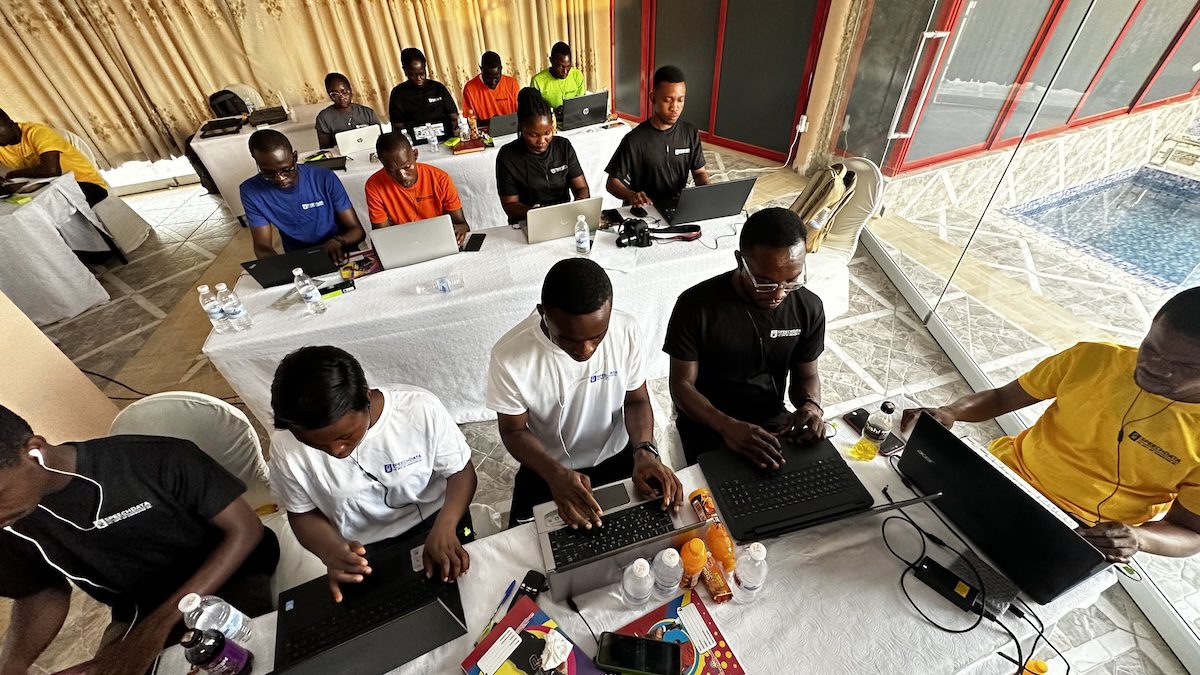
Google Africa headquartered in Accra, Ghana launched a database with Indigenous African languages. Photo: Google Africa / X
Artificial intelligence (AI) has become one of the defining technologies of the twenty-first century. Governments, corporations, and international organizations present it as the engine of a new industrial revolution capable of transforming healthcare, agriculture, education, finance, and governance. But the optimism in the Global South is confronted with major realities and questions surrounding infrastructure capabilities, ownership of data, and power over the technology in the context of geopolitics and development.
For Africa, this question is particularly urgent. The continent possesses many of the strategic minerals required for AI hardware, has one of the world’s fastest-growing digital populations, and generates enormous quantities of data through mobile technologies and digital platforms. Despite these advantages, it occupies a familiar historical position, as a supplier of raw materials, a producer of valuable resources, and a consumer of technologies developed elsewhere.
Digital sovereignty in Africa
Digital sovereignty therefore represents far more than technological advancement. It concerns political independence, economic justice, and the ability of African societies to determine how digital technologies are designed, governed, and used. However, Africa enters this technological transition from a position of structural dependence.
Read more: Digital Bandung: Why the Global South must seize its data future
In dialogue with BreakThrough News, analyst and policy strategist Kambale Musavuli explains:
“We are quite far, when we’re speaking about digital sovereignty, we’re talking about ownership of the infrastructure where the digital space runs. In most cases, we don’t control it.”
His observation captures the major contradiction facing the continent. Africans increasingly use digital technologies in everyday life, but the infrastructure that enables these technologies is overwhelmingly owned, financed, or controlled by foreign corporations.
He adds, “If you look at the investment for the under-the-sea cable, who are the investors who put money to build our so-called internet that we use? Mostly foreign investments.”
Africa’s internet depends upon undersea fiber-optic cables, cloud services, hyperscale data centers, satellite systems, and increasingly AI computing infrastructure. Ownership remains concentrated among multinational technology corporations and international investors.
Musavuli notes that even where data centers are constructed on African soil, many are financed or controlled by foreign firms and sometimes located within special economic zones that limit the jurisdiction of national governments.
“Most of the data centers across the continent are also foreign-owned or foreign-funded… usually in special economic zones, meaning that it may not be under the jurisdiction of the country’s laws.”
Infrastructure ownership is not just a technical issue. Cloud infrastructure for instance controls where data is stored, how it is processed, which laws apply, and who ultimately benefits economically from digital services.
Data: Africa’s new strategic resource
Every internet activity interaction generates data. Artificial intelligence systems rely upon these massive datasets to learn patterns, improve performance, and generate increasingly sophisticated outputs. Musavuli identifies two indispensable foundations of modern AI: “There are two core elements … that make AI what it is; critical minerals and data. Without critical minerals, without data, AI is just technology that exists,” Africa supplies both.
The Democratic Republic of Congo alone produces approximately 70% of the world’s cobalt, while countries such as Zambia, Zimbabwe, Namibia, and South Africa possess critical deposits of lithium, graphite, manganese, nickel, and rare earth minerals essential for AI infrastructure, batteries, and semiconductor production.
This resembles earlier forms of colonial extraction. Musavuli draws a direct historical comparison:
“The data produced by humans … is being collected for free all around the world. Without that dataset … AI will not have the strength that it has … Those two things are being taken for free … but then solutions are being presented to ordinary people to collect profit.” He continues:
“It’s a similar form of extraction that has happened before … We are not understanding that there is extreme extraction of surplus value for a very few people.” The profits generated through this process rarely remain where the data originates.
Read more: The left and breaching capitalism’s digital fortress
Why digital / AI literacy matters in Africa
Digital sovereignty cannot be achieved solely through government policy or technological investment. It also requires public understanding.
Musavuli argues that digital literacy must become a democratic project.
“We are mostly on the African continent consumers of foreign tools. Though there are attempts to create technology that we can use, it is not consumed widely. So, we are not where we need to be.
“If we’re not there, we must start our long walk to digital sovereignty. And that long walk will require many components, but one of the most critical is that at the base level, ordinary citizens must understand what is happening, which will allow policymakers or innovators or whoever is shaping the digital sovereignty space to be held accountable by the people who understand what is happening as well.”
Musavuli adds, “Technology is not neutral … ordinary citizens must understand what is happening … then they can challenge policymakers.”
Most discussions surrounding AI remain confined to technical experts, multinational corporations, and policymakers. Without widespread public understanding, democratic accountability becomes impossible.
AI must solve African problems
Rejecting AI is neither realistic nor desirable. Instead, the challenge is ensuring that AI addresses African priorities rather than only expanding markets for foreign technology companies. Musavuli argues that Africa should build AI around concrete developmental challenges.
“I want to live on the African continent where AI is actually solving African problems.”
Healthcare, agriculture, education, disaster prediction, language preservation, climate adaptation, and public administration all present opportunities where AI could produce significant public benefit. The objective should not be technological imitation but technological relevance. AI should emerge from African realities rather than simply reproducing imported technological models.
Musavuli also challenges dominant understandings of what constitutes data infrastructure.
“Timbuktu is our data center.”
Rather than viewing African knowledge systems as relics of the past, he reframes archives, oral traditions, storytelling, and indigenous knowledge as foundational elements of future AI systems.
He adds, “The traditional scribe … is the data annotator. The storytelling that we have in our community is the data creation process.”
Challenging the assumption that AI must be built exclusively from Western datasets and epistemologies. Instead, African languages, histories, archives, and cultural knowledge should become central to the continent’s digital future.
Towards digital sovereignty
Africa’s AI future cannot simply consist of consuming foreign technologies while exporting critical minerals and valuable data.
Digital sovereignty requires investment across the entire technology. It also requires stronger continental cooperation through institutions such as the African Union, common regulatory frameworks, and investments in shared computing infrastructure capable of supporting African-developed AI systems, and such a tool for African development, dignity, and self-determination.