Yemen demands Saudi-led blockade on the country be lifted immediately
On Friday, Saudi Arabia allegedly attempted to prevent an Iranian airplane from landing at Sanaa International Airport, marking an escalation in the over a decade-long war and blockade on Yemen.
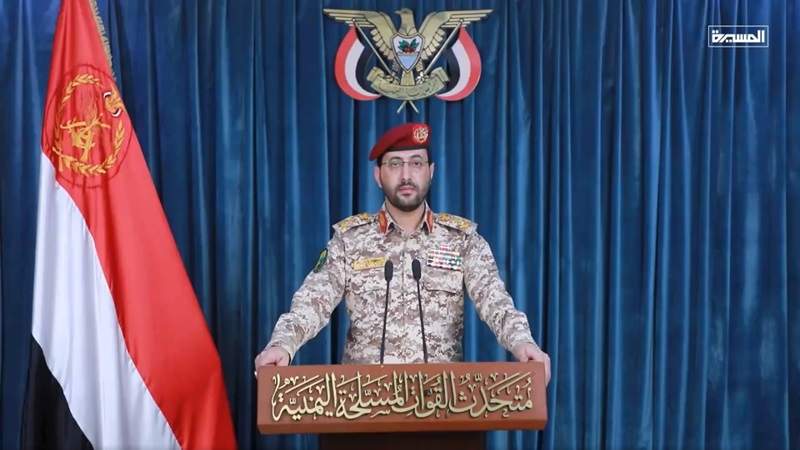
Brigadier General Yahya Saree. Photo: Almasirah
The Yemeni government in Sanaa demanded on Sunday, July 5, an immediate end of the Saudi Arabia-led, blockade on the country, claiming it violates the fundamental rights of its citizens. The blockade has been imposed on Yemen for nearly a decade.
The government also objected to Saudi Arabia’s description of international travel through its Sanaa International Airport as a “threat to its security” and repeated the warning against any attempt to block such travel in the future with severe consequences.
The Ansar Allah–led government also declared its decision to break the blockade, if necessary, by force, in the coming days, claiming it is already in the “first phase” of doing so.
The declaration followed a fresh escalation of tensions between Saudi Arabia and Yemen after the Saudi Arabian air force tried to prevent an Iranian aircraft from landing at Sanaa International Airport on Friday.
Yemen claimed the Saudi Arabian air force chased the Iranian aircraft carrying over 200 Yemeni nationals, including a number of patients and other travelers stranded outside the country.
The plane also carried the Yemeni delegation to the funeral ceremony of former Supreme Leader of Iran Seyyed Ali Khamenei, who was assassinated during the US-Israeli war on Iran earlier this year.
The Saudis, in their attempt to impose the blockade on Yemen, threatened the life of all the passengers on the Iranian plane and violated the Yemeni airspace, Sanaa claimed. Saudi war planes withdrew only after Yemeni air defenses threatened to intervene.
This was the first Iranian airplane to land at Sanaa international airport in almost a decade.
The government in Sanaa later issued a warning of counter attacks on vital Saudi infrastructure if such attempts to impose the illegal blockade are repeated.
“We will not accept the continuation of the unjust Saudi-American siege on our country indefinitely, and we will take all legitimate steps to end it,” an official Yemeni statement on Friday said.
This invited Saudi Arabia threatening to use “unprecedented force” to protect its national security and what they have termed “Yemeni sovereignty.”
In a statement issued on Saturday, the Saudi Arabia-backed Yemeni government, known as the Presidential Leadership Council, also described the Iranian flight to Sanaa as a “violation of Yemeni sovereignty.”
The blockade has caused one of world’s worst humanitarian crises
On Sunday, thousands of Yemenis gathered near Sanaa international airport demanding the end of the blockade and expressing support for the government’s moves.
The protesters denounced the Saudi Arabia-led blockade and lauded Iran’s move to send its airplane to Sanaa in defiance of it as “courageous.”
Dismissing Saudi Arabia’s claims that Sanaa has been responsible for the continuation of the war, the Yemeni government urged it to resume the peace talks largely suspended since a UN-led mediation achieved a ceasefire in 2022.
Saudi Arabia led a coalition of some Gulf Cooperation Council (GCC) and other countries and declared a war on the Ansar Allah-backed government in Sanaa in 2015 in support of the then-president of the country, Abdrabbuh Mansur Hadi, who later fled the country and was replaced by the Presidential Leadership Council.
The international coalition was initially supported by the US, the UK, and some other European countries.
The coalition later imposed a complete sea, air, and land blockade on the country in August 2016, preventing Sanaa from having all external trade and travel.
The air blockade was partially lifted after a UN mediation in 2022 on humanitarian grounds. The Saudi-led coalition agreed to allow six weekly flights from the Sanaa international airport.
However, the agreement was never implemented in its totality. The airport was also targeted in various attacks carried out by Israel during its war on Gaza as well making it largely dysfunctional.
The air, sea, and land blockade stopped all external trade to the country. This deprived the country of all essential commodities, including food and medicine, given the lack of domestic production and war situation.
The air blockade prevented Yemenis from going in and out of the country, depriving a large number of people from getting necessary medical treatment, meeting their relatives outside or reporting to work in other countries.
The UN claimed the war and the blockade was responsible for causing one of the worst humanitarian disasters of the century. The lack of food and medicine has caused hundreds of thousands of deaths in the last decade and has made millions of Yemeni citizens, more than 90% of its population at one point, dependent on humanitarian aid to survive.