Mass protests in India against government’s move to undermine rural employment program
Legally-guaranteed employment provides crucial additional income to the majority of the Indians who live in rural areas and depend on agricultural activities for their livelihood.
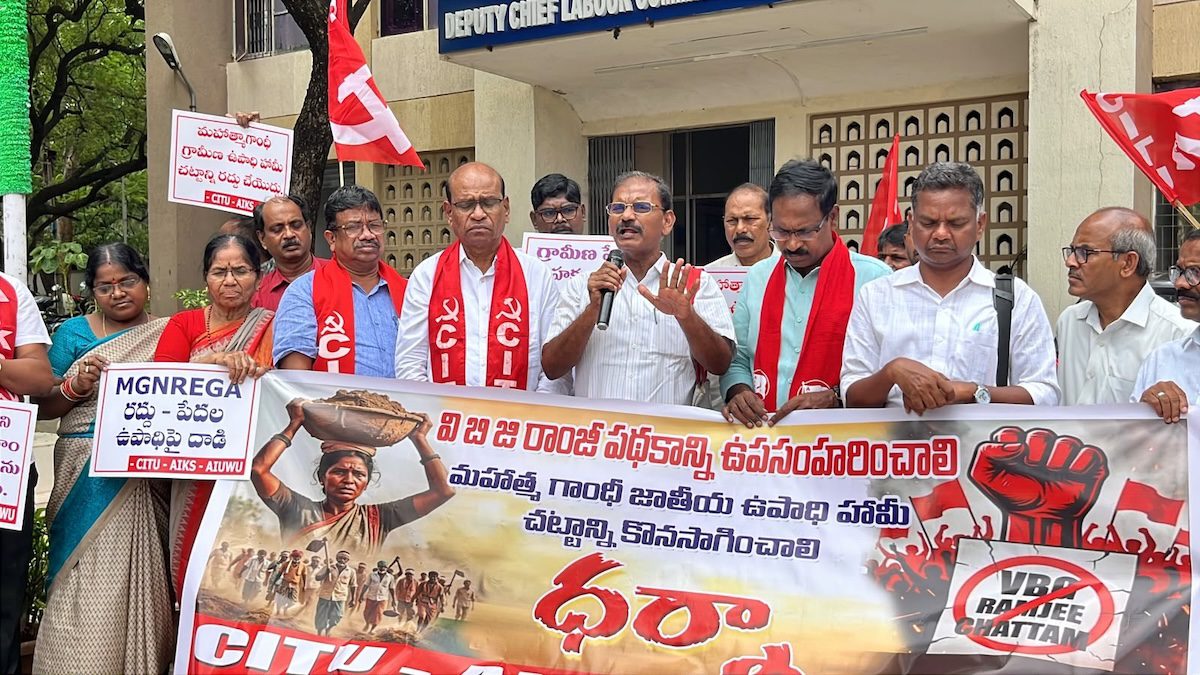
Protestors gather outside local administration offices to protest for guaranteed employment rights in rural areas in India. Photo: CITU
Hundreds of thousands of peasants, agricultural, and rural workers protested across India on Wednesday, July 1, against the ultra-right-wing government’s attempts to withdraw their existing limited right to work.
The protesters gathered at the hundreds of local administration offices across the country and demanded that the union government restore the legislation, called the National Rural Employment Guarantee Act (NREGA), which provided millions of people in rural parts of India a limited right to work.
They opposed the new act, called Vikshit Bharat-Guarantee for Rozgar and Ajeevika Mission Gramin (VB-GRAMG), which the government has introduced to replace the NREGA, calling it deficient and demanding its immediate withdrawal.
Large-scale protests were observed in the southern states of Kerala, Telangana, and Andhra Pradesh, the north Indian states of Haryana and Rajasthan, and the northeastern state of Tripura, among others. In some places workers also barged into district collectors’ offices and submitted their grievances.
The protest was called by the left-wing All India Agricultural Workers Union (AIAWU) and a Joint Platform of Rural Workers’ Organizations. It was supported by one of India’s largest trade union federations, Center for Indian Trade Union (CITU), and farmers’ organization, All India Kisan Sabha (AIKS), among others.
“The introduction of VB-GRAMG from July 1, 2026 is a calculated attempt to dismantle the only statutory guarantee of 100 days of wage employment available to rural households,” claimed AIAWU and others.
Unlike NREGA which was “legally enforceable right to work” and provided “wage security, strengthened the bargaining power of labor against landlordist and capitalist exploitation” and offered “protection against chronic unemployment and distress” the VB-GRAMG is merely a scheme which is “contract driven and non-statutory,” the AIAWU and other maintain.
Rural distress in India
India, with the majority of its population still living in rural areas which largely depend on agriculture and related sectors for its livelihood, is also home to one of the world’s largest landless populations.
In addition, the majority of its farmers are also small and marginal farmers with very small landholdings and limited income.
The majority of these small and marginal farmers and landless poor in the country have traditionally sought occasional and seasonal employment for additional income.
They are often dependent on large landlords or rural businesses for such employment and are often exploited with a large number of cases of bondage as well.
After years of struggle, the unions and the left parties were able to pressure the then-centrist government in 2004 to enact NREGA, which provided a guaranteed 100 days of employment with legally protected wages to millions of those small and marginal farmers and landless poor who were looking for work.
In the name of cutting government expenditure and to provide cheap labor to big business, CITU claims, the present ultra-right-wing Bharatiya Janata Party (BJP) government is attacking the organized working movements in every way possible. Attacks on the legal protections available to the rural poor in the form of NREGA is part of that agenda.
By abolishing the legal guarantee to work, the government is pushing millions of “rural poor back into a cycle of indebtedness, distress and even conditions of bondage,” CITU claims.
“The erosion of NREGA strengthens the hand of employers seeking to suppress wages and weaken labor rights across the economy,” CITU further claims.
“We demand that NREGA should be reinstated with reforms that would further help the workers in getting their right to work,” AIAWU said in a press release on Wednesday, warning of more protests in the coming days if their demands are not met.