India’s left stands against the right wing’s bulldozers
The newly elected BJP government in West Bengal, India, has launched massive demolition drives in Kolkata, and other areas, targeting street vendors and slum dwellers.
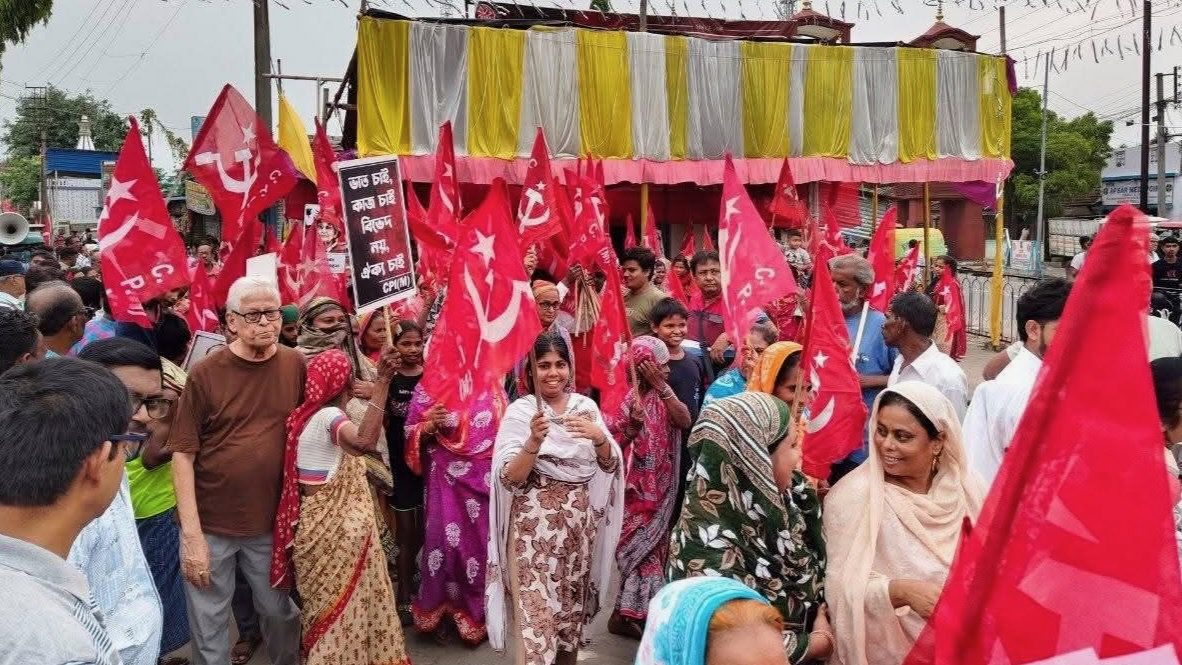
CPI(M) activists and CITU workers stand in solidarity with those facing displacement in West Bengal. Photo: CPI (M)
Thousands are taking to the streets of the capital, Kolkata, and other major cities in the Indian state of West Bengal everyday against the newly elected ultra-right-wing government’s policy of large-scale demolitions of houses and small shops.
The mobilizations, some spontaneous but mostly organized by the left parties in the state, are a result of the left’s call to not allow such actions to take place without proper rehabilitation and compensation, as most of the affected are poor and marginalized people.
Whenever the bulldozers turn up for demolition without prior notification and well announced rehabilitation plans, cadres and local leaders of the left parties, carrying red flags and banners, march with the affected population often surrounding them and forcing them to retreat.
On most occasions, the protesters face state repression, such as violence and arrests. Sometimes, the cadres have to stay up all night keeping watch for the possible return of the bulldozers, as the state has tried to deceive them on several occasions with tactical retreats in the day only to return and conduct the demolitions in the middle of the night.
The left organizers, including the hawkers’ unions, have also filed several legal petitions demanding protection from what they call the “arbitrary actions” of the state. The courts have obliged them temporarily on certain occasions.
The left’s anti-demolition protests across West Bengal and in Kolkata city in particular have pushed other groups and common people to also stand up against the drive, which threatens to force millions of poor city dwellers into destitution.
Anti-minority, pro-rich government
Only days after assuming power in the state, the Bharatiya Janata Party (BJP)-led government unleashed the demolition drive against millions of people living in shanties/slums inside Kolkata and other parts of West Bengal. It also issued notifications against several residential colonies, calling them “illegal.”
The media in the state tried to portray the demolitions as a move against “illegal immigrants” a euphemism for minority Muslims in order to polarize majority support behind the government’s move, Sawmen Mitter, a prominent resident of the city and a left sympathizer told BreakThrough News.
The BJP may still want to push a narrative that pits Hindus against Muslims, claims Alakesh Das, a former member of the parliament and a left activist, as it serves their purpose of legitimizing pro-rich and anti-poor policies.
The fact is, Das argues, most of the people affected by the demolitions are poor Hindus who have migrated to Kolkata and other major cities in the state in search of better livelihoods in the context of the prolonged rural distress in the state.
The demolitions target street vendors, petty shopkeepers, shanties and slums in Kolkata and other major cities. Demolition also aims to “reclaim” government land near railway stations, bus stands, and public places, apart from targeting some residential areas within the city which have emerged during the 15-year rule of the previous government and are mostly considered to be inhabited by Muslims.
Though Mitter rubbishes the BJP claims of most of the minority Muslims are “illegal Bangladeshi migrants” flooding the state and the city, he agrees that the number of people living in those shanties, on the streets and even in unauthorized colonies in Kolkata increased many fold during the last 15 years of TrinaMool Congress (TMC) rule.
This happened because “the real estate developers in the city and across Bengal used their links with the ruling party to illegally occupy open spaces in the city to fill it with migrants from rural areas in exchange for money and electoral benefits, with the administration largely looking the other way.
“Most of the people living even in those illegally constructed apartments – in those ghettos in particular – are also not really well off,” Mitter notes. Most spent their hard-earned money to move to these apartments for better living and protection from rising religious hatred across the country, he argues.
Responding to the questions of legality, Mitter argues that “to the left, that is not the question at all.”
“That’s a middle class narrative which, in essence, I think, is absolutely self-centric. It’s the neoliberal Hindu middle classes that think as such, devoid of any compassion whatsoever for the people living on the margins, irrespective of whatever their faith is.”
Lives of millions at stake
It is well established that most of the people affected by the demolitions are poor who have been working in Kolkata city and other urban spaces in the state.
“The BJP-led government is using the beautification of Kolkata, talking about laws just to displace hundreds of thousands perhaps millions of people who have lived and worked in the same cities for decades without making any alternative arrangement for the affected,” Alakesh Das says.
The absence of a rehabilitation program would mean that millions who are already very poor will become destitute in the city as they cannot go anywhere else. They would be living without shelter and with no source of livelihood if pushed out from their present dwellings, Das warns.
Das talks about the lack of consideration of the impact this mad drive may have on millions of people.
Thousands of these street vendors have long been the main provider of affordable goods and services to millions living and working in the city and the adjacent areas.
Even if your daily income was less than two US dollars per day you could eat two square meals in street side food stalls and restaurants and save some money for other basic needs. This will no longer be possible as one of the largest sections affected by the demolition is those very food stalls and restaurants, Alakesh Das said, citing one example of how the large-scale demolitions may affect normal life in Kolkata as a whole.
The poor who pull cycle rickshaws and drive autos in the city, for example, will be forced to pay more for their food and accommodation now because of these demolitions. It will make their services also expensive. This would mean both the poor and the middle class, the majority of the city dwellers, would be affected, Das underlines.
Talking to BreakThrough News, Debes Das, another left activist living in the city for generations, claimed that the BJP wants to replace these petty shops with big malls and shiny shopping centers, which will raise the cost of living for the majority of people in the city.
“Demolitions are anti-people because those at the receiving end of such drives are mostly the ones that live a hand to mouth existence,” Mitter says. He claims that it is almost impossible for those affected by these demolitions to “find a means to somehow sustain themselves and those dependent on them” once the demolition is carried out.
“They can barely afford to live a life of minimum human dignity with their settlements gone, nor can they carry on with what they do for a living out of the shops they had been running for quite some time.”
The dubious role of the media
Talking about the media’s attempts to give the demolitions a religious face and completely ignore the poor, both Mitter and Das call it deliberate. It is an execution of a malicious agenda of the ruling party which has mastered the art of selling anti-people policies as pro-Hindu, they argue.
“There’s nothing surprising in this,” Mitter argues, noting it has been the norm across the country in the last 12 years of BJP rule.
Mitter also argues that, “the corporate controlled pliant media” has created a binary and loves to promote it. The result of the binary is the absence of talks around actual people, poor people, and their daily struggles.
The media “hardly ever mentions the left for example. Even though, over the last four to five years, it has taken the state by storm time and again over issues concerning the people and the state. In a society like it is now, people – even die hard left sympathizers remain in the dark if things are not shown on TV.”
This affects the movements’ capacity to have a demonstrative effect. In most cases, the movements remain a local intervention, even if they have larger aspects, as in the case of the anti-demolition protests.
That is why the left has pushed anti-demolition actions on social media, hoping to shift public opinion in opposition to the narratives pushed by the mainstream media in India.
Left in West Bengal
The left in West Bengal is largely made of cadres of the communist party of India (Marxist), the Communist Party of India (CPI), and other left parties.
Though it has been a leading political force in the state during and after the anti-colonial period in Indian history it emerged as a ruling party only after winning the 1977 elections and retained power for over three decades.
It lost the state legislative elections to the centrist TMC in 2011.
The 15-year rule of the TMC is considered the worst phase for left politics in the state as its activists and leaders faced massive state-sponsored repression. This also made the left electorally irrelevant for over a decade.
The BJP won the last state legislative elections held in April this year amidst allegations of large-scale manipulation and the misuse of state machinery.
The left alliance could only win two seats in the state legislature, despite popular disenchantment from the TMC rule.
However, unlike the TMC, which seems to be disintegrating as a political force since the electoral defeat, the left decided to put all its force behind protecting the livelihoods and shelters of hundreds of thousands of Bengalis and stand against the sectarian and anti-poor policies of the BJP.
Both Kolkata and the state of West Bengal are one of the most densely-populated regions of India, with large-scale migration from rural areas to urban centers in search of jobs and better living conditions.
West Bengal is also a state which shares a large international border with Bangladesh. The BJP has promoted the majoritarian narrative that most of the Muslims in the state, around 30% of over a 100 million population, are “illegal migrants” from Bangladesh. It had promised to push these “illegal immigrants” out in its attempts to mobilize majority Hindu votes during the elections.
Kolkata is one of the largest cities in India with a population of over 16 million.
The left is the only force which can defeat the pro-corporate Hindutva force
“The left cannot simply afford to leave people to fend for themselves when a vindictive government is out to destroy them and thereby, polarize the populace on religious lines even further,” Mitter argues and demands a sustained and strong movement.
Though the media has totally blacked it out, the anti-demolition movement by the left is getting popular support as well. This is simply because it is the people who are affected in mass and there is no other political force which is even willing to stand in front of the BJP’s anti-people policies, Debes Das asserted.
Despite the fact that it’s an “uphill task for the left, particularly the CPI (M), to stand up to this aggression, given its diminished strength” electorally, it is putting up the best possible fight it can in decades, Mitter affirms.
Of course, if the government continues with its demolition drive, the left will continue to fight against it. This fight will only grow more organized in the coming days, exploring all possible means, including legal avenues to stop the BJP’s anti-people policies, claimed Alakesh Das.
We simply cannot let the BJP destroy millions of peoples lives and force them into destitution, just so that some people can become richer. The left won’t allow this in Bengal, he concluded.