Keralam’s left prepares to defend social programs from newly elected centrist gov’t
Years of social investment in a robust welfare mechanism by successive governments in Keralam has produced relatively better living conditions and higher human development in the Indian state.
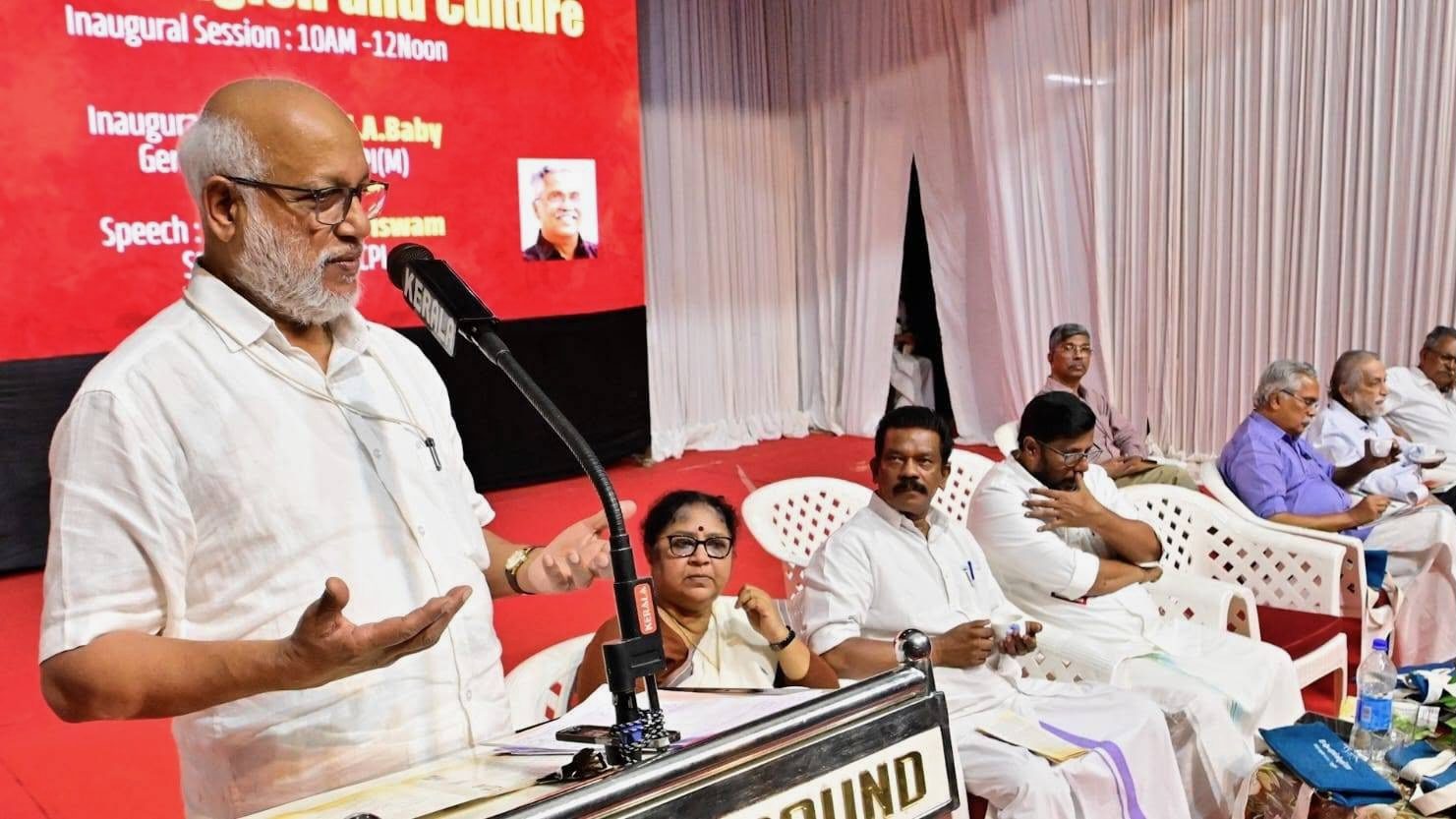
A two-day CPI (M) seminar in Kerala was inaugurated by General Secretary Com. M.A. Baby. Photo: CPI (M)/X
The left parties in India’s Keralam say they are laying the groundwork to launch mass struggles in defense of the state’s public sector and welfare system. As Keralam’s newly elected centrist government begins to push neoliberal economic policies, the state’s left says it will never accept the privatization of its public services.
The various constituents of the Left Democratic Front (LDF) have already taken to the streets in the state to oppose some of the policy initiatives of the newly elected government, calling them contrary to the general political consensus of the state, which is rooted in welfarism.
Keralam boasts of strong public control on crucial social sectors, such as health and education in comparison to other states in India. The successive left governments have also established a vibrant social security system in the state, providing protection to hundreds of thousands of vulnerable people, such as senior citizens, women, and other marginalized communities.
This makes Keralam a distinct state in India which is largely ruled by a combination of right wing and neo-liberal populism, with the “Kerala Model” touted as an alternative to neo-liberal development models.
The last left-front government (2021-26) even pursued a multi-agency Extreme Poverty Eradication Project, targeting thousands of people to make Keralam only the second place in the world, after China, where no extreme poverty exists.
Around 35 million people of Keralam enjoy higher living standards than the rest of the country’s population. The state records higher human development indexes than the rest of India, sometimes higher than some of the richest countries on the earth, because of the intricate welfare mechanisms and land reforms carried out under successive Left Front governments at various levels since the formation of the state in 1956.
The left activists, who spoke to BreakThrough News, claimed that there is an imminent threat to this achievement under the new centrist United Democratic Front (UDF)-government, led by V D Satheesan, which has been trying to break the consensus around welfarism in the state and gradually dismantle “the Kerala Model.”
Attempts to dismantle “Kerala Model” will not be tolerated
The newly elected chief minister and his party have repeatedly accused the previous left front government of emptying the state’s exchequer in carrying out large-scale public welfare measures.
The Satheesan government released a so-called “white paper” on the state’s fiscal health earlier this month, accusing the previous government of putting the state into the debt trap.
The left has questioned the figures presented in the white paper and maintained that repeated attempts by the Satheesan government to portray the debt burden on the state is nothing but a part of its larger push to create the grounds for the privatization and withdrawal of the state from crucial sectors, citing the lack of resources.
Actually the so-called white paper is “deeply rooted in neo-liberal dogma, strategically utilizing data to justify a retreat from the Kerala Model’s of people-centric, public institution driven development,” claimed by the left.
Senior journalist Abhilash S also wrote that the so-called “debt trap” is basically an “arithmetic of retreat” pursued by the UDF government.
Communist Party of India (Marxist), the largest constituent of the LDF, claimed the white paper “actually proposes the privatization or sale of departments that provide essential public services.”
“Democratic governments do not treat sectors such as healthcare, education, public distribution, electricity, drinking water, and [public] transportation as profit making enterprises,” CPI (M) claimed, calling them essential services and asserting that “viewing them through the prism of profitability is a defining feature of neoliberal and privatization policies.”
The UDF government’s budget, presented earlier this month, further confirmed the Left’s apprehensions about its real intentions.
According to another statement issued by the CPI (M), the UDF government has “effectively dismantled major welfare initiatives such as the LIFE housing scheme” under which the state government built and transferred more than 500,000 houses to poor families during its budget presentation.
The left also accused the UDF government of trying to reverse the land reforms and dismantle the social security net benefitting hundreds of thousands of people, especially women.
Increased public mobilizations
The left is already mobilizing large-scale protests across the state against UDF’s attempts to dismantle its historic pro-people policies, with thousands of its cadres marching to respective government offices in various districts. The left has promised more such militant protests in the coming days.
The youth wings of the CPI (M) and the CPI, recently carried out huge marches to the legislative assembly in the state’s capital, Thiruananatpuram, defying the use of force and repression. They were demanding the withdrawal of some of the regressive policy decisions already taken, such as its new liquor policy.
The left claimed the new liquor policy announced by the Satheesan government was a blatant attempt to benefit companies at the cost of a significant loss of revenue for the public exchequer.
Such losses of revenue can tomorrow be used to justify the withdrawal of further welfare measures which the left cannot allow to happen, claimed a left sympathizer, while talking to BreakThrough News.