Ebola outbreak could become the worst ever
Originating in DRC’s eastern region, torn by proxy war for minerals, the Ebola outbreak could become the worst ever, Africa CDC warns.
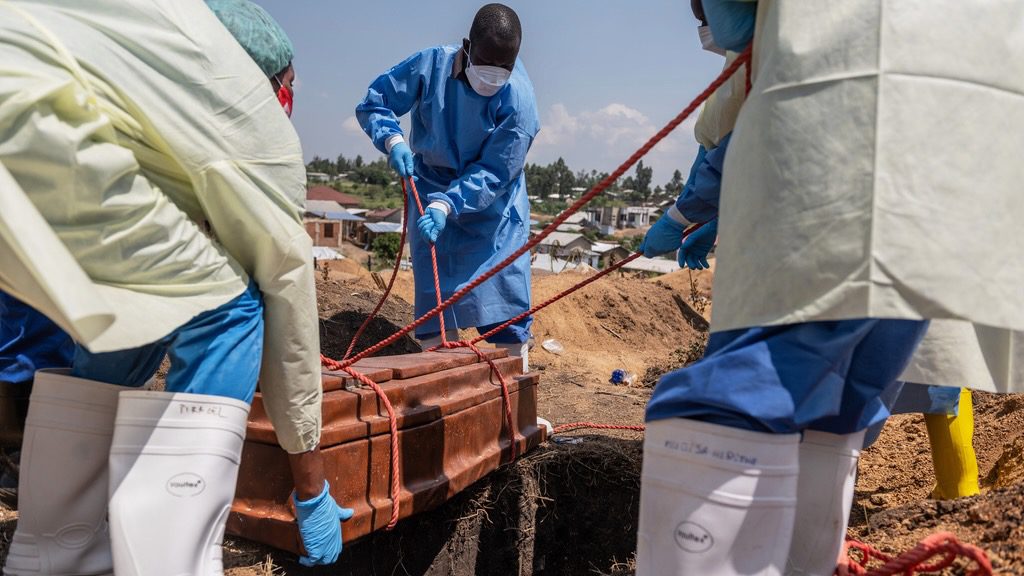
Red Cross workers prepare to bury Vanisa Anifa, a 6-month-old orphaned girl who died of Ebola, at the Bigo Cemetery, in Bunia, Congo, Friday, June 19, 2026. Photo: AP
With over 200 dead and at least 875 confirmed to be infected, the Ebola outbreak in the war-torn, mineral-rich eastern region of DR Congo could spread to historically unprecedented proportions, the Africa Centers for Disease Control and Prevention (CDC) has warned.
Addressing a virtual meeting of African heads of state in Burundi, its director-general, Jean Kaseya, said, “If we don’t stop the outbreak very soon, it will be worse than what we had in West Africa and eastern DRC.”
The latter, in 2018, had killed 2,000. The former outbreak in West Africa had spread across borders for the first time, infecting 28,600 people and killing over 11,000 between 2014 and 2016.
At the time, the WHO had described it as “the largest, most severe and most complex Ebola epidemic in the nearly four-decade history of the disease. The number of cases and deaths to date far exceeds those from all past outbreaks combined.”
To put in context Kaseya’s warning that this outbreak could be even worse, the first month of the West Africa outbreak had 242 cases in 2014. The 875 cases confirmed since May 15, 2026, when the government officially declared the outbreak, are over 3.5 times higher.
Water shortage
In just over a week, there has been a 38% increase in cases in DRC. Bunia, Mongbwalu, and Rwampara in the Ituri province in the northeast are the hotspots. The province has nine treatment centers, over 90% of which are already occupied within the first month. Only a fifth of the healthcare facilities here have access to clean water.
“Water – the absolute first line of defense in any public health emergency – is simply not available. Miners working in the surrounding areas have no toilets and handwashing stations, then they return home to communities already battling the virus. Clean water costs two dollars for 20 liters. For most families here, that is far beyond what they can afford,” said Manel Rebordosa, Ituri’s Field Response Coordinator of Oxfam.
Spread into occupied areas
More worrying is the spread southward into the province of North Kivu, and further down into South Kivu. Large swathes of the Kivu region are occupied by the Rwandan troops and their proxy armed group, the M23.
The population in this occupied territory is already reeling under mass arrests and forced recruitment for soldiering and labor, including children. Torture and summary executions are also reported.
Read more: Rwandan military and M23 are committing war crimes in occupied eastern DR Congo: HRW
Lowest rate of contact tracing in occupied territories
Inaccessible to health workers – many of whom have also lost their lives in the struggle to contain its spread – North Kivu, whose capital Goma was overrun by the M23 armed group backed by the Rwandan military in January 2025, has a particularly “high case fatality rate,” said Africa CDC’s epidemiologist, Wessam Mankoula.
It also has the lowest “rate of contact tracing” among the three affected provinces. Only a night before Mankoula issued this warning, provincial health authorities said that “armed men” had abducted a mother and child, who had tested positive for the virus, raising the risk for further transmission.
Estimating that 17,000 to 35,000 people in DRC have come into contact with infected persons, he sounded an alarm that only 4,000 of them have been tracked.
The hotspot, Ituri, is itself affected by armed conflict between the government troops and an M23-affiliated militia backed by Rwanda and Uganda. But the virus does discriminate between sides in this global conflict for the DRC’s minerals.
Read more: The DRC’s historic case against Apple over blood minerals in its supply chain
Originating in DRC, it has already crossed the border into Uganda, killing at least two and infecting at least 19. Given the high rate of movement across the porous border to the northeast, there is also a high risk of the disease spreading to South Sudan, which is also on the brink of returning to civil war.
Read more: 178 killed in massacre as South Sudan slides back toward civil war
Fund cut amid an unprecedented crisis
This crisis, threatening to grow into an unprecedented epidemic of one of the deadliest diseases, with a historic average fatality rate of 50%, has come on the heels of a 46% cut in global humanitarian funding for the DRC between 2024 and 2026. Of the $910 million pledged by donors to combat the disease, not even 10% has been paid yet.
The State Department of the US (to which the DRC threw open its critical minerals in exchange for a Donald Trump-brokered peace deal with Rwanda, which it violated immediately) has announced a commitment of $270 million in direct Ebola response funding.
Read more: In the wake of Trump’s “peace deal”, 200,000 displaced due to escalated M23 attacks on DRC
However, “countries and groups dealing with the outbreak are in the dark about where the money is going,” given the opaque nature of the disbursement of the committed funds and the US decision not to engage with the WHO, Health Policy Watch reported earlier this week.
In response to its question, Kaseya told a media briefing last week, “We know that announcements were made by the US government.” However, he added, “we want to understand how much money from what the US gave to a number of partners can really go to supporting the response.”