The hidden cost of the US military: The real budget is far larger than reported
Until Congress begins reporting accurate numbers, members of the media and other analysts should tell the public what the country is really spending on the military and war instead of repeating incomplete congressional data.
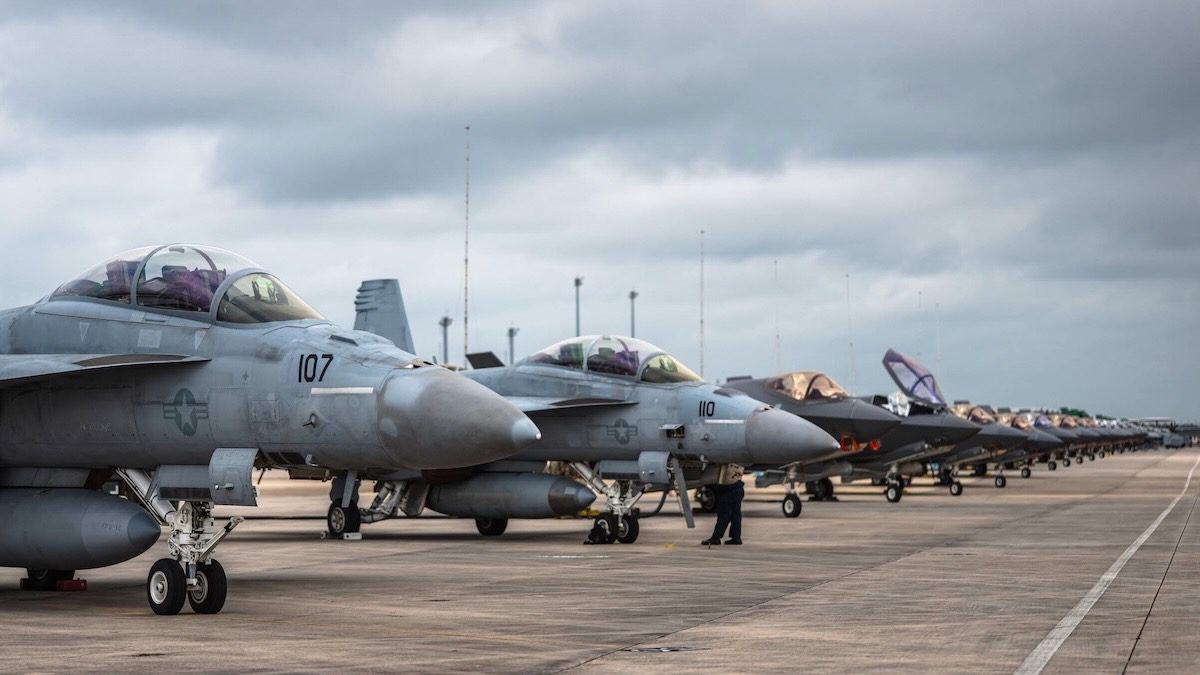
Tyndall Air Force Base in Flordia. Photo: US Air Force/FB
Lee en español aquí
US President Donald Trump has proposed a $1.5 trillion military budget for the fiscal year 2027, which would increase the acknowledged budget for 2026 by 44%. While a roughly $500 billion increase would be unprecedented in modern US history, the idea that the military budget only recently hit $1 trillion is incorrect. US military spending has exceeded $1 trillion for many years. Adding $500 billion (and potentially $200 billion more to fund war in Iran), as the president has proposed, would take the total military budget up from $2 trillion to $3 trillion.
A new report from the Project On Government Oversight (POGO), written by David Vine, John Bellamy Foster and Gisela Cernadas, argues that this widely reported number dramatically understates the true cost of maintaining the US military. Using five different methodologies, the report estimates that total military spending in 2025 was between $1.5 trillion and $1.8 trillion and could be as high as $2.3 trillion when interest payments associated with military-related debt are included. The report concludes that the United States has been spending well above $1 trillion on military activities for many years, contrary to the common perception that this threshold was only recently crossed.
According to the analysis conducted by the POGO, the Hartung/Smithberger methodology produces the highest base estimate at $1,766,172,000,000, followed by the Wheeler approach at $1,727,634,000,000 and the figure reported by USAspending.gov at $1,717,989,509,643. The Cernadas/Foster and National Priorities Project methodologies yield comparatively lower base estimates of $1,494,236,125,000 and $1,477,081,000,000, respectively. When interest is incorporated, the totals increase substantially, ranging from $1,713,283,160,060 under the National Priorities Project methodology to $2,284,383,842,468 under the Cernadas/Foster approach. It should be noted that the National Priorities Project figure focuses on discretionary spending and excludes mandatory forms of spending; were the latter included, this estimate would align far more closely with the others.
Whether intentionally or otherwise, Congress, presidents, and the Pentagon have hidden the true size of the US military budget for decades. Journalists, think tank analysts, academics, and other experts have, with rare exceptions, perpetuated the problem by reporting only a portion of true military spending; most are unaware of the costs they’re overlooking.
The problem with most conventional reporting is that there are hundreds of billions of dollars in military spending outside the Pentagon’s annual budget appropriated by Congress. Even a generally authoritative source of global military spending data such as the Stockholm International Peace Research Institute (SIPRI) underestimates US spending by overlooking significant sums outside what Trump calls the Department of War and related budgets.
One major example is nuclear weapons spending, which represented around $33.5 billion in net spending for FY 2025. Although nuclear forces are controlled and deployed by the US military, a significant portion of the budget for maintaining and modernizing the nuclear arsenal is allocated through the Department of Energy rather than the Pentagon.
Another large category of hidden spending involves veterans and military retirees. The costs of pensions, health care, disability benefits, survivor assistance, and other long-term obligations are primarily funded through the Department of Veterans Affairs and other federal accounts. These expenditures are direct consequences of maintaining military forces and fighting wars, yet they are typically excluded from military budget calculations.
Beyond veterans’ benefits and nuclear weapons, military-related spending can also be found within the budgets of the Department of Homeland Security, the Department of State, and several other agencies. Programs ranging from military aid to foreign governments to certain homeland security functions contribute to national military capacity but often fall outside official defense budget totals.
A major significant issue is debt financing. Since the wars launched after September 11, 2001, the United States has relied heavily on borrowing rather than taxation to finance military operations. For this reason, some refer to the post-2001 wars as “credit card wars.” While analysts disagree on how much of the national debt should be attributed to military activities, including these costs pushes 2025 military expenditures well above $2 trillion under some methodologies.
Despite differences in definitions and data sources used by the authors, all five methodologies arrive at a similar conclusion: the commonly cited military budget substantially underestimates what the United States actually spends on war, military forces, and related activities. This suggests that the issue is not a matter of partisan interpretation but rather the result of longstanding budget practices that disperse military costs across numerous federal agencies.
Understanding the true scale of military spending is essential for democratic accountability. Citizens cannot effectively debate national priorities if they are presented with incomplete information about how public funds are allocated. If major expenses associated with military activities are distributed across multiple departments, the public may struggle to compare military expenditures with spending on other priorities such as education, housing, infrastructure, health care, or climate resilience.
If the United States is already spending between $1.7 trillion and $2.3 trillion annually on military-related activities, proposals for additional increases should be evaluated against that broader fiscal reality rather than against the narrower Pentagon budget alone.
Unfortunately, there remains ambiguity about the full scale of military spending given the poor state of Pentagon accounting practices, including its inability to pass a financial audit. Members of the public and members of Congress need a full accounting of the military budget to analyze, discuss, and debate the proper size of military spending both on its own and in relation to other non-military funding priorities.
To provide accurate spending figures, Congress should reform its budgeting practices and provide a true total military budget that combines all forms of military and war spending in one place and one true total figure. Congress also should stop appropriating, and thus hiding, money for the military in other agencies’ budgets. Until Congress begins reporting accurate numbers, members of the media and other analysts should stop repeating incomplete congressional spending data and tell the public what the country is really spending on the military and war.
Gisela Cernadas is an economist at the Centre of Economic Development Studies, National University of San Martin, Argentina, and a Member of the No Cold War collective. David Vine is a fellow at the Transition Security Project and former professor of anthropology at American University. John Bellamy Foster is an emeritus professor of sociology at the University of Oregon.
This article was produced by Globetrotter and No Cold War.