Shack dwellers protest bill that would criminalize land struggles in South Africa
Allowing courts to order evictions without a provision for alternative accommodation, the PIE Amendment Bill also criminalizes activism for the land rights of the urban poor, protests Abahlali baseMjondolo (AbM), South Africa's radical shack dwellers' movement.
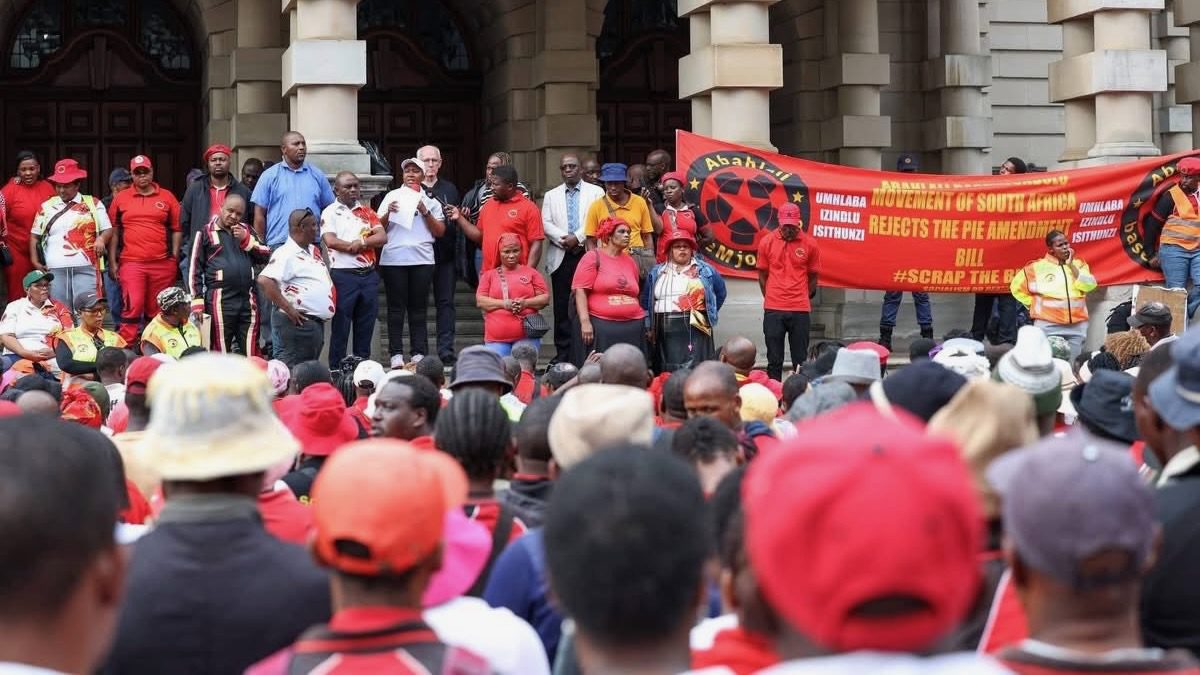
Shack dwellers movement protests PIE Amendment Bill. Photo: AbM/FB
In protest against a proposed law that would criminalize the land struggles of the urban poor, thousands of members of Abahlali baseMjondolo (AbM), South Africa’s shack dwellers’ movement, took to the streets in three cities in coordinated actions on Friday, June 12.
Releasing the proposed Prevention of Illegal Eviction from and Unlawful Occupation of Land (PIE) Amendment Bill for public comments in April, “It will strengthen our ability to address individuals and organized groups who are responsible for orchestrating these invasions,” explained Human Settlements Minister Thembi Simelane.
“Let me conclude by highlighting some of the key proposals contained in the Bill,” she added, and went on to flaunt two years imprisonment and/or R2 million fine “a person or individuals who incite people to unlawfully occupy land.”
On the front lines of the land rights struggle for two decades, AbM has been organizing the urban poor and defending their occupations of unused land to build shacks near urban centers, which offer some chance of livelihood, amid an unemployment rate of almost 44%.
“A direct attack on our movement”
With imprisonment for “inciting” occupation, “the PIE Amendment Bill would criminalize our movement” – with 180,000 shack-dwelling members in four provinces – “overnight,” the AbM said in a statement. “It is a direct attack on our movement.”
About 2,000 members, accompanied also by leaders of the country’s second-largest trade union federation, the South African Federation of Trade Unions (SAFTU), marched from Jeppe Park to the Gauteng Provincial Legislature in Johannesburg in protest on Friday.
In Mpumalanga province, members staged multiple pickets around the Department of Human Settlements in Pixley Ka Seme Local Municipality.
About 4,000 more AbM members gathered in Durban center at the historic landmark of Curries Fountain, and marched two to three kilometers to the City Hall. Following their demonstration, Zenkosi Mhlongo, a deputy director-general of the Department of Human Settlements, received their submission on the minister’s behalf.
The Department had provided 60 days’ time ending mid-June for submissions after making the draft public in April. After presenting it to the cabinet in July, with any revisions made after the submissions, the bill will be tabled before parliament later that month or in early August.
Failing to secure enough seats in the parliament in the 2024 election for the first time since the end of apartheid, the African National Congress (ANC) entered into an alliance with its main opposition party, the Democratic Alliance (DA), widely recognized as the party of White privilege. A number of smaller parties also joined in the coalition to form the Government of National Unity (GNU). Together, they have well over the number of seats needed to secure the number of votes required to pass this legislation.
“We will resist in the streets, we will resist in courts, we will stop them,” said AbM’s deputy president, George Bonono, insisting that the movement will not allow the GNU to reverse the rights landless people had won in the course of their struggle against Apartheid.
An apartheid legacy, uncorrected
The problem of landlessness in contemporary South Africa is shaped by the Apartheid regime, which segregated Blacks from the prime urban land.
To prevent them from breaking the segregation, the regime passed the Prevention of Illegal Squatting Act in 1951, empowering White landowners, the local authorities, and the State to evict the poor from the lands they had taken over.
Although no successful land reforms were undertaken post-Apartheid to correct this historic dispossession, the Nelson Mandela government limited this power with the PIE Act in 1998, mandating a court order.
Before ordering eviction, courts were bound to consider “whether land has been made available or can reasonably be made available by a municipality or other organ of state or another land owner for the relocation of the unlawful occupier.”
Eviction without alternate accommodation
This has been a key constitutional protection for the shack dwellers, on the basis of which the AbM has been organizing grassroots struggle for land rights.
The PIE Amendment Bill, however, adds that “the court may choose to grant an eviction order without requiring the municipality or any organ of state to provide alternative accommodation or land.”
AbM warns that, if enacted, the amendment will not only “criminalize activism” but will allow the eviction of the urban poor “into homelessness”, at a time when South Africa has 3.7 million homeless families, joined by 178,000 more every year.
“People are not occupying land because they are criminals. They are occupying land because: there are no jobs … there is no housing, there is no future in the rural areas, and the cities are the only sites of survival,” SAFTU said in a statement.
“This Bill deliberately ignores these realities. Instead of addressing the structural crisis, the state is choosing to criminalize those who are forced to survive within it.”