Ghana’s reparatory justice conference draws criticism over Macron invitation
Ghana is set to host a major High-Level Consultative Conference on Reparatory Justice in Accra from June 17–19, building on a landmark United Nations resolution by developing a global framework for reparatory justice.
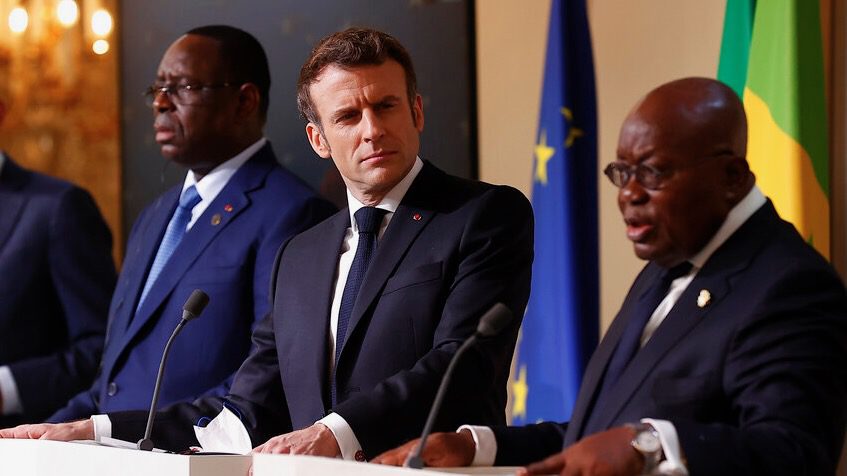
French President Emmanuel Macron, second right, listens to Ghana's President Nana Afuko Addo, right, with Senegal's President Macky Sall, and European Council President Charles Michel, left, during a joint press conference on France's engagement in the Sahel region. Photo: AP
From June 17–19, Ghana will host a major High-Level Consultative Conference on Reparatory Justice in Accra, bringing together heads of state, scholars, activists, civil society organizations, and international delegations to advance the growing global movement for reparations for slavery, colonialism, and their enduring consequences.
Under the leadership of President John Dramani Mahama, Ghana has emerged as one of the leading advocates for reparatory justice on the African continent. The country’s diplomatic efforts contributed to the landmark adoption of a United Nations resolution on reparatory justice earlier this year, marking a historic step in placing the issue firmly on the international agenda.
Objectives of the conference
The Accra conference seeks to build on this momentum. Organizers have outlined several key objectives, including creating a platform for dialogue among Africans and people of African descent worldwide, developing a coherent global framework for advancing the implementation of the UN resolution, and producing a comprehensive outcome document that will contribute to the United Nations Secretary-General’s report to the 82nd Session of the General Assembly.
Among the expected outcomes are the establishment of three global mechanisms; an Advisory Panel on Reparatory Justice, an Expert Panel on the Restitution of Cultural Artefacts, and a Legal Panel for Reparatory Justice. The conference also aims to institutionalize an annual high-level consultative forum to sustain political momentum and strengthen international coordination around reparations.
Concerns over Macron’s invitation
Reparations have increasingly moved from the margins of international discourse to the center of debates on historical justice, particularly as African nations demand a reckoning with the legacies of slavery, colonial exploitation, cultural plunder, and underdevelopment.
But, even before the conference begins, questions have emerged over the invitation extended to French President Emmanuel Macron to deliver a keynote address.
While Macron has acknowledged aspects of France’s historical role in slavery and colonialism, his participation has caused criticism from sections of Africa’s social justice and progressive movements. They argue that France remains deeply implicated in contemporary neo-colonial relations across Africa and has yet to fully accept responsibility for its historical role in the transatlantic slave trade and colonial domination.
Read more: “The African masses reject Françafrique in all its forms”: Kenyan left mobilizes against France-Africa summit
The criticism is particularly justified because France abstained from the United Nations vote on reparatory justice earlier this year. For many reparations advocates, that abstention raises questions about France’s commitment to the very principles the Accra conference seeks to advance.
Opposition to Macron’s participation has been especially vocal within Ghana itself. The Ho Collective of the Socialist Movement of Ghana issued a statement calling out the decision to grant the French president a keynote platform.
In its statement, the movement declared that Macron’s participation is “deeply problematic, undignified, and an affront to the very cause it claims to advance.” The statement further notes that France “represents a state with a centuries-long history of involvement in the Transatlantic slave trade but has never apologized for its complicity.”
For the Socialist Movement of Ghana, France’s abstention at the United Nations is not a minor diplomatic detail but a reflection of its broader position on reparations. “A state that will not stand for reparatory justice at the United Nations has no credibility as its mouthpiece,” the statement argues.
The movement also questioned the logic of granting Macron a prominent platform at a conference dedicated to historical accountability. “How do we give Macron the voice to speak, when a couple of months ago, France could not vote a yes, how can we overlook this contradiction?” the statement asks. “How does the accused, who has shown no remorse, offered no apology, or shown any accountability, become the central voice in this conference?”
The criticism is part of the broader political developments across Africa, particularly the growing rejection of French influence in the Sahel. In recent years, governments in Burkina Faso, Mali, and Niger have expelled French military forces and challenged longstanding political and economic arrangements associated with French influence. For many anti-imperialist movements, these developments are a struggle for sovereignty and self-determination.
The movement further argued that reparatory justice cannot be separated from contemporary forms of economic domination. It pointed to France’s continued influence in Francophone Africa, particularly through monetary and economic arrangements that critics have long described as neo-colonial. If France is genuinely interested in reparatory justice, it should begin by addressing the ongoing realities of economic dependency that persist in parts of West Africa.
Macron’s participation risks diluting the political character of the reparations movement itself. “Giving Macron any presence or chance to speak at this program symbolically turns this project into a European-managed one,” the statement declared. “This emboldens other colonial powers to insert themselves, dilute, and change the cause that we have struggled for.”