Benin seeks reset with AES as new president visits Niger and Burkina Faso
After years of strained relations between Benin and the Alliance of Sahel States (AES), newly-elected President Romuald Wadagni visited Niger and Burkina Faso this week in a bid to revive diplomatic ties and strengthen cooperation with the bloc.
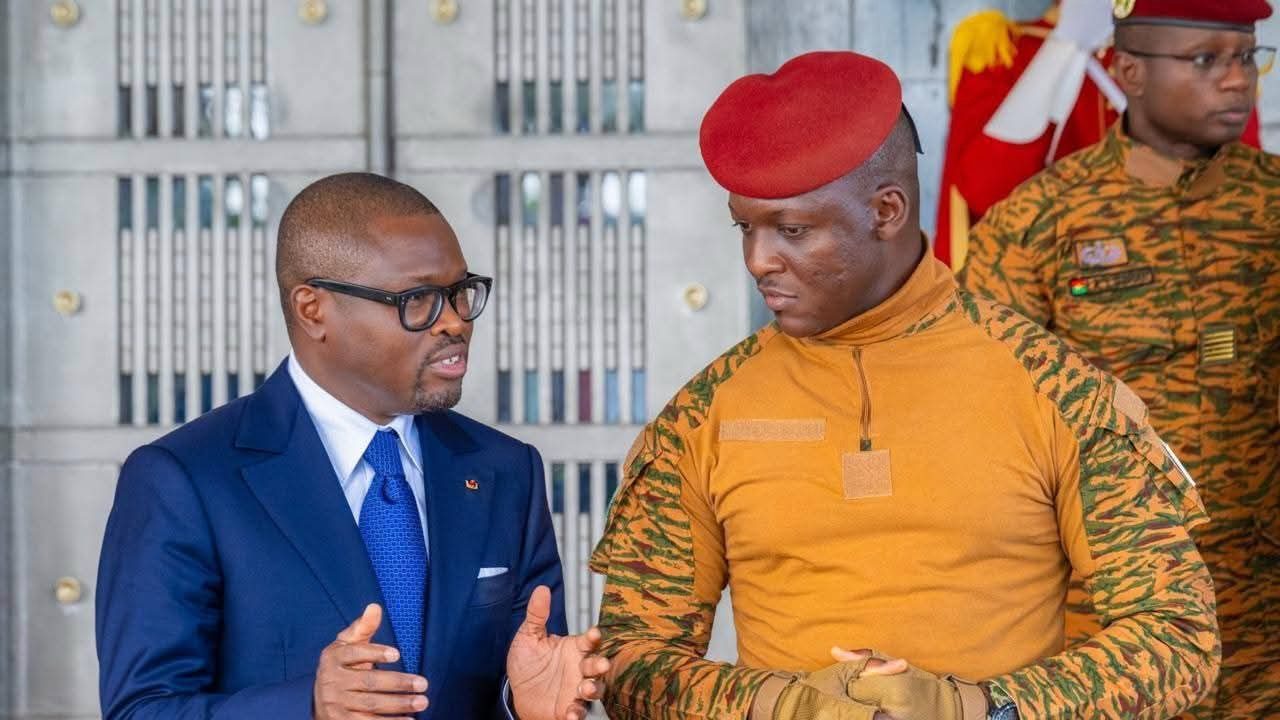
Benin's newly-elected president, Romuald Wadagni meets with Ibrahim Traoré, president of the transition of Burkina Faso. Photo: Government of Burkina Faso
Just days after taking office, Benin’s newly-elected president, Romuald Wadagni, has embarked on a diplomatic mission that may reshape relations between his country and the Alliance of Sahel States (AES). On June 2, 2026, Wadagni visited Niger and Burkina Faso, two founding members of the AES, a bloc that has emerged as one of the most consequential political developments in West Africa.
Since 2023, Burkina Faso, Mali, and Niger have pursued a new political course through the AES, asserting sovereignty, regional self-reliance and resistance to foreign influence. The three countries expelled French military forces, rejected external pressure on their internal affairs and eventually withdrew from ECOWAS, arguing that the regional bloc had become an instrument of outside interests.
For Benin, relations with Niger deteriorated sharply after the July 2023 coup that brought General Abdourahamane Tchiani to power. Cotonou supported ECOWAS sanctions and border restrictions against Niamey, while Niger accused Benin of adopting a hostile posture toward its new authorities.
Given this context, Wadagni’s decision to make Niger and Burkina Faso among his first foreign destinations carries some political symbolism.
Before the visit, the new president had already signaled a different tone. Addressing the countries of the AES shortly after his inauguration, he declared:
“My conviction is that in a sub-region confronted with the challenge of terrorism, we are compelled to work together. I want to tell them of my belief that together we can build a strong Africa by making our own strategic choices and, above all, ensuring their effective implementation.”
Revamping relationship with Niger
Following talks between President Wadagni and President Abdourahamane Tchiani, both governments issued a joint communiqué expressing a shared desire to move beyond the recent period of confrontation.
The statement noted that:
“The two Presidents reaffirmed their shared determination to revitalize bilateral cooperation and elevate it to the level of their ambitions and the legitimate expectations of their respective peoples, who aspire to peace, security, and development.”
The language marked a sharp departure from the hostility that characterized relations after 2023.
Security concerns occupied a central place in the discussions. Both countries continue to face growing threats from armed groups operating across the Sahel and northern coastal West Africa. Terrorist attacks and cross-border criminal activity have increasingly affected northern Benin while remaining a persistent challenge for Niger.
In response, the two leaders “reaffirmed their commitment to joining forces in the fight against terrorism and banditry.”
Perhaps the outcome of the meeting that people will be looking at, was an agreement to address longstanding obstacles to cooperation, particularly the closure of the border between the two countries.
Renewing ties with Burkina Faso
In Ouagadougou, both governments described the occasion as a “friendly and working visit,” to deepen cooperation. The joint statement, released after discussions between Wadagni and Captain Ibrahim Traoré, affirmed:
“The need to build a renewed partnership based on trust, mutual respect, solidarity, and the search for collective solutions to common challenges.”
The statement also points to a convergence of views regarding the security crisis affecting the region. Burkina Faso remains one of the countries most affected by insurgent violence, while Benin has increasingly found itself on the frontlines of the southward expansion of armed groups.
The communiqué says, “The two Heads of State stressed the urgent need to strengthen cooperation, solidarity, and consultation among neighboring states in the face of common threats, particularly terrorism, organized transnational crime, and all forms of violent extremism.”
Beyond security matters, the discussions focused on trade, transport infrastructure, vocational training, logistics and investment. Both countries acknowledged the strategic importance of the Port of Cotonou and agreed to facilitate transit and economic exchanges that benefit their populations.
Expectations in the region
The visit also generated reactions from political organizations in Benin. The Patriotic Front welcomed the diplomatic initiative.
The Front highlighted several priorities, including reopening the border with Niger, strengthening security cooperation and pursuing independent strategic choices for the region.
Following the meetings, the organization congratulated both presidents, stating:
“The Patriotic Front congratulates Presidents Abdourahamane Tchiani and Romuald Wadagni for responding to these legitimate aspirations of the peoples of both countries.”
At the same time, it issued a reminder that public expectations would ultimately be measured by concrete results rather than declarations:
“The Patriotic Front encourages them to trust their peoples and not betray their commitments.”
Perhaps most revealing was the Front’s broader interpretation of the events. It argued that the enthusiasm surrounding the exchanges reflected a deeper regional sentiment:
“The reception accorded to the AES delegations in Cotonou during the inauguration ceremony, as well as the welcome given to the President of Benin and his delegation in Niger and Burkina Faso, clearly demonstrates that the peoples of Benin, Burkina Faso, Mali, and Niger desire the same path and momentum.”
Whether Wadagni’s initiative marks a genuine strategic shift remains uncertain. The real test will come in the weeks ahead.As a longtime ally of former President Patrice Talon, a regime that was oppressive to the majority of the people of Benin and the opposition, he inherits both the opportunities and the baggage of the previous administration. Skepticism persists among some supporters of the AES, who will judge the new government’s intentions by its actions rather than its words.