Israel escalates its aggression on Lebanon to derail Iran-US talks
Iran suspended talks with the US over the Israeli escalation in Lebanon. Consequently, Trump exerted pressure on Israel to de-escalate.
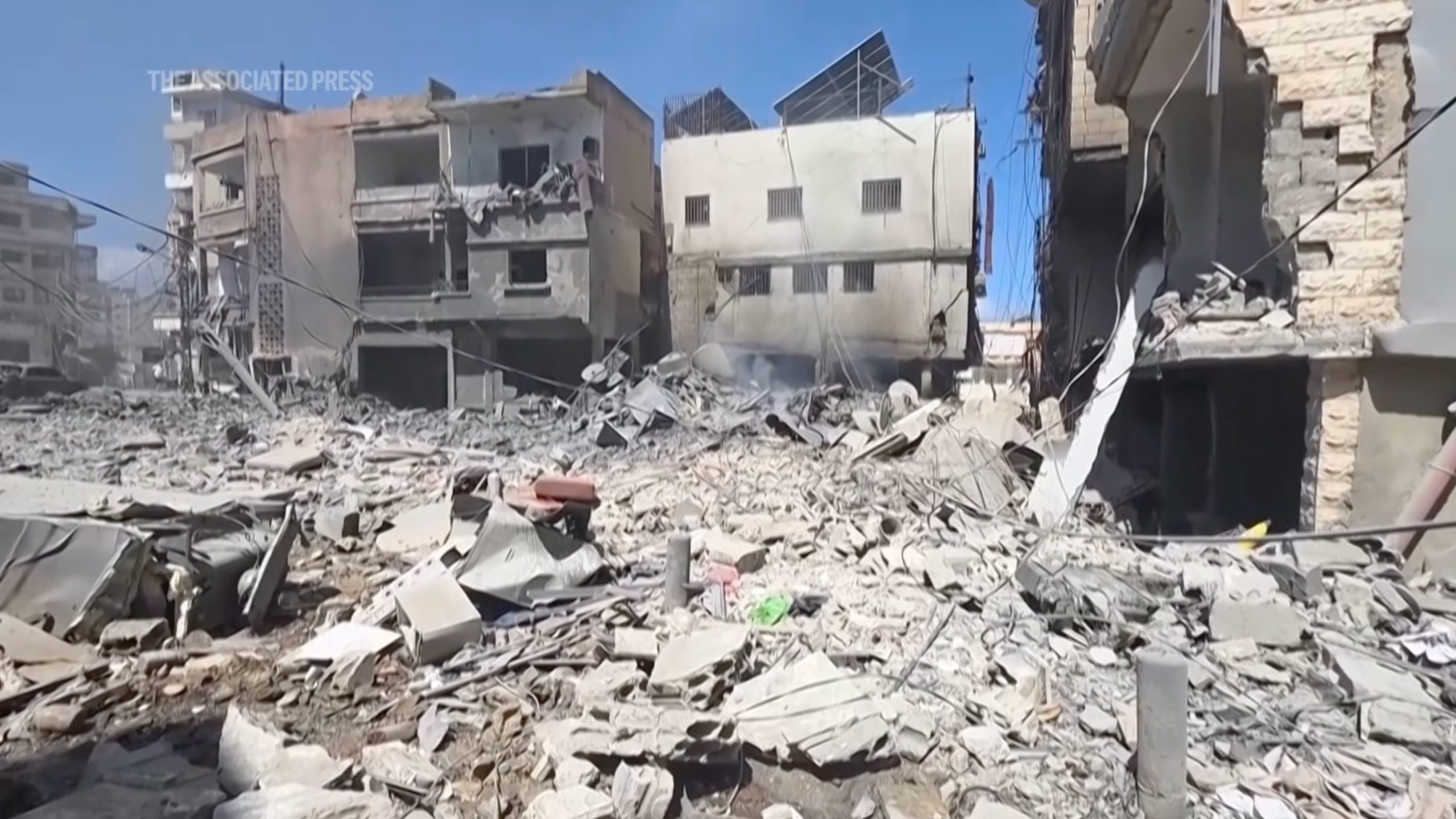
Israeli airstrikes in southern Lebanon on Tuesday, June 2. Photo: screenshot
Despite Trump’s ostensible efforts to de-escalate the Israeli aggression on Lebanon, the IOF continued to launch airstrikes across southern Lebanon on Tuesday, June 2, killing four people and injuring 127 others.
Just hours before, Trump took to Truth Social to claim that he exerted the needed pressure on Netanyahu, in order for Israel to stop the intended assaults on Beirut. He also claimed to have reached out to Hezbollah through mediators to stop their retaliatory attacks against Israel.
“I had a very productive call with Prime Minister Bibi Netanyahu, of Israel, and there will be no Troops going to Beirut, and any Troops that are on their way, have already been turned back. Likewise, through highly placed Representatives, I had a very good call with Hezbollah, and they agreed that all shooting will stop – That Israel will not attack them, and they will not attack Israel,” Trump said.
In a later post, the US president confirmed that talks with Iran “are continuing, at a rapid pace”.
The Israeli Occupation Forces (IOF) had expanded ground incursions in Lebanon during the past week, pushing even beyond the demarcation line of the Litani River.
The move was described as the deepest incursion into the country since Israel’s withdrawal from southern Lebanon in 2000.
The prompt, uncompromising reaction of the Islamic Republic of Iran to halt negotiations with the US seemed to have pushed Trump to recalculate his political maneuvers before the negotiations completely collapsed. However, Israel’s constant violations of the ceasefire remain a threat to the fragile peace process.
Massive displacement and worsening humanitarian crisis
The unprecedented escalation saw the issuance of sweeping forced evacuation orders by the IOF for residents of southern Lebanon, warning them to move north of the Zahrani River, as all areas south of the river were declared “combat zones.”
The evacuation orders, which were followed by a series of airstrikes, targeted dozens of towns and villages across southern Lebanon, including the coastal city of Tyre and its surrounding Palestinian refugee camps.
This in turn, resulted in the forced displacement of hundreds of thousands of people, added to over 1.2 million people, who were already displaced between March and April across the country, which has, for many years, suffered a severe economic collapse.
The seizure of Beaufort Castle: why is it a serious development?
Israel’s capture of the strategic and historic Beaufort Castle in southern Lebanon (also known as Qal’at al-Shaqif) has been among the most serious developments of the past week.
Besides its location, which overlooks the Litani River, and offers a commanding unobstructed vantage point over large swathes of southern Lebanon, and the northern Palestinian territories occupied by Israel, the castle has historic symbolism that brings to mind the firm resistance of the Palestinian fighters during the Battle of the Beaufort in 1982.
In that battle, about 30 Palestinian fighters engaged in fierce clashes with 1200 Israeli troops supported by aircrafts, tanks, and tracked vehicles for around two days.
The battle ended with the IOF seizing the castle until the withdrawal of its troops from southern Lebanon in 2000. Nonetheless, the Palestinians fought until the last breath, despite the military disparities. The losses they managed to inflict on the Israeli side were described by then-prime minister Menachem Begin, as “an open wound.”
Lebanese-American journalist Rania Khalek highlighted the significance of seizing the castle due to its military usefulness, height, strategic location, and also because it marks the capture of more territory deep inside Lebanon that the Israelis haven’t occupied since their withdrawal 26 years ago.
However, Khalek pointed out that there is apparently ongoing fighting between the Israelis and Hezbollah around that castle.
For his part, Israel’s defense minister, Israel Katz, announced that the IOF will remain stationed at the castle as part of the new security zone.
“Twenty-six years after the withdrawal, our heroic soldiers have captured Beaufort once again, and will remain there as part of the security zone in Lebanon,” Katz said during a ceremony.
“The capture of Beaufort and the expansion of the [ground] maneuver constitute a clear message to our enemies: Whoever threatens the citizens of Israel will lose their strategic assets one after another,” he added.
Israel ordered strikes on Beirut’s Dahiyeh
In what was interpreted as an attempt to sabotage the talks between Iran and the United States, the Israeli government ordered the IOF on Monday, June 1, to launch airstrikes on the southern suburb of Beirut (known as Dahiyeh).
Analysts argue that this order could not have been issued without a green light from US President Donald Trump. He may have allowed the Israeli escalation as a way to test Tehran, which has insisted on including Lebanon in the deal to end the regional war.
“Iran has repeatedly demanded that Israeli attacks on Beirut stop and has signaled that continued escalation in Lebanon could jeopardize diplomatic efforts,” Rania Khalek wrote on X.
“The Israelis cannot attack Beirut without approval from Donald Trump and they cannot sustain a war of this scale without American political, military and diplomatic backing.
Donald Trump has the power to restrain Israel if he chooses but he remains either unwilling or is allowing an escalation for leverage against Iran,” she continued.
Khalek believes that in addition to their motive to derail the Iran-US deal, Israel is interested in escalating its aggression on Lebanon for reasons related to their ethnic cleansing and expansionist policies.
“If the Israelis could, they would just have a permanent war until every single person they hate is dead.”
She argues that Israel knows they have a limited amount of time before a deal is made between the US and Iran.
“They are using this time as much as they can to destroy as much as possible, displace as many people as possible, and capture as much territory as possible so they can use it as leverage moving forward and then also create their buffer zone or dead zone, which is like an ethnically cleansed area of Lebanon where there will be no Lebanese if the Israelis have their way. And that they would eventually take it for themselves, and probably their more religious crazies would settle it with Israeli Jews.”
Tehran turns the table on Washington by suspending the talks
Tehran seems to have succeeded in foiling Trump’s attempts to impose leverage by choosing to suspend the talks with Washington in response to the escalation against the Arab country.
Iran’s foreign minister, Abbas Araghchi, reaffirmed on Monday that “the ceasefire between Iran and the US is unequivocally a ceasefire on all fronts, including in Lebanon.”
He further warned that “its violation on one front is a violation of the ceasefire on all fronts.”
Araghchi also held the US and Israel “responsible for the consequences of any violation.”