Milei reverses his popularity crisis and triumphs in legislative elections
With higher absenteeism than in the 2021 and 2023 elections, the ruling party won in Argentina, thus increasing its number of legislators in both chambers.
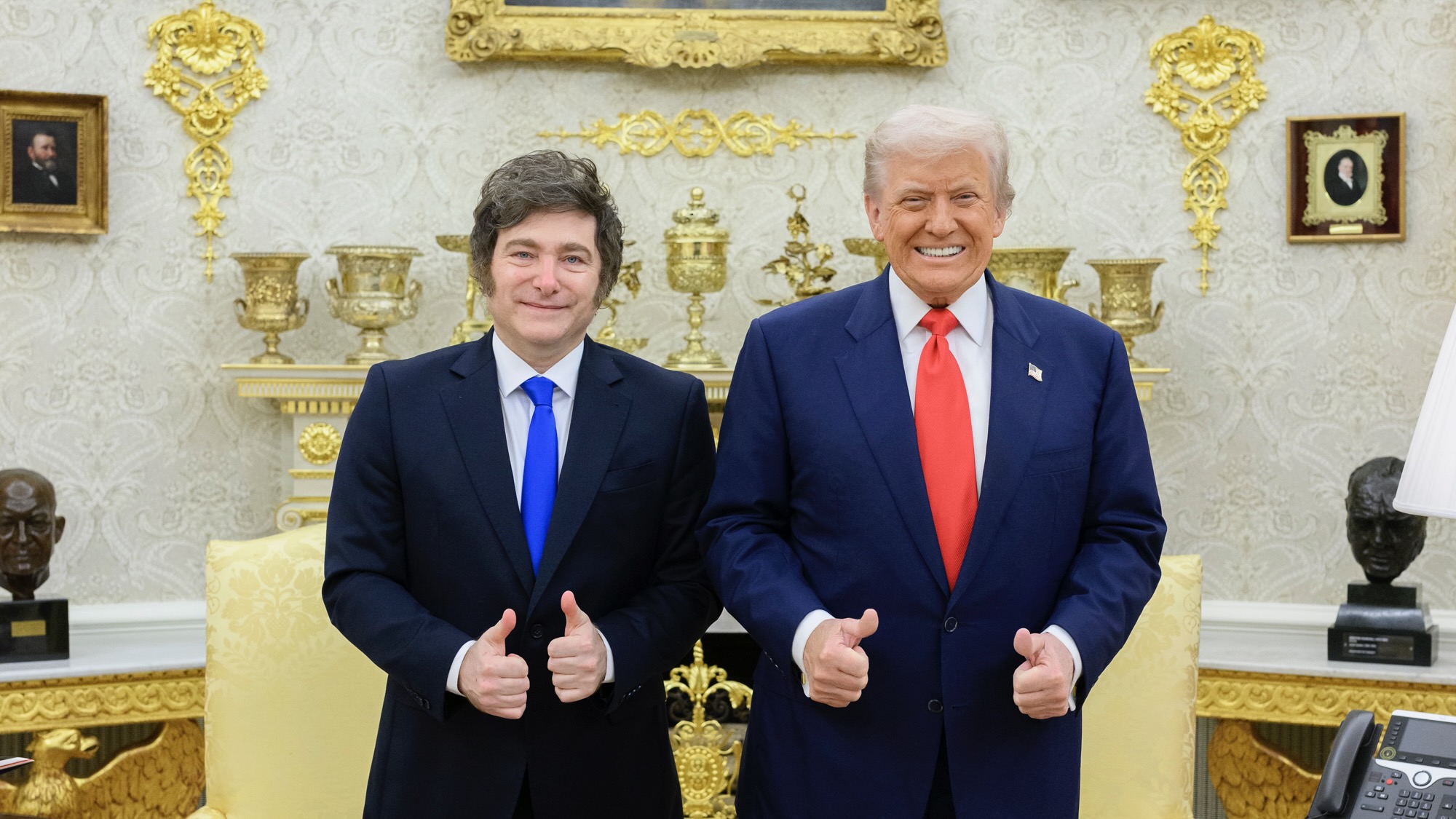
Argentine President Javier Milei visits US President Donald Trump to thank him for the over USD 20 billion in funding to stabilize the Argentine economy. Photo: X
Argentina’s far-right, libertarian ruling party, La Libertad Avanza (LLA), surprised the country in this past Sunday’s legislative elections. Once 99% of the votes had been counted, LLA had obtained more than 40% of the total votes, while Peronism had achieved 31.62%. In third place, the party with the most votes was the Provincias Unidas alliance, which unites several local political forces that attempted to position themselves in the political center. In fourth place, the Left Front obtained 4% of the votes.
Far-right President Javier Milei, who was in the midst of a popularity crisis amid economic challenges, corruption scandals, and political setbacks in Congress thus received significant support for his administration. Several leaders of the global far right, such as Donald Trump, Benjamin Netanyahu, and Georgia Meloni, congratulated the Argentine president via social media, who said: “Today has been a historic day. The Argentine people have left decline behind and opted for progress. Today, we have passed a turning point. Today we begin the construction of a great Argentina.”
The last elections for legislators in the province of Buenos Aires, Argentina, took place on September 7. In them, Peronism, united around the Fuerza Patria (FP) party, the most dominant political force in the River Plate region in recent decades, managed to deal a severe blow to the libertarian political project led by Milei. FP won 47.35% of the vote, while La Libertad Avanza (LLA) received 33.78% of the vote.
And while the September elections were important for the election of several legislators who renewed the legislature, the fundamental importance of the results lay in the fact that they might be a preview of how the October 26 legislative elections would turn out, in which the entire country would vote, and 127 deputies (out of a total of 257) and 24 senators (out of a total of 72) would be elected.
If Milei had suffered another defeat in such a short period, it would have been very difficult for the far-right leader to sustain such an aggressive political project, which aims to reduce the size of the state and align Argentina geopolitically with Washington, as he is doing today. However, Milei was able to secure a victory and, at least for the moment, avert the total collapse of his agenda.
The new morphology of the Argentine legislature
These results significantly improved the position of right-wing libertarianism in both legislative chambers. In the Senate, LLA is the only political force that will increase its number of legislators (from 6 to 18), while the rest of the political forces will reduce their representation, with Peronism being the most striking case (it previously had 34 senators, while now it will have 28). Despite this, the opposition will continue to control the Senate.
The same trend continues in the Chamber of Deputies for the far right, which went from 37 deputies to 80, an increase of almost 100%. Peronism manages to maintain its number of legislators (99), while the PRO, the party of former President Mauricio Macri, reduces its strength by 11 deputies, going from 35 to 24, which suggests a clear migration of votes from the right to the far right.
Thus, Milei managed to prevail in almost all of Argentina, with Buenos Aires being the most contested province. However, even there, where LLA suffered a heavy defeat a few weeks ago, the ruling party is now ahead of Peronism by 1 point, something that has left many stunned.
How was Milei able to reverse the trend?
At the moment, there are many interpretations of the election results. Some analysts suggest that absenteeism played a dirty trick on Peronism, which, according to some experts, is no longer able to generate a sense of mass mobilization as it did during the presidencies of Néstor Kirchner (2003-2007) and Cristina Fernández (2007-2015), although this does not mean that it is a defunct party. Today, it is still the only political force capable of challenging Milei at the polls, and many are pinning their hopes on the governor of Buenos Aires, Axel Kicillof, to defeat the far right in future presidential elections.
Several analysts also point to the importance of the financial bailout provided by Donald Trump’s administration to an Argentine economy that was beginning to experience serious problems under Milei’s neoliberal adjustment program. The United States gave more than USD 20 billion to Milei’s government in exchange for Argentine pesos, which has been seen as not only an economic bailout but also a political one in favor of Milei, who traveled to Washington before the elections to personally thank the US for the money.
In this regard, Juan Grabois, founder of the Union of Workers of the Popular Economy, allied with Peronism, said: “This election was much more difficult than the one on September 7 because the president of the world’s leading power took the lead in the election campaign. The head of the La Libertad Avanza campaign is Donald Trump, and the Minister of Economy is Scott Bessent. Of course, it is an unequal struggle that we are fighting with courage and dedication.”
Other analysts have seen the LLA election campaign as the key to understanding the results. In recent weeks, Milei’s campaign team has been reviving old fears and myths against Peronism, associating the idea of the past with that of crisis and the future with that of hope, despite the fact that the present, for most Argentines, is causing clear economic difficulties and, in many cases, an increase in social inequalities.
Argentinian political scientist Lara Goyburu told the BBC: “The surprise may come because we perhaps fail to see that there is a significant percentage of the population who, faced with the certainty of the past, opted for the uncertainty of the future … The idea of ‘I don’t know what comes next and I’m having a hard time today, but I know I don’t want to go back to the past’ caught on quite strongly.”
Whether it is one or a combination of these and other elements, the truth is that a large part of Argentina has once again been seduced by the ideas of the most radical and vociferous neoliberal, and by an abstract future of social prosperity for the vast majority which no one quite knows how the right-wing libertarian program (championed by Javier Milei) will achieve. For now, it remains to be seen how much the ruling party will accelerate its neoliberal program and how the opposition will manage (if it can) to recover after an electoral disappointment that many did not see coming.