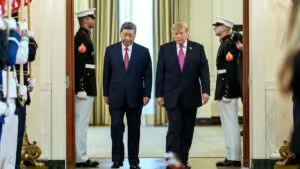
Sharm El-Sheikh summit charts new path for US-dictated “peace” in Gaza
Analysts say the summit promoted the two-state solution as the only guarantor for regional stability in West Asia.
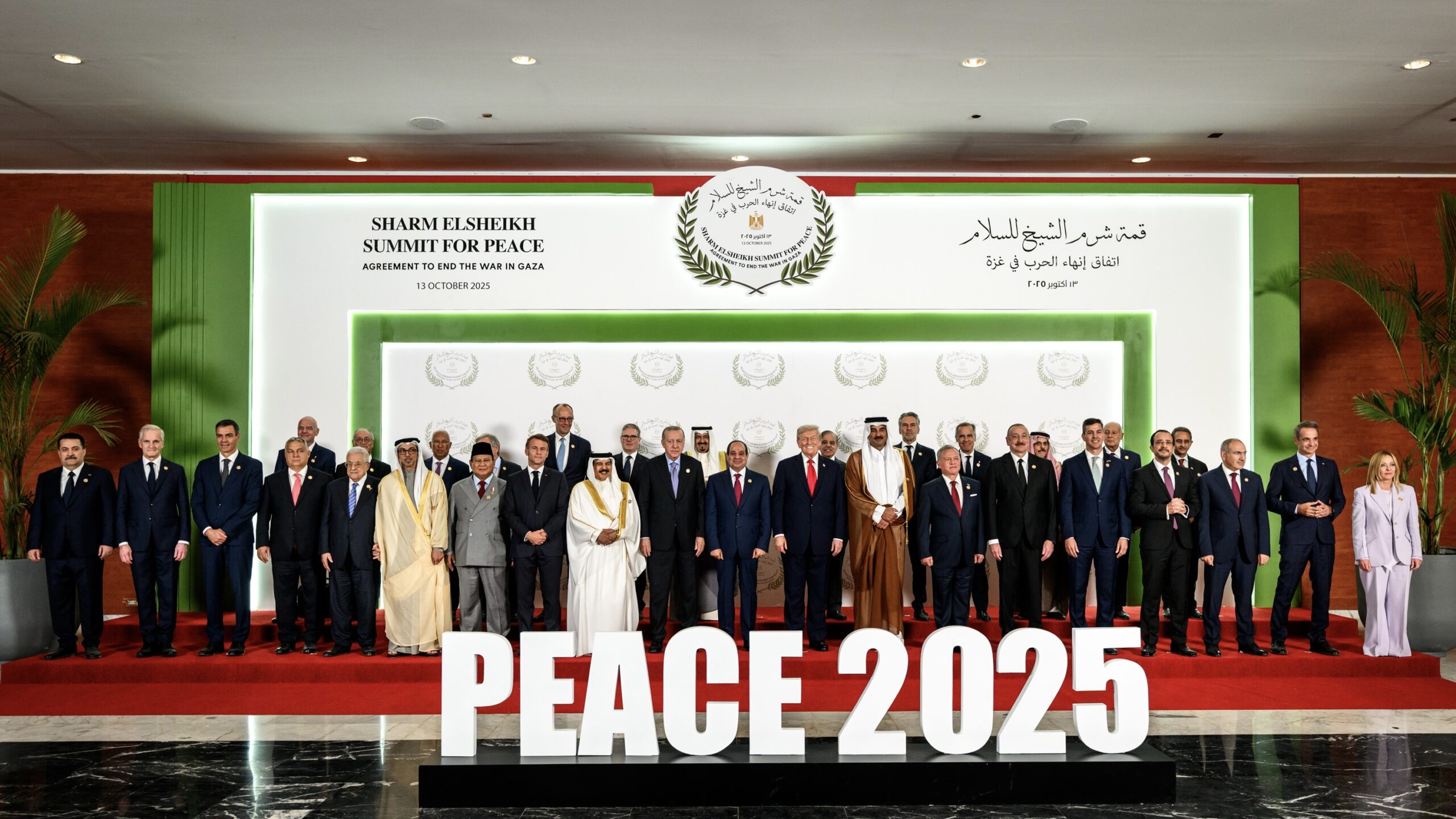
Representatives from over 20 countries at the Sharm El-Sheikh Summit for "Peace in the Middle East". Photo: POTUS / X
An international summit was held in the Red Sea resort city of Sharm El-Sheikh, in Egypt, on Monday, October 13, to sign Gaza’s third ceasefire deal, which was announced by US President Donald Trump about one week earlier.
The summit, which was co-chaired by Trump and Egyptian President Abdel Fattah el-Sisi, was attended by leaders and officials representing 25 countries from across the world, aside from the US and Egypt.
United Nations Secretary-General António Guterres, European Council President Antonio Costa, and Arab League Secretary-General Ahmed Aboul Gheit participated in the summit as well.
While Trump hailed the ceremony, which was held to advance his ceasefire and post-war proposal for Gaza, saying: “A new and beautiful day is rising and now the rebuilding begins”, El-Sisi described it as the “last chance” for peace in the region.
Iran declines, refusing to “engage with those who attacked, threatened and sanctioned the country”
Although Iran was among the countries Trump invited to the summit, its senior officials decided not to attend, explaining that they were unwilling to interact with representatives from countries that attacked the Islamic republic, and continue to threaten and impose sanctions on it.
“Iran is grateful for President El-Sisi’s invitation to attend the Sharm El-Sheikh Summit. While favoring diplomatic engagement, neither President Pezeshkian nor I can engage with counterparts who have attacked the Iranian People and continue to threaten and sanction us,” Iranian Foreign Minister Abbas Araghchi wrote on X.
The move came as a response to Israel’s unprovoked 12-day aggression against Iran on June 13, which the US joined one week later to destroy the country’s nuclear program.
Furthermore, Iran accuses the US of orchestrating the “snapback” of comprehensive international sanctions, which the UN Security Council reimposed on it in September.
Despite skipping the summit, the Iranian FM, clarified that his country “welcomes any initiative that ends Israel’s Genocide in Gaza and ensures the expulsion of occupation forces.” He further asserted that “Palestinians are fully entitled to secure their fundamental right of self-determination.”
Araghchi emphasized that all states have an obligation “more than ever” to assist the Palestinian people “in their lawful & legitimate cause.”
The senior Iranian official reaffirmed that “Iran has always been, and will always remain, a vital force for peace in the region.”
“Contrary to the genocidal Israeli regime, Iran is not after Forever Wars – particularly on the dime of its purported allies – but seeks Forever Peace, Prosperity, and Cooperation,” Araghchi insisted.
Netanyahu’s absence: was it due to religious holidays, Erdoğan’s warning, or Abbas’ presence?
Conflicting news surfaced regarding the absence of Israeli Prime Minister Benjamin Netanyahu from the summit, although he received a late invitation from Trump.
Some media outlets linked Netanyahu’s decision to media reports that claimed that Turkish President Recep Tayyip Erdoğan would refuse to land his plane in Sharm El-Sheikh if the Israeli premier attended.
Erdoğan reportedly informed his Egyptian counterpart about his objection to Netanyahu’s attendance mid-air. However, it was not confirmed whether this was the reason that prevented the head of the Israeli government from showing up.
Netanyahu’s office issued a statement justifying his non-attendance of the summit, which was scheduled at the start of a Jewish holiday:
“The Prime Minister thanked President Trump for his invitation but stated that he would not be able to attend due to the proximity of the event to the start of the holiday.”
Historically, Israeli leaders have avoided traveling on the Jewish Sabbath and Jewish holidays, except under extraordinary circumstances.
Israeli media outlets suggested that Netanyahu cancelled the trip over concerns that traveling on a Jewish holiday would have sparked strife within his coalition, although the ultra-Orthodox United Judaism party did not show any dissatisfaction in that regard.
Nonetheless, analysts argue that Netanyahu’s decision was politically motivated, to avoid interacting with Palestinian President Mahmoud Abbas, who accepted the invitation to the summit, especially after Israel had ruled out many times that the Palestinian Authority would not have any role in post-war Gaza.
The summit resulted in signing the “Gaza Peace Plan”
During the summit, the leaders of the US, Egypt, Qatar, and Türkiye, who assume the role of mediators in Gaza’s ceasefire deal between Hamas and Israel, signed a document referred to as “The Trump Declaration for Enduring Peace and Prosperity”.
The White House published the full text of the declaration on its website on Monday.
“We, the undersigned, welcome the truly historic commitment and implementation by all parties to the Trump Peace Agreement, ending more than two years of profound suffering and loss — opening a new chapter for the region defined by hope, security, and a shared vision for peace and prosperity,” the declaration begins.
Ignoring the major role that Trump played in perpetuating Israel’s genocidal aggression on Gaza by providing unwavering support to Netanyahu, the statement continues:
“We support and stand behind President Trump’s sincere efforts to end the war in Gaza and bring lasting peace to the Middle East. Together, we will implement this agreement in a manner that ensures peace, security, stability, and opportunity for all peoples of the region, including both Palestinians and Israelis.”
The declaration focused on the idea that a lasting peace will be achieved only when “both Palestinians and Israelis can prosper with their fundamental human rights protected, their security guaranteed, and their dignity upheld.”
It also affirmed that “meaningful progress emerges through cooperation and sustained dialogue, and that strengthening bonds among nations and peoples serves the enduring interests of regional and global peace and stability.”
The declaration highlighted “the deep historical and spiritual significance of this region to the faith communities whose roots are intertwined with the land of the region — Christianity, Islam, and Judaism among them.”
None of these signatories has ever prevented the Israeli occupation from desecrating the holy sites of both Muslims and Christians in occupied Palestine. A violation that continued for decades, and drastically intensified during Israel’s two-year genocide in Gaza. Nevertheless, they proclaimed in the declaration: “Respect for these sacred connections and the protection of their heritage sites shall remain paramount in our commitment to peaceful coexistence.”
“We are united in our determination to dismantle extremism and radicalization in all its forms. No society can flourish when violence and racism is normalized, or when radical ideologies threaten the fabric of civil life. We commit to addressing the conditions that enable extremism and to promoting education, opportunity, and mutual respect as foundations for lasting peace,” the statement added.
The leaders of the four countries confirmed their commitment “to the resolution of future disputes through diplomatic engagement and negotiation rather than through force or protracted conflict.”
Moreover, they acknowledged “that the Middle East cannot endure a persistent cycle of prolonged warfare, stalled negotiations, or the fragmentary, incomplete, or selective application of successfully negotiated terms.”
“The tragedies witnessed over the past two years must serve as an urgent reminder that future generations deserve better than the failures of the past,” the heads of the mediating countries stressed.
The declaration concludes with the impression that Trump’s vision towards the West Asia region may have shifted towards the two-state solution as the only guarantor for regional stability:
“We seek tolerance, dignity, and equal opportunity for every person, ensuring this region is a place where all can pursue their aspirations in peace, security, and economic prosperity, regardless of race, faith, or ethnicity.
“We pursue a comprehensive vision of peace, security, and shared prosperity in the region, grounded in the principles of mutual respect and shared destiny.
“In this spirit, we welcome the progress achieved in establishing comprehensive and durable peace arrangements in the Gaza Strip, as well as the friendly and mutually beneficial relationship between Israel and its regional neighbors. We pledge to work collectively to implement and sustain this legacy, building institutional foundations upon which future generations may thrive together in peace.
“We commit ourselves to a future of enduring peace.”