José Jerí: Peru’s eighth president in a decade
The controversial, right-wing Jerí takes office amid a profound economic, political, and security crisis in the Andean country
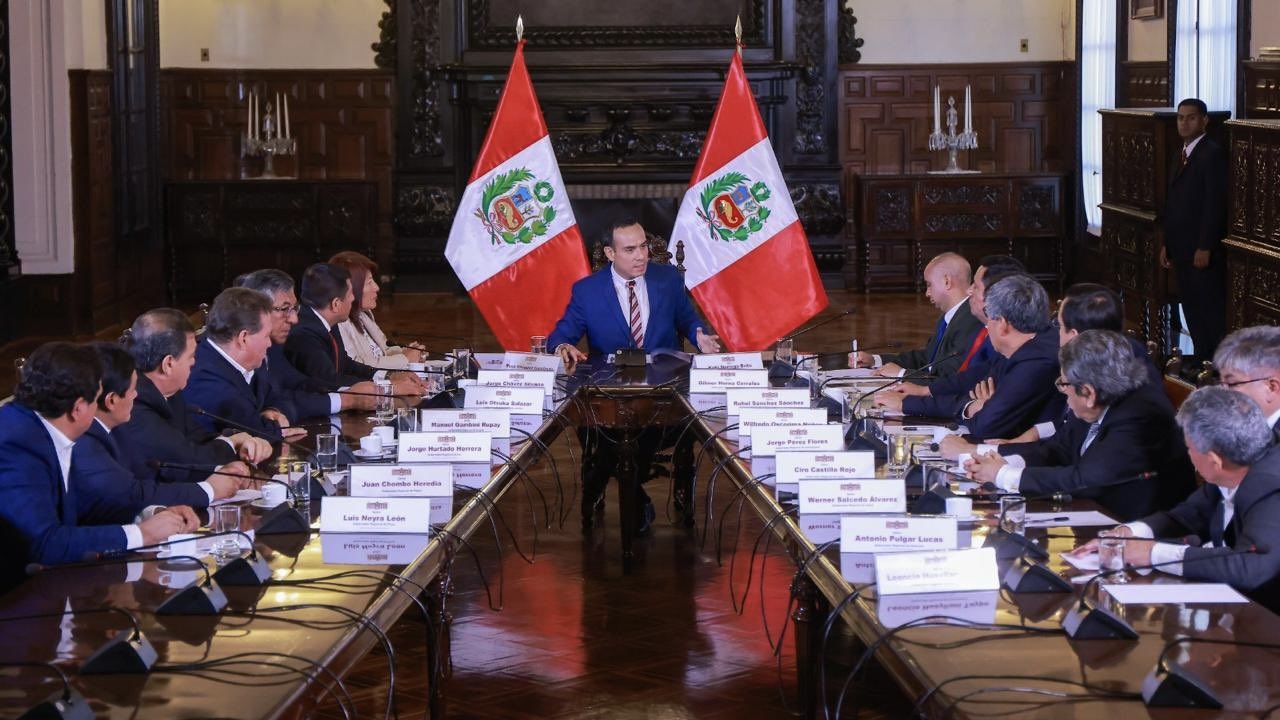
Peru's latest president, José Jerí, meeting with the country's governors. Photo: Presidencia Perú / X
After a turbulent and controversial presidency, Dina Boluarte was deposed by the same Congress that had installed her after overthrowing her former comrade Pedro Castillo in December 2022. Boluarte left office two years after more than 60 people were killed by security forces in protests against her newly formed government.
Despite having consolidated her position in the executive branch with an iron fist, her government never enjoyed the legitimacy she had hoped for. Recurring repression of protesters, increased violence, and growing protests against her government may have prompted her right-wing backers in the legislature to pull their support. It is no accident that she was removed amid mass social mobilizations and record levels of rejection of her administration and the right wing congress, which in recent weeks reached 96%.
The baton has been passed to 38-year-old José Jerí, a figure who is completely unknown to many and whose meteoric rise has not been entirely transparent. As accusations and allegations against him grow, many are growing wary of Peru’s latest president.
Jerí’s beginnings and rapid rise
Jerí was born in Peru’s capital Lima, in 1986. He graduated with a law degree from the Inca Garcilaso de la Vega University and served as an advisor to the right-wing Somos Perú party in Congress in 2020. In 2013 and 2014 he ran for city councilor in Lima and was defeated on both occasions.
His political opportunity came in 2021 when he was granted a seat in Congress by Somos Perú despite having obtained only slightly more than 11,000 votes and not winning the race. His position was only possible thanks to the disqualification of former president and then-congressional candidate Manuel Vizcarra, who obtained more than 200,000 votes.
In Congress, he voted in favor of Pedro Castillo’s impeachment on December 7, 2022, and subsequently voted in favor of shelving the investigations into then-President Boluarte over the deaths of protesters. Jerí was also chairman of the Budget Committee, even though his great ambition was to become president of the entire Congress, which he did not achieve. However, his desire did not wane, and on July 26, 2025, thanks to a large alliance of the Peruvian right, he managed to become president of the legislative board.
From the President of Congress to the President of Peru
On October 10, Jerí, who defines himself as a “lawyer and animal rights activist”, assumed the presidency of the country after the removal of Dina Boluarte for alleged “moral incapacity,” a legal-political argument repeatedly used in the Andean country when “dethroning” heads of state. In Peru, eight presidents have been sworn in in less than a decade because of the serious political crisis.
“At 38 years of age, I take on the challenge of leading Congress. Today, I proudly embrace this responsibility, where the energy of my youth is combined with a firm commitment to politics and service to our nation. I want to tell young people that politics needs their ideas and, above all, their love for Peru,” said the new president at his inauguration ceremony.
In his early days, Jerí acknowledged that his government would be “one of transition,” as presidential elections are scheduled for April 2026. To rally more support than his predecessor, he has also said that “The evil that afflicts us at this moment is crime. The main enemy is on the streets.” Along these lines, Jerí has promised a “War on Crime.”
Various social sectors, such as transport workers, had joined the demonstrations in recent weeks against the Boluarte government, demanding a greater police presence on the roads following the extortion and murder of several drivers. According to Human Rights Watch, Peru is one of the countries in the region with the fastest-growing rate of violent deaths.
Despite this anti-crime, pro-youth rhetoric and coalition between various political forces, Jerí still must deal with a difficult stain on his record, which from the very first minute of his government has already led to several accusations from his detractors.
Allegations against Jerí
In the wake of his selection as president, Peruvian media outlets have reported on an investigation by the Peruvian Public Prosecutor’s Office against Jerí for rape. Prosecutors investigated what happened at a meeting in December 2024, where a 31-year-old woman was allegedly sexually assaulted while unconscious.
While the investigation was ongoing, Somos Perú temporarily suspended Jerí, who from the outset categorically denied the accusations against him. A few months ago, in August 2025, the Prosecutor’s Office announced that it was closing the investigation, despite requesting that the then-congressman undergo psychological treatment, which Jerí refused.
In addition to this case, the current president of Peru has been accused of alleged illicit enrichment and corruption that supposedly benefited people close to him while he was chairman of the legislative committee in charge of the country’s budget. Jerí has repeatedly denied these accusations and promised to submit to any investigations that the courts deem necessary.
What does Jerí’s swearing-in mean?
Analysts seem to be in agreement that the new president will not transform the current balance of political power in Peru. On the contrary, they see his inauguration as a way of maintaining the status quo, albeit with a touch of “change” due to the change of presidents.
Political scientist Rodrigo Barrenechea said this to the BBC: “Jerí represents the continuity of power relations in parliament, which is made up of unpopular parties that fear being swept away in the next election in 2026… They decided to get rid of Boluarte because of the liability her presidency represented for the 2026 elections, but they did not decide to elect someone distant from them either.”
For its part, El País stated in an editorial that the political crisis actually represents a crisis of representation within the state structure: “With José Jerí’s interim assumption of power, Peru is entering a new phase that promises to be just as precarious as the previous ones: street protests, widespread discredit, and a vacuum of authority that threatens to drag on… The result is a country trapped in a seemingly endless loop. Peruvian politics exists under a permanent state of emergency. Mistrust between the branches of government, parliamentary opportunism, and the weakness of the parties have turned the government into a series of institutional patches. Ultimately, the country faces something deeper than a crisis of names: it is suffering a crisis of representation.”
In short, Jerí inherits a Peru in turmoil, deeply distrustful of public institutions, with staggering social inequalities (Peru is the fourth most unequal country in the world) and shaken by rising crime. Some analysts speculate that it would not be unreasonable for Jerí to be removed from office before the 2026 elections, although it seems that the chess move by the Peruvian political elites is aimed at bringing some stability to Peru before the elections.