Shades of Peril: Sinophobia, Anti-Palestinian Racism and the War on Universities
On March 19, 2025, the Presidents of Carnegie Mellon, Purdue University, Stanford University, the University of Illinois, the University of Maryland, and the University of Southern California received an unusual government request: to turn over lists detailing every currently enrolled Chinese citizen studying in advanced STEM fields at their institutions. The demand, issued by Michigan […]
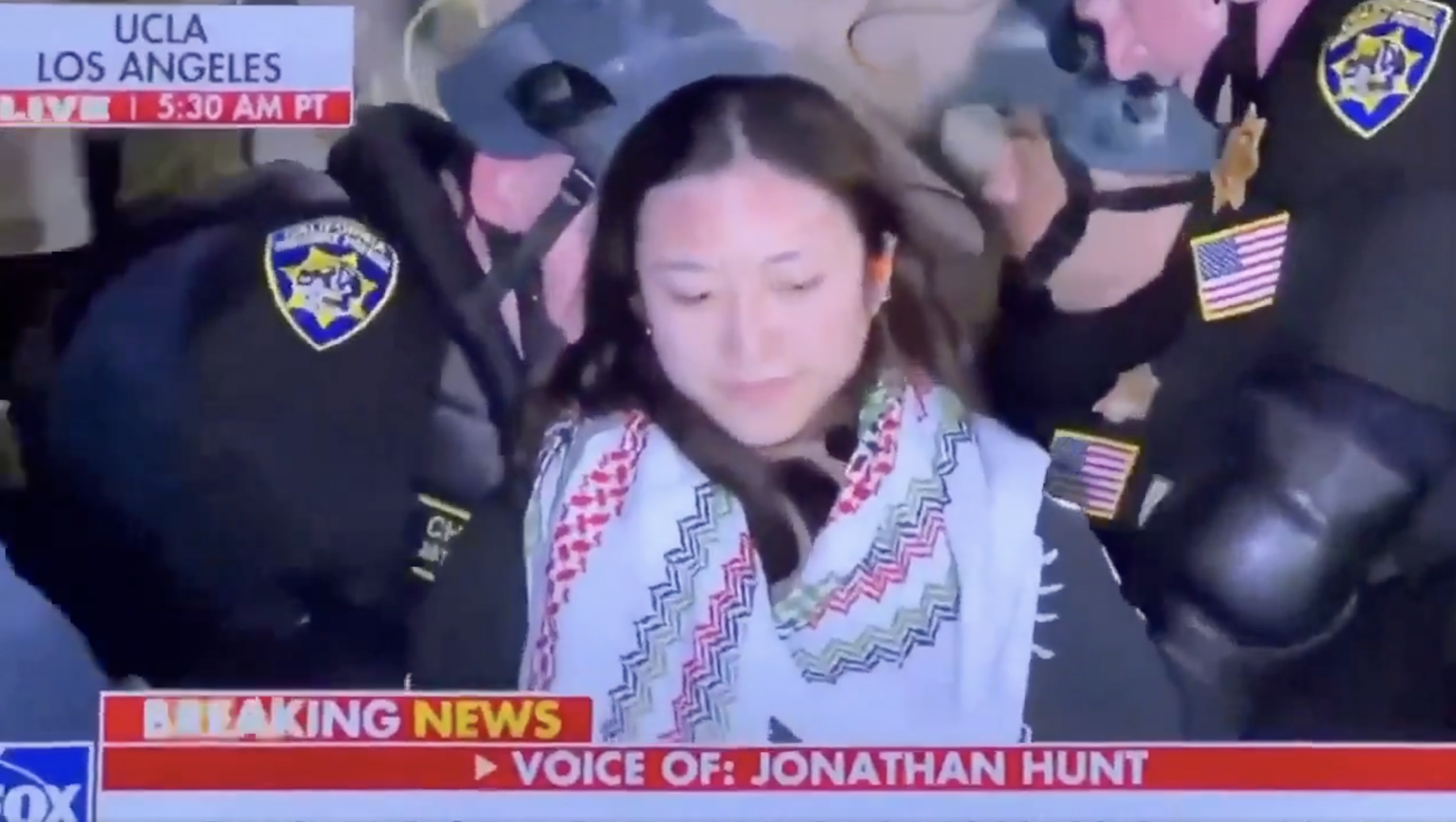
Police unmask an Asian American graduate student at UCLA in front of news cameras during the 2024 student encampments. This incident was seized upon by right wing media, who falsely described the student as a Chinese national, "Liu Lujin," though no such person existed.
On March 19, 2025, the Presidents of Carnegie Mellon, Purdue University, Stanford University, the University of Illinois, the University of Maryland, and the University of Southern California received an unusual government request: to turn over lists detailing every currently enrolled Chinese citizen studying in advanced STEM fields at their institutions.
The demand, issued by Michigan congressman and chair of the House Select Committee on the Chinese Communist Party John Moolenaar, comes as the Trump administration escalates its attacks on Chinese students and researchers in “critical fields” such as artificial intelligence, semiconductors, and aerospace engineering.
The same month, House Republicans proposed a bill that would effectively ban Chinese international students from being granted visas to study in the United States. Though the bill was stalled by opposition, the Department of State took matters into its own hands by promising in May to “aggressively revoke” visas for Chinese students. By August, the Department of State boasted that it had already revoked 6,000 student visas, though it is unknown how many Chinese students were swept up in the crackdown.
Regardless, Chinese researchers have become the target of sensationalized claims of surveillance, espionage, and even bioterrorism. In June, University of Michigan doctoral student Yunqing Jian and her boyfriend, Zunyong Liu, were charged with conspiracy and smuggling for bringing an undeclared plant fungus sample into the United States.
Trump has wielded the “China threat” as a pillar of both his xenophobic and expansionist ambitions. And when it comes to Chinese researchers and students, the administration is pairing Sinophobia with anti-Palestinian racism as part of a broader ideological assault on higher education.
While the incident could have been treated as a bureaucratic issue of missing paperwork, the Department of Justice instead warned of an attempt to bring a “potential agroterrorism weapon into the heartland of America.” The allegations were not based on national origin alone, but also ideological grounds: the DOJ claimed that searches of her electronic devices had revealed Jian was a “loyal member of the Chinese Communist Party.”
The ensuing media frenzy cast the story as evidence of Chinese ambitions to infiltrate the United States. Later media reports conceded that the fungus in question (Fusarium graminearum) is already prevalent in the United States and likely originated in North America. Yet the narrative of Chinese contagion—recalling conspiracy theories surrounding the COVID-19 pandemic—had already been set.
The case of Jian and Liu fits into a broader history of persecution of Chinese in America based on racist allegations of conducting espionage for the People’s Republic of China. Unsurprisingly, these accusations have intensified with the rise of China as a “strategic competitor”of the United States.
During the first Trump presidency, the DOJ further institutionalized these racist witch hunts by launching the China Initiative, a program intended to combat Chinese espionage and which led to the firing of hundreds of Chinese American scientists, and triggered widespread criticisms that the program engaged in racial profiling.
Both the New McCarthyism at home and the New Cold War in Asia build on a long history of racist state repression, with immigration enforcement working in tandem with US geopolitical ambitions.
On the surface, DOJ programs such as the China Initiative may look like failures. Half of all cases under the China Initiative were eventually dropped, with many leading to expensive government settlements and lawsuits. The program itself was disbanded by the Biden administration in 2022, though the Trump administration has signalled its interest in rebooting it.
But the China Initiative was a success insofar as it provided an outlet for the anti-China anxieties that plague US political culture. The Trump administration’s current crackdown against Chinese students and researchers performs the same function: to play on racist and anticommunist fears in order to scapegoat China and Chinese people for the fading era of US unipolar power, and justify a host of extreme policies. From campaign promises to deport Chinese migrants that he alleged were building up a “little army,” to invoking the specter of Chinese influence to shore up his colonial ambitions in Panama, Trump has wielded the “China threat” as a pillar of both his xenophobic and expansionist ambitions. And when it comes to Chinese researchers and students, the administration is pairing Sinophobia with anti-Palestinian racism as part of a broader ideological assault on higher education.
Sinophobia and anti-Palestinian Racism
When the Department of Homeland Security threatened to withdraw Harvard University’s Student and Exchange Visitor Program, which enables universities to enroll foreign students and visitors, they cited both Harvard’s “failure to maintain a campus environment free from violence and antisemitism” as well as concerns that the university had “coordinated with the Chinese Communist Party.”
These intersecting national security claims were on full display in the far right’s invention of “Liu Lijun,” who was described as a Chinese-born UCLA graduate student sent by the Communist Party of China to instigate pro-Palestine protests. This narrative spawned online after video footage of an East Asian woman, wearing a K95 mask and a keffiyeh, had her face coverings removed as she was arrested by LAPD during a May 2024 protest of UCLA’s complicity with the genocide in Gaza.
After the footage was retweeted by a far right account on X, a flood of comments labeled the UCLA alum a “Chinese operative” and called for investigations of her “CCP connections.” When the Trump administration came into office a year later, the footage recirculated, with right-wing accounts now celebrating that “Liu” had had her visa revoked and was facing deportation. As “Liu,” a US-born UCLA alum, put it in her own words, this narrative of malign Chinese communist influence and ideological deportation was “fabricated…to intimidate pro-Palestine protestors.”
This fusion of anti-Palestinian and anticommunist rhetoric is an evolution of the McCarthyist tactics deployed by the US government during the Cold War. Both the New McCarthyism at home and the New Cold War in Asia build on a long history of racist state repression, with immigration enforcement working in tandem with US geopolitical ambitions.

McCarthyism and the Chinese Confession Program
Today, the specter of China’s rise fuels the Department of State’s attacks on both Chinese and pro-Palestine immigrants in the name of national security. So too did McCarthyism enshrine “subversive” ideology as grounds for immigration exclusion and deportation by using imperial preoccupation with Asian geopolitics in the wake of the founding of the People’s Republic of China in 1949 and the US invasion of Korea in 1950. In fact, Sen. Joseph McCarthy himself blamed communist infiltration of US government and institutions for the “loss of China” to communism.
From such blatantly imperialist origins, McCarthyism grafted anticommunism onto longstanding racist and xenophobic anxieties, inevitably targeting Chinese in America, along with Black radicals, Jews, and immigrants as racial and ideological threats to national security. 5,000 overseas Chinese students in the United States found themselves sudden targets of US outrage at the “loss” of China. While US policymakers once viewed Chinese students as potential vessels for American influence in China, the Cold War transformed them into assets for “Red China.”
Upon China’s entrance into the Korean War in 1950, the United States declared a state of emergency that blocked Chinese students and scientists with technical skills from returning to China. That year, US officials repeatedly intercepted groups of Chinese students en route to China and forced them to remain in the US. In some cases, Chinese students were both targeted for deportation by Immigration and Naturalization Services (INS) and prevented from returning to the PRC by the Department of State.
Fears of ties between Chinese in the United States and the new Chinese government also reverberated throughout Chinese American communities. Responding to claims that the Chinese government was engaged in mass immigration fraud in order to infiltrate the United States, the INS unveiled a program in 1956 designed to crack down on immigration fraud within the Chinese American community: the so-called Chinese Confession Program.
Even as it undertook an ideological purge of the Chinese American community, the Program also enabled many Chinese Americans to claim US citizenship, therefore allowing the US government to promote an image of racial inclusion.
As historian Mae Ngai writes, the Chinese Confession Program “reflected both the legacy of Chinese exclusion and Cold War politics.” Officials justified the program on the basis that Chinese immigrants had evaded Exclusion laws by claiming to be the blood relatives of Chinese American citizens—a practice known as the “paper son” system. After the founding of the PRC, INS officials worried that Chinese communists would take advantage of these gaps in the immigration system. The Chinese Confession Program aimed to resolve this issue by encouraging Chinese American “paper sons” to “confess” their status in exchange for normalizing the immigration status of their families “if at all possible under the law.”
Between 1956 and 1965, the program exposed more than 22,000 Chinese Americans whose claims to citizenship were fraudulent. While the vast majority of these individuals were able to adjust their legal status, the INS practiced a selective enforcement that marked “subversive aliens” for deportation. The program thus relied on state surveillance and community informants to identify potential communist sympathizers.
For example, the INS relied on subscription lists for New York’s left-leaning China Daily News and membership lists for the pro-labor Chinese Hand Laundry Association in order to target what the INS referred to as the “problem of the subversive class of Asiatic origin.” Crucially, these efforts relied on the cooperation of powerful Kuomintang-influenced Chinese American organizations such as the Chinese Consolidated Benevolent Association. Even as it undertook an ideological purge of the Chinese American community, the Program also enabled many Chinese Americans to claim US citizenship, therefore allowing the US government to promote an image of racial inclusion.
Almost 70 years since its initiation, the legacy of the Chinese Confession Program lives on in the Trump administration’s targeting of Chinese people in America—operating under a similar strategy of not only repressing “subversives” but also rewarding compliance.
In a 2020 speech sounding the alarm on Chinese espionage, FBI director Christopher Wray distinguished the threat of the Chinese government from Chinese Americans, the latter of which he applauded for striving for the “blessings of liberty” and contributing to American society. Considering how many researchers have faced baseless charges of espionage and the mass revocation of their visas, the distinction seems more rhetorical than practical.
In the midst of widespread attacks on immigrant communities, the history of McCarthyism compels us to remember that the shifting grounds of “subversion” mean that ideological compliance is no guarantee of safety.