Women in Sahel are at the forefront of the fight for sovereignty
Ahead of the Alliance of Sahel States’ second anniversary, a webinar highlighted the historic role women are playing in the fight for sovereignty, linking their struggles against patriarchy and exploitation with broader anti-imperialist resistance.
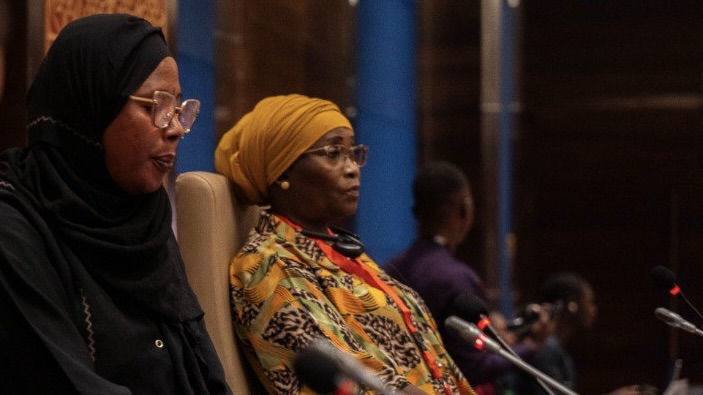
Women speaking at the Sahel Solidarity conference in Niamey, Niger, November 2024. Photo: Pedro Stropasolas
With the second anniversary of the founding of the Alliance of Sahel States (AES) on September 16 approaching, a timely webinar was held on August 31, to reflect on the role of women in the fight for sovereignty and against imperialism in the Sahel.
The critical discussion brought together leading voices from across Africa, including Amina Hamani Hassane from the Revolutionary Movement of Pan-African Women of Niger (MORFEPAN), Hadiza Augustin from Klayascu, and Loretta Naa Dei Ashie from the Socialist Movement of Ghana (SMG).
The panel explored key questions:
- What gains have women made in the Sahel states?
- What is the path ahead in these countries?
- What goals are women’s movements setting in this new era?
Women in the history of resistance
Speakers emphasized the fact that Sahelian women have always been central to struggles for freedom. From the anti-colonial resistance of the early 20th century to present-day mobilizations, women have participated as organizers, militants, and revolutionaries. During the colonial period, they resisted the imposition of the French language, religion, and education systems by spreading messages of defiance through villages, markets, and traditional networks. In the independence period, they joined strikes and demonstrations, with women’s groups playing key roles in movements like the African Democratic Rally. Under progressive leaders such as Thomas Sankara, women assumed political roles and worked to build societies free from neocolonial domination.
Women at the frontlines today
Today, women in Niger, Burkina Faso, and Mali remain at the forefront of the anti-imperialist struggle. They have mobilized in demonstrations against foreign military bases, resisted economic sanctions imposed by ECOWAS, and connected women’s liberation to the broader project of Pan-Africanism. According to Amina Hamani, the AES, formed in September 2023, has given new momentum to these efforts by uniting Sahelian states around the defense of political, economic, military, and cultural sovereignty. Women, she stressed, have taken this moment to strengthen autonomous structures, build collectives around sovereignty and liberation, and publicly denounce exploitation in markets, mines, and conflict zones.
Women also play a decisive role in sustaining local economies and ensuring food security in the Sahel, with over 70% of the workforce in the agriculture sector being women.
Rooted in a tradition of African women’s struggles
For Hadiza Augustin, the present struggle is rooted in a long tradition of women’s struggles. She recalled how, in 1956, over 20,000 women in South Africa took to the streets against apartheid, underlining that across Africa, women have consistently been the vanguard of resistance. “As a daughter of the Sahel, I see myself in this history of resistance and commitment,” she said. She noted that since 2023, women’s organizations have multiplied, women have become more visible in public life, and their role in political and economic struggles is increasingly recognized.
Still, challenges remain. Speakers pointed to the “double oppression” faced by women, both from patriarchy and from imperialism. Access to decision-making positions remains limited, and women in conflict zones continue to suffer disproportionately which has been called out. However, participants agreed that the path forward is clear; advancing women’s leadership in politics, education, and the management of natural resources, while building Pan-African networks to deepen the struggle for sovereignty.
The webinar also highlighted the innovative tactics women use to organize. These include associations, cooperatives, intergenerational mobilization, political education through songs and rituals, and the creative use of public spaces. In Niger, for example, the historic women’s conference of July 1991 demanded greater inclusion in decision-making, a struggle that continues today with even greater momentum and hope under the new leadership in the region.
As the anniversary of the AES approaches, the voices of women in the Sahel convey a clear message; the struggle for sovereignty is inseparable from women’s liberation. Their fight remains not only for themselves, but for the future of the Sahel and the wider African continent.