Israel claims the assassination of Al-Qassam’s spokesperson, Abu Obaida, Hamas yet to confirm
The news has yet to be officially confirmed, and is perceived by some as to be a part of psychological warfare waged by Israel
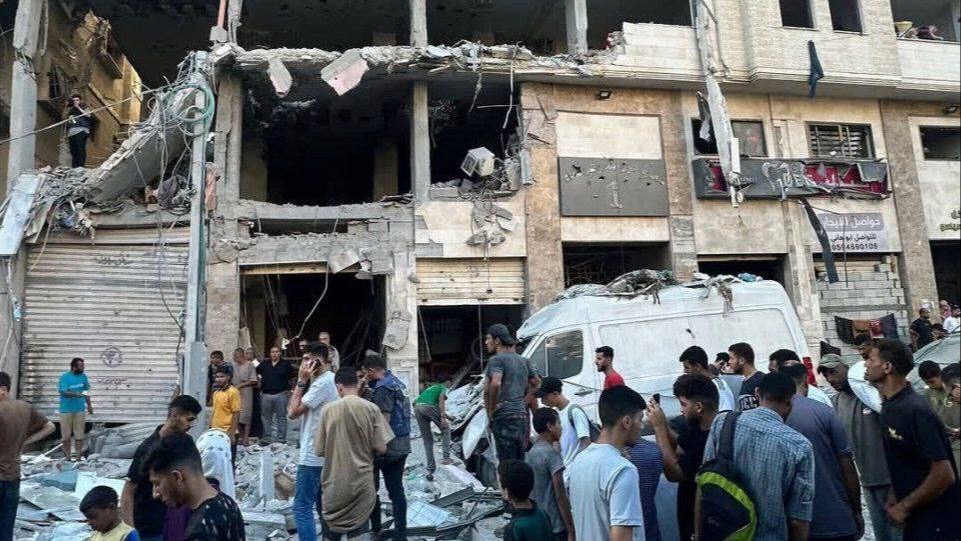
First and second floors of the Bseiso building near Palestine stadium in Gaza city. Photo: X
The Israeli Occupation Forces (IOF) and the Israel Security Agency (known as Shin Bet) announced on Sunday, August 31, the assassination of Abu Obaida, the spokesperson of the Al-Qassam Brigades, the military wing of Hamas, in an airstrike that targeted Al-Rimal neighborhood in western Gaza city one day earlier.
The news, which has not been confirmed by Hamas yet, provoked confusion and caused a stir on social media. For over two decades, Abu Obaida has been one of the most influential resistance leaders, whose speeches represented a reliable source of information regarding the struggle of the Palestinian people against the Israeli occupation, particularly in the Gaza Strip.
The identity of the charismatic masked speaker has never been revealed by Hamas. However, Israel has many times published a photo of an unmasked man attributing it to Abu Obaida, while also alleging that his real name is Hudhaifa Samir Abdullah al-Kahlout.
Some observers argue that Israel declared that Abu Obaida had been assassinated in order to cover up another massacre committed by Israeli forces against civilians in a residential building in Al-Rimal neighborhood on Saturday, which left at least seven people dead.
Others suggest that Israel wants to hide the failure of its military operation in Gaza by boasting about the potential killing of the powerful resistance figure, who had so far escaped all of its assassination attempts since 2008 unharmed.
Analysts also suggest that Israel sometimes claims the killing of prominent resistance leaders as part of its psychological warfare, to break the spirit of resistance fighters as well as that of the grassroots whenever the IOF suffers defeat in ground battles in Gaza.
Israel rushed to announce the assassination of Abu Obaida hours after the Al-Qassam Brigades had carried out an ambush in the Al-Zeitoun neighborhood east of Gaza City on Saturday, in which a number of Israeli soldiers were killed and four others were declared missing. This in turn makes the assumption theoretically possible.
Hamas releases video of its “martyred leaders” excluding Abu Obaida, following Israel’s announcement
One day after Israel announced the assassination of Abu Obaida, Hamas released a video titled the “Master of Martyrs” that focused on Al-Qassam’s late commander Mohammed al-Deif with a number of other top Hamas leaders, who were assassinated by Israel at different phases of “Al-Aqsa Flood” battle.
Notably, Al-Qassam’s senior military leader Mohammad Sinwar, the brother of late leader of Hamas’s political bureau Yahya Sinwar, appeared in the video.
Hamas had abstained from confirming the assassination of Mohammad Sinwar since it was announced by Israel last May. Thus, his appearance in the video was perceived by many as an implicit confirmation of his death.
Although the video was released shortly after Israel claimed it had murdered Abu Obaida, he did not appear among the martyred leaders in any scene. The video also did not refer to Abu Obaida’s martyrdom in any way.
The footage was interpreted as a message of reassurance to the supporters of Palestinian resistance and defiance to Israel, by indicating that no matter how many top leaders have been assassinated, Hamas remains unshaken.
In recent months, the military wing of the movement has inflicted considerable losses on the IOF during ground battles in different areas of the Gaza Strip. Military analysts attribute the brigades’ ability to recover from significant losses to the horizontal hierarchy of leadership within Al-Qassam’s organizational structure. Since the Brigades were founded in 1991, they have proven that none of its assassinated commanders were irreplaceable.