Argentine pensioners face heavy repression in weekly march
The repression took place during the usual Wednesday demonstration demanding better living conditions for Argentine seniors and the reversal of neoliberal measures.
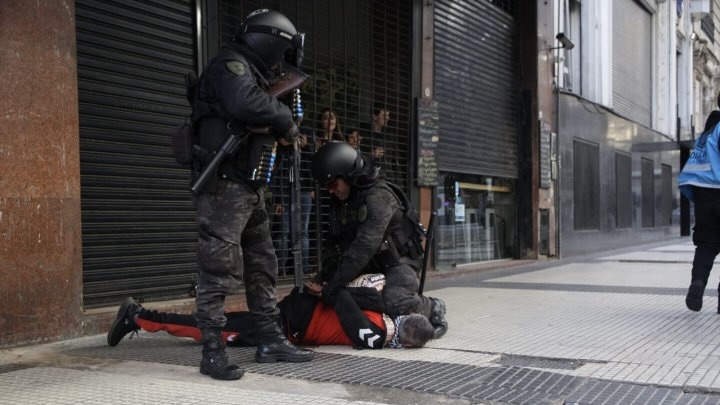
Argentine police arrested 7 people during the July 30 pensioners march. Photo: La Izquierda Diario
30 people were injured and seven were arrested in the weekly pensioners protest in Argentina on July 30. Starting early in the day, federal forces launched a large operation installing barricades and patrol cars throughout the area near Congress, where the demonstration was to take place.
In the afternoon, several social organizations began to gather for the usual protest. Then, when nearly a hundred protesters attempted to block a street named Avenida de Mayo, clashes with security forces began.
The police immediately antagonized the protesters. Tempers quickly flared, with blows and rubber bullets fired by law enforcement. After the altercations, about 30 people were injured. In addition, it was reported that seven people were detained by federal police.
¿Saben cuál es la definición de un gobierno de miserables inhumanos?
Uno que el sábado le baja los impuestos a la Sociedad Rural y el miércoles reprime a los jubilados que no tienen para comer. pic.twitter.com/knPxwiVl1I
— Argentina Humana (@arg_humana) July 30, 2025
Pensioners weekly cry for dignity
Some political traditions arise from struggle. The Wednesday march of retirees in Buenos Aires, Argentina, is one such case. For months pensioners have been protesting against the neoliberal austerity measures of Javier Milei’s government.
Read more: Argentina responds to the brutal repression of retirees’ march
While their march started as a protest against Milei’s veto of the pension increase approved by Congress, the regular demonstration is now expressing a general rejection of the right-wing libertarian government.
The protesters are demanding an increase in pensions. They allege that their purchasing power has been drastically reduced due to inflation, and are unable to afford their basic needs. They also demand better healthcare, the provision of medication for the elderly, and a guarantee from the state that pensioners will be able to live with dignity. They have also strongly criticized the government’s subordination to the dictates of the International Monetary Fund.
Their demands are fundamentally at odds with Milei’s aggressive neoliberal program, which instead seeks – and is achieving – a drastic reduction of the state in almost all areas, except for security.
However, the executive branch often responds to the demands of the elderly and other citizens with repression.
Is repression becoming normalized?
Just as there are political traditions of resistance that arise from social struggles, there are also others that arise from repeated repression. It seems that in Argentina, it is becoming commonplace for law enforcement to crack down on citizens who disagree with government measures, regardless of the age of the protesters.
This is the perspective of QR journalist Pablo Caruso: “This has become normalized. It is normal for protesters to be beaten every week. I wonder what needs to happen for this to change and how this atrocity can be denormalized. If the media were aligned on this point, the story would be different … Repression prevails over the cause of the protest. A while ago, we would have spent hours looking at images of repression. Now they are just another piece of news for the day.”
If this is the case, Milei has managed, on the one hand, to neutralize those who protest in the streets through repression, while at the same time ideologically neutralizing any potential rejection of the state’s repressive attitudes. This double helix of repression (physical and ideological) could lead to an acceleration of the neoliberal project.
However, retirees, unions, social movements, etc., refuse to accept this way of governing, and continue to reject Milei and his goal of dismantling a state that, historically in Argentina, has been present in the lives of its citizens. In this way, two different visions of life are confronting each other: the normalization of repression vs. the persistence of resistance.
Read more: Milei’s chainsaw economics met with working class unity
The poet Pablo Neruda said about this confrontation: “They can cut all the flowers, but they will not be able to stop the spring.”