Venezuelan migrants in Bukele’s CECOT were subjected to torture and abuse, prosecutor denounces
Venezuela’s Attorney General announced in a press conference that Venezuelan migrants held in El Salvador underwent torture and abuse while imprisoned in CECOT
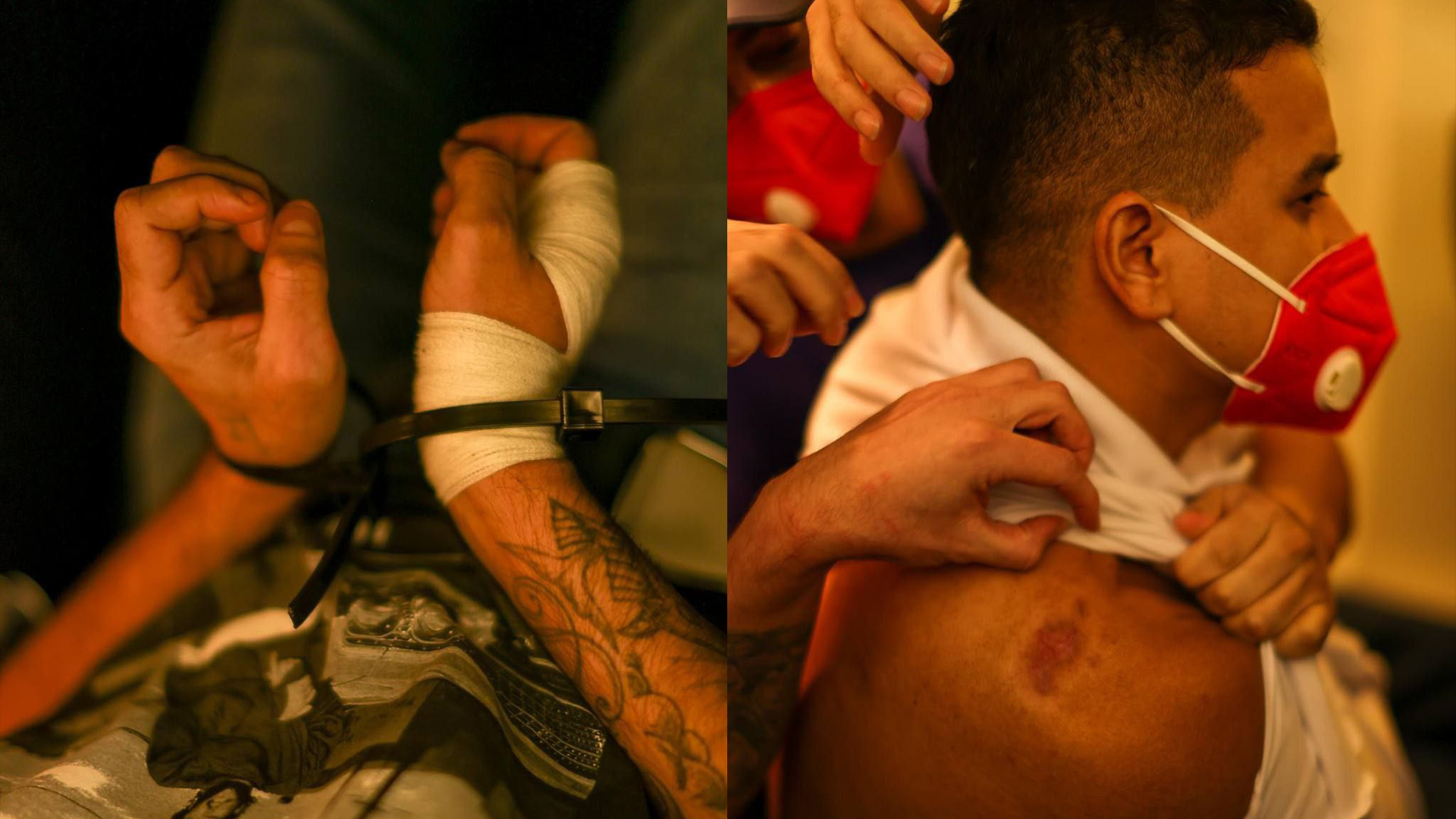
Venezuelans repatriated to Venezuela show signs of torture from their detention in CECOT. Photos: Nawseas
252 Venezuelan nationals returned to their home country on July 18, after spending months in El Salvador’s infamous CECOT, being deprived of their most basic human rights. Their return was the result of months of struggle waged by the family members of the Venezuelan migrants as well as the Venezuelan government, which reached an agreement with El Salvador which included the release of 10 US citizens.
The men, who had been held in migrant detention centers in the United States, were unilaterally sent to El Salvador on March 15, after the Trump administration implemented the 1798 Alien Enemies Act, declaring that members of the Tren de Aragua gang were members of a Foreign Terrorist Organization and an invading force. The 252 Venezuelans that were sent to El Salvador were cast as members of Tren de Aragua, yet media reports revealed that 75% of those detained did not have criminal records and family members testified that many were detained because of having tattoos, including one person with an autism awareness tattoo.
On July 18, after their arrival, the Venezuelan citizens were received by their relatives, as well as by Venezuelan Secretary of the Interior Diosdado Cabello, Vice President Delcy Rodríguez, and Jorge Rodríguez, president of the National Assembly.
Tarek William Saab, attorney general of Venezuela, described the release of the Venezuelans as: “A glorious return, a historic repatriation and liberation of the 252 Venezuelans brutally kidnapped in one of the worst prisons on the planet.” He also highlighted that, for several months, the president of Venezuela, Nicolás Maduro, together with the Public Ministry, coordinated actions inside and outside El Salvador for the freedom of the Venezuelan citizens.
Venezuelan migrants report alleged torture in El Salvador
According to Saab, 123 documented complaints were collected from the repatriated persons. Through these statements, it was found that they were victims of the unlawful deprivation of liberty because they were detained in a third country without being subject to a formal accusation and without the option of presenting themselves to a court. Due process violations also included interrogations without legal assistance and prohibition of contact with family members.
But most seriously, Saab denounced that the detainees suffered systematic torture that included daily beatings by guards and isolation in a cell known as “La Isla” (The Island), with no ventilation or contact with sunlight. According to accounts, it was common for detainees to be forced to remain on their knees for several hours on rough floors under permanent exposure to intense artificial light.
In addition, they were given rotting food and undrinkable water that caused them severe gastric diseases. Despite their state of health, the detainees reported that they did not receive medical attention.
One of the most controversial accusations made by the prosecutor is that most of the detainees were sexually abused by the guards. Saab further stated that the torture and mistreatment was concealed during the few visits made by the Red Cross and US congressmen. During these inspections, custodians allegedly forced detainees to engage in sports or recreational activities so that none of the visitors would have proof of the crimes being committed inside the prison.
Those who did not comply with these orders were beaten and shot with pellets. Saab classified these actions as crimes against humanity and reported that the Venezuelans who returned are being attended by specialized doctors, psychologists, and psychiatrists. According to the medicolegal reports, the detainees present serious physical and psychological injuries, including suicidal ideations due to the torture they faced.
Saab accused Salvadoran President Bukele of being the intellectual author of these acts and affirmed that he had full knowledge of the crimes committed in CECOT.
Venezuela opens investigation into Bukele
The Salvadoran president, Nayib Bukele, claimed on X that the Venezuelan government was satisfied with the exchange agreement. However, he argued criticisms were only raised after they “realized that they were left without hostages” from the US, referring to the US citizens with military backgrounds detained in Venezuela for involvement in plots to destabilize the government that were exchanged in the deal.
According to the Venezuelan government, based on reports from the repatriated nationals, criminal acts were committed during their detention in San Salvador, which has sparked outrage from Venezuela and around the world.
Based on the collected testimonies by the Public Prosecutor’s Office on the ill-treatment and torture that detainees were victims of in CECOT, the attorney general announced the start of an investigation against the Salvadoran president: “We have decided to open a formal investigation, with the respective file number, with the three designated national prosecutors into the following officials of El Salvador: to Nayib Armando Bukele, the ruler who violates the Salvadoran Constitution itself and calls himself president of El Salvador”.
The prosecutor explained that Venezuela can initiate this investigation based on the “legal status” given by the Convention against Torture and Other Cruel, Inhuman or Degrading Treatment or Punishment, the International Convention for the Protection of All Persons from Enforced Disappearance, and the Rome Statute of the International Criminal Court (ICC).
He informed that the Minister of Justice and Public Security of El Salvador, Héctor Gustavo Villatoro, and the Vice Minister and General director of Penal Centers, Osiris Luna Meza, will be investigated. In addition, Saab requested the support of the international community, including the International Criminal Court, the UN Human Rights Council, and the corresponding organizations, to also denounce the crimes committed in CECOT.
Repatriation of Venezuelans continues
Through a national radio and television network on July 21, President Nicolas Maduro announced that, during the first quarter of 2025, the Venezuelan government coordinated 47 flights to bring nationals from the United States to Venezuela, so that 8,743 migrants who were in ICE jails returned to their country, including children and pregnant women.
Additionally, Maduro said that the Return to the Homeland mission will provide psychological and economic support to Venezuelans who have returned to the country.
The national TV channel also featured the testimonies of several young people who said they had been arrested and accused of having links with the criminal group Tren de Aragua for the simple fact of having tattoos and without any other type of evidence.